The Window That Was Waiting
The first window died before the saw touched it.
Maya saw the diamond tip lower behind the polycarbonate shield. She saw the tiny bright point meet the corner of the glass. She saw one white scratch appear, thinner than a hair.
Then the whole pane became rain.
It did not crack in lines. It did not split politely into halves. It burst all at once into thousands of greenish crumbs that jumped and rattled across the metal table like a jar of buttons poured onto a drum.
Soren had both hands flat on the safety rail. His mouth stayed open after the noise stopped.
The technician looked over from the other side of the fabrication bay, where she was trying to hang a banner by herself. The banner said WELCOME TO THE GLASS GARDEN in letters made of tiny solar cells.
“Bad pane,” she said. “Happens. Sweep cycle, then try another.”
The sweep cycle whispered on. Little rubber brushes pushed the pieces into a slot. The bay smelled faintly of wet stone and machine oil.
Maya did not move.
“It broke wrong,” she said.
Soren reached for his paper notebook, which was already open to a page of measurements for the moth nursery lid. The lid had to be clear, so visiting children could watch the lunar moths unfold their wings without anyone lifting the top and changing the warm damp air inside.
“It broke everywhere,” he said.
“That is the wrong part,” Maya said.
Soren looked at the empty table, then at the video screen above the saw. The saw always recorded cuts in slow motion, mostly so people could admire themselves being careful. He slid the replay bar back with one finger.
The scratch appeared again.
The pane vanished again.
Soren moved it back farther. The scratch appeared. The pane vanished.
“Nothing travels from the corner,” he said.
Maya nodded once. “It was already doing something.”
The technician came over with the banner cord looped around her elbow. She was good at machines and bad at stopping. There was silver dust on one cheek from the mirror-polishing booth.
“Oh,” she said. “Tempered. That is what tempered glass does if you try to cut it. It turns into safety bits instead of knives. Great for doors. Terrible for resizing.”
She tapped the crate beside the saw with her shoe. It was full of salvaged panels from old tram shelters, balcony rails, and smart windows whose circuits had gone out.
“Use a different one. Scanner says they are all soda-lime glass.”
She hurried back to the banner, which had begun to sag in the middle.
Soren looked at the crate. Ten panes leaned together, clear and ordinary, each one with a paper tag gone soft from old rain. Some tags said TEMPERED. Some said ANNEALED. Some said nothing at all.
“The scanner knows what they are made of,” he said.
Maya was already walking around the crate, looking at the edges. “Not what happened to them.”
Soren wrote that down, then stopped with his pencil still touching the page.
The same glass. Different past.
The fabrication bay was built along the warm side of the greenhouse. Beyond the worktables, banana leaves leaned against the glass wall. Condensation made tiny beads on the panes. Above them, the dome held the morning sky in hundreds of clear rectangles.
Maya crouched beside the crate.
“If we choose wrong,” she said, “the next one rains.”
“Behind the shield,” Soren said.
“Still wrong.”
The technician called from the ladder, “Try tapping the edge. Tempered sounds bright.”
Soren tapped one pane very gently with a plastic ruler. It made a small clean tick.
He tapped another. Tick.
Maya gave him a look.
“Not enough,” he said.
“Good.”
He flipped through his notebook, not because the answer was there, but because blank space helped him make room. There was a pressed fern from the humidity study. A sketch of a snail that had escaped its terrarium. A note about how the old tablet screens in the education room went black when seen through Maya’s polarizing sunglasses, but only when she turned her head sideways.
He looked up.
“The tablet trick,” he said.
Maya had already turned toward the light cabinet.
The cabinet was used for looking at thin slices of minerals. Beside it hung square sheets of polarizing film in cardboard frames. The signs said PLEASE DO NOT FOLD. Maya took two.
The technician saw her and said, “Those are not for crafts.”
“Not crafts,” Maya said.
Soren carried the first unbroken pane to the low inspection stand. Together, they propped it upright. Maya held one dark square in front of the work light. Soren held the other on the far side and slowly turned it.
The light dimmed. Then it went almost black.
The pane stayed clear.
“Maybe annealed,” Soren said.
“Maybe,” Maya said. “Next.”
They slid the first pane back and lifted another.
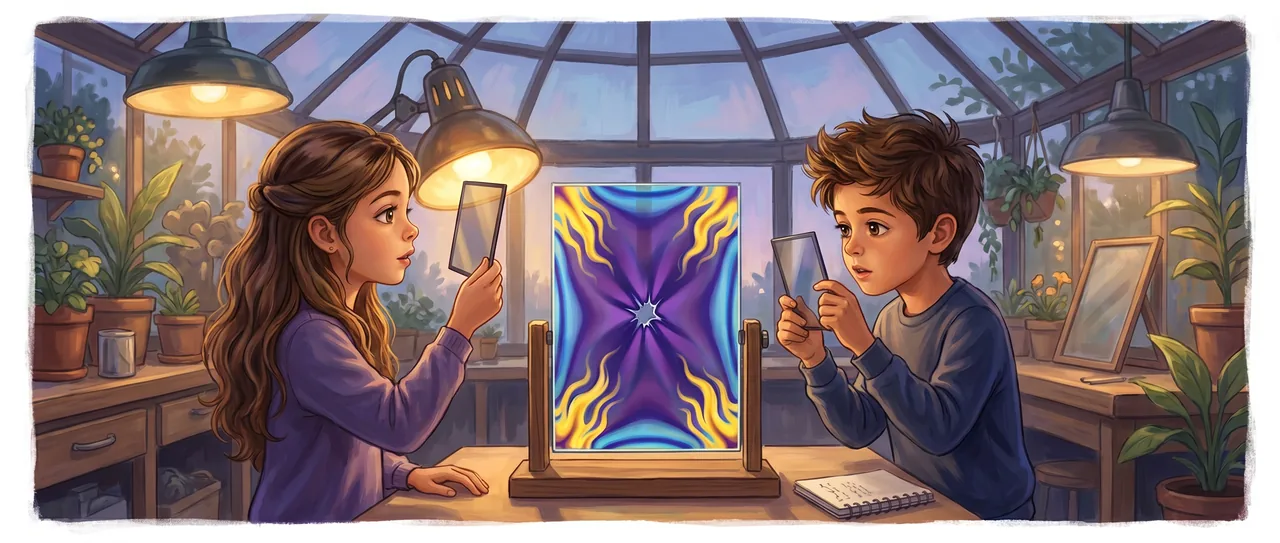
This time, when Soren turned the second polarizer, colors opened inside the glass.
They were not painted on the surface. They floated in it. Yellow flames curled from the corners. Blue bands clung to the edges. Near a tiny chip, a purple star tightened itself around the flaw.
Maya leaned closer until her breath fogged the glass.
“There,” she said.
Soren did not write. He forgot to. The pane that looked empty was full of weather with no wind.
The technician climbed down from the ladder. “Stress patterns,” she said, surprised into stillness. “I always forget how pretty they are.”
Maya did not look away from the colors. “Pretty is not the useful part.”
Soren shifted his polarizer. The colors slid, vanished, and returned. “The outside was squeezed when it cooled.”
“The middle is pulling back,” the technician said, but softly, as if she was answering herself.
Maya touched the cardboard frame, not the glass. “So one scratch gives it a place to stop holding.”
Soren looked at the crate of ordinary-looking panes. “The labels are the least important part.”
They tested every panel.
The tempered ones bloomed at the edges. Some had bright knots where old bolts had held them in tram shelters. One pane showed four pale circles in the corners, ghosts of hardware that had been removed years ago. The annealed panes mostly stayed dark between the crossed filters, except for faint smudges where they had been stacked too tightly.
Maya made two piles with masking tape on the floor. Soren checked each pile twice. The technician started to say something about the festival schedule, then looked at the growing map of colored stress and went quiet.
For the moth nursery, they chose an annealed pane for the piece that needed cutting. The saw scratched it, sprayed a thin line of water, and followed Soren’s measured path. A rectangle lifted free with smooth edges.
They did not throw away the tempered glass.
Maya held one large, uncut panel over the nursery frame. It was too wide for the lid and too strong to reshape, but it fit perfectly as the front wall of a viewing tunnel. Soren set the annealed lid above it. The moths would have warm air, clear walls, and no one’s fingers reaching in.
The technician finally got the banner straight. Outside the bay, the first festival visitors were gathering under the greenhouse dome, their faces turned up toward the sunlit glass.
Soren picked up one polarizing square. Maya picked up the other.
She looked at the crate. Then at the dome.
“Wait,” she said.
They walked to the greenhouse wall where the banana leaves pressed broad shadows against the panes. Maya held her square to the glass. Soren stood on the other side of her and turned his square slowly in front of it.
Maya lifted the dark plastic higher. Soren turned his lens until the daylight thinned. Across the greenhouse roof, invisible rivers came on in blue, gold, and violet.
Read the interactive version, listen to the narration, and earn a gold star →
A science-verified short story for curious kids · Curiosity Land