The Shore That Would Not Hold Still
At nine minutes before the museum opened, Soren made the island longer by measuring it correctly.
He had not meant to. He had meant to finish the blue label, tape it under the glass, and stop being the only person in the room still using paper.
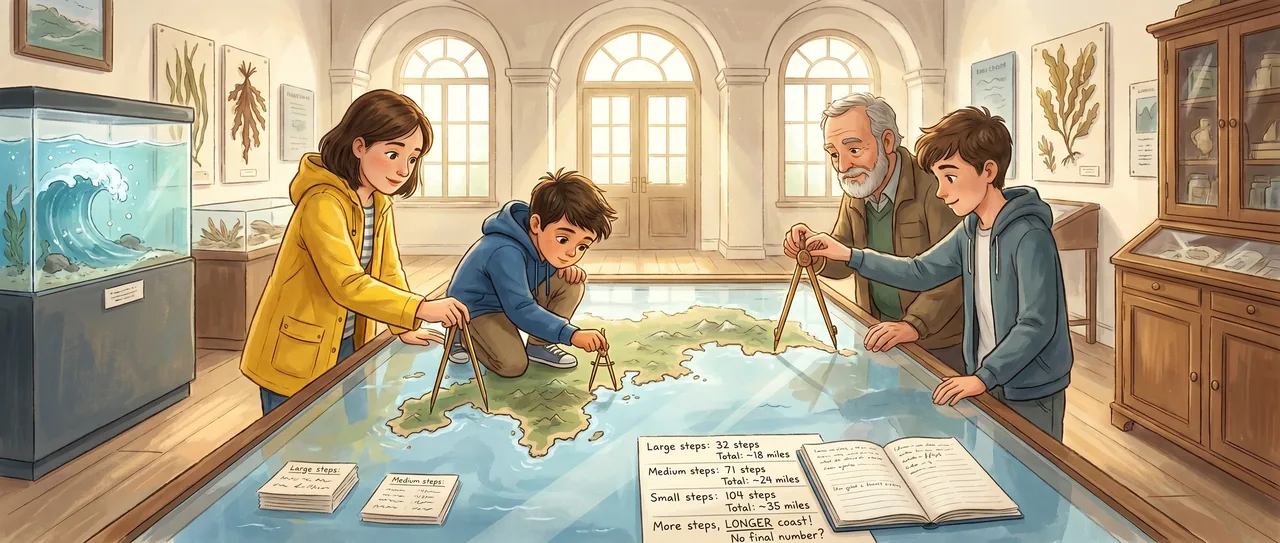
The new exhibit filled the back hall of the Seaward Science Museum. There was a table-sized map of Bracken Island under clear plastic, all coves and cliffs and tiny hooked beaches. There were three brass dividers on chains. There was a blank label that said, Length of coastline: ______.
Dr. Voss, who ran the museum and always had two pencils in her hair but could never find either one, hurried past carrying a box of shells.
“Three point two kilometers,” she said. “That is the official number. Write it neatly, please.”
Soren looked at the blank label. Then he looked at the map scale. Then he looked at the dividers.
“How official?” he asked.
Dr. Voss stopped with the box against her hip. “Official enough for doors opening in eight minutes.”
“That is not a kind of official,” Soren said.
“It is today,” said Dr. Voss, and hurried away.
Soren opened his notebook on the corner of the map table. It was the only paper thing among the touch screens, glowing tide models, and little robots that rolled along painted tracks. A sign near the entrance said, Welcome to the Future Shore. Soren liked the robots. He also liked that paper stayed where he put it.
He set the largest divider to the map scale for one hundred meters. One point went at the ferry dock. The other reached around the first smooth bend. He walked the points along the shore, heel to toe, click by click.
By the time he returned to the ferry dock, he had counted thirty-two steps.
Three point two kilometers.
That matched. He wrote it down.
Then he set the divider to fifty meters, because the smaller tool was already chained there, waiting, and because a number that behaved only once was not finished.
Click, click, click.
The smaller steps dipped into coves the big steps had jumped over. They climbed around the hooked end of Gull Point instead of cutting across it. They entered the cracked place behind Seal Rock and came out again.
Soren counted seventy-one steps.
Three point five five kilometers.
He checked his count. He started again from the ferry dock. Seventy-one.
A group of volunteers moved through the hall, placing chairs for the opening talk. Someone tested the wave machine, and a sheet of water slapped softly against glass. Dr. Voss called, “Label, please!” without looking up from a tangled extension cord.
Soren set the smallest divider to ten meters.
The island lengthened under his hand.
The points found every bite in the stone, every small beach that had been a straight yellow smudge before, every twist in the marsh creek mouth. The brass legs clicked and clicked and clicked. Soren’s wrist began to ache. The line that had looked like an edge became a path with rooms in it.
He was only halfway around when the museum doors opened.
Cold morning air came in with the first visitors. Shoes squeaked. A child laughed near the tide pool tank. Dr. Voss arrived at Soren’s elbow and stared at the blank label.
“Soren.”
“I have three answers,” he said.
“I need one.”
“That is the problem.”
Dr. Voss pressed both hands over her face, which made one pencil fall from her hair. “The problem is that the mayor is going to stand beside this map in four minutes and say something about beautiful accurate science.”
“It is accurate,” Soren said. “If we say which ruler.”
Dr. Voss lowered her hands.
Soren showed her the notebook. One hundred meters, thirty-two steps, three point two kilometers. Fifty meters, seventy-one steps, three point five five kilometers. Ten meters, still counting, already more.
Dr. Voss looked from the notebook to the map. Her mouth made the shape people made when they wanted the world to be tidier and suspected it would not cooperate.
“The official survey uses a standard method,” she said.
“Then the label should say the standard method.”
“The label has room for a number.”
Soren looked at the plastic slot. It did have room for a number. It had exactly enough room to be wrong.
Dr. Voss was called away by a man in a suit holding a microphone too close to his chin.
“Three point two,” she said over her shoulder. “Please.”
Soren picked up the blue marker. He wrote a three. He wrote a point. Then he stopped.
On the far side of the hall, the touch screens glowed with maps from satellites. The little shore robots blinked green in their charging docks. The museum smelled of saltwater tanks and new carpet and somebody’s coffee. Everything in the room was built to help people see better.
Soren pulled the label back out.
He found the roll of blank cards in the supply drawer. He found tape. He found three wooden rulers from the school box and the three chained dividers. He moved the shell box off a low table and dragged the table beside the map. It made a terrible scraping sound. Several adults looked over. None of them stopped him.
On the first card he wrote, Use a giant step.
On the second card he wrote, Use a smaller step.
On the third card he wrote, Use the smallest step here.
On the fourth card, after a pause, he wrote, What happens next?
Then he taped his notebook page under the glass, beside the blank official label, where anyone could see the columns.
The mayor began speaking near the entrance. “Our coast has always shaped who we are,” he said into the microphone.
Soren took the ten-meter divider and kept walking it around the island.
A woman in a raincoat stopped beside him. “Is that part of the exhibit?”
“It is now,” Soren said.
She picked up the fifty-meter divider. “Where do I start?”
“Ferry dock,” Soren said.
Soon three people were measuring the same coast with three different steps. The person using the biggest divider finished first and looked pleased. The person using the middle divider frowned at the notebook, counted again, and wrote a larger number on a scrap card. The person using the smallest divider muttered, “Oh, come on,” when the line ducked into Pebble Cove and came out longer than expected.
More visitors gathered. The mayor’s voice faded behind them.
Dr. Voss appeared at the edge of the crowd. Her microphone man stood behind her, waiting. She looked at the map, the rulers, the growing column of numbers, and Soren’s unfinished trip around the island.
Then she took the official label from his hand and turned it over.
“How long is Bracken Island’s coast?” she wrote.
Under it she wrote, Choose your ruler.
She taped it into the plastic slot.
Soren did not look up right away. The smallest divider had reached the marsh mouth. On the map, the marsh mouth was drawn as three blue fingers. On the real island, he knew, each finger would have mud cracks, reed clumps, crab holes, and water shining between grass stems.
A boy beside the table asked, “What if the ruler was as small as a grain of sand?”
Soren set down the divider.
Dr. Voss said nothing.
The boy pointed at the map. “Would it ever finish?”
Soren looked toward the museum windows. Beyond the glass, the actual shore curved away below the seawall. The tide was low. Wet rocks glistened. Foam hung in the cracks like torn lace.
“Let’s try smaller,” Soren said.
By afternoon, the exhibit had no line for a single answer. It had a line of people waiting to make the island longer. The future shore robots rolled along their tracks, blinking cheerfully. The wave machine breathed in and out. On the map table, the columns of numbers spread across three cards, then four.
Soren’s notebook stayed under the glass, open to the page with the ruler sizes. Nobody asked why he had written so much. They needed the columns.
When the museum emptied, Soren carried the smallest divider outside to the seawall stairs.
He crouched by a wet black rock where barnacles made white rings around a crack.
The water slid back, leaving a new lace of foam, and Soren opened the dividers a little smaller.
Read the interactive version, listen to the narration, and earn a gold star →
A science-verified short story for curious kids · Curiosity Land