The Room That Would Not Hurry
The curator wanted thunder.
She had silver curtains, blue lights, a fog machine, and a button labeled MAKE A GIANT CRYSTAL. The button was as big as Soren’s palm. It looked important in the way toy spaceship controls looked important.
“It is for the opening,” the curator said. “Children press it, the screen flashes, and the crystal grows. Boom.”
Soren stood in the half-built exhibit with his backpack still on one shoulder. The wall behind the curtain showed a photograph of the real cave in Mexico. White beams of crystal crossed the darkness like frozen lightning. One of them was longer than a school bus.
The curator tapped the button. On the screen, a crystal shot from the floor to the ceiling in three seconds.
Soren said, “That is not boom.”
“It is very much boom,” said the curator. She had a roll of tape stuck around her wrist and a pencil in her hair. “It has sound effects.”
“It is wrong boom.”
The curator looked at the clock. “I have a donor preview at four. I have electricians in the dinosaur hall. I have a fog machine that smells like soup. Tell me quickly.”
Soren took out his notebook, then did not open it. The photograph held him. He already knew the fact. He had read it three times. In Cueva de los Cristales, beneath Naica in Chihuahua, gypsum crystals had grown in hot mineral water for about five hundred thousand years. Some were eleven meters long. The cave air was around fifty-eight degrees Celsius and nearly full of water vapor. People could only go in with special suits, and not for long.
The screen crystal grew again. Flash. Rumble. Done.
Soren said, “It makes it look easy.”
“It is an exhibit,” said the curator. “Exhibits are allowed to be dramatic.”
“Not if the drama is the opposite part.”
The curator sighed, but not meanly. She shoved a plastic tub toward him. “Fine. I also have instant crystals.”
Inside the tub were hand warmers, clear packets, and a metal disk. The curator snapped one disk. White spikes spread through the liquid in a rush, branching and thickening until the packet was solid and warm.
“Crystallization,” she said. “Visible. Touchable. Fast.”
Soren held the packet between two fingers. Heat pressed into his skin.
“It is good,” he said.
“Thank you.”
“For a hand warmer.”
The curator shut her eyes for one second.
Soren turned the packet over. The crystals inside were crowded and cloudy. They had hurried into every space they could find. They looked like frost trying to win a race.
“The cave ones are clear,” he said. “Huge and clear.”
“Selenite gypsum,” said the curator. “Calcium sulfate with water in the crystal structure. The packets are sodium acetate. Different material, same general idea.”
“Same word. Different story.”
The curator pulled the pencil from her hair. “Then give me the story.”
Soren opened his notebook after all. He wrote eleven meters on one line and five hundred thousand years on the next. He divided badly first, crossed it out, and divided again. The curator answered a message on her phone while walking in a small circle.
Soren wrote: about twenty-two micrometers each year, if it grew evenly.
He knew a human hair was around seventy micrometers wide. Not always. Close enough. He drew a hair, then three tiny marks beside it.
The pencil stopped.
The screen crystal exploded upward again behind him. The sound effect shook the floor.
Soren looked at the drawing of the hair. Three years for the width of one hair. Maybe more. Maybe less. The real cave had not cared whether anyone was watching. It had been dark before the museum, before his school, before the city, before the language on the labels. Hot water holding minerals had stayed around the crystals. Not perfectly forever, but steadily enough. The cave had kept doing a nearly invisible thing until the invisible thing could block a tunnel.
The curator came back. “Please do not tell me the answer is to make children stare at nothing.”
Soren looked up. “Yes.”
“No.”
“Yes, but better.”
The curator’s phone buzzed. She ignored it, which seemed difficult for her. “Soren, if nothing happens, they leave.”
“Then the leaving is part of it.”
“That is a terrible slogan.”
“Only if you put it on a banner.”
He walked to the supply table and began moving things. A clear tank. A safe heater meant for classroom aquariums. A humidity sensor. A small light. A shard of gypsum from the teaching drawer, not from the protected cave, because the real crystals were not souvenirs. He found a ruler printed with tiny lines, then asked for the microscope camera from the rock lab.
The curator folded her arms. “We cannot recreate the cave.”
“No,” Soren said. “This room would cook people.”
“Correct.”
“So we make a polite lie about the heat and an honest thing about the waiting.”
That got her attention.
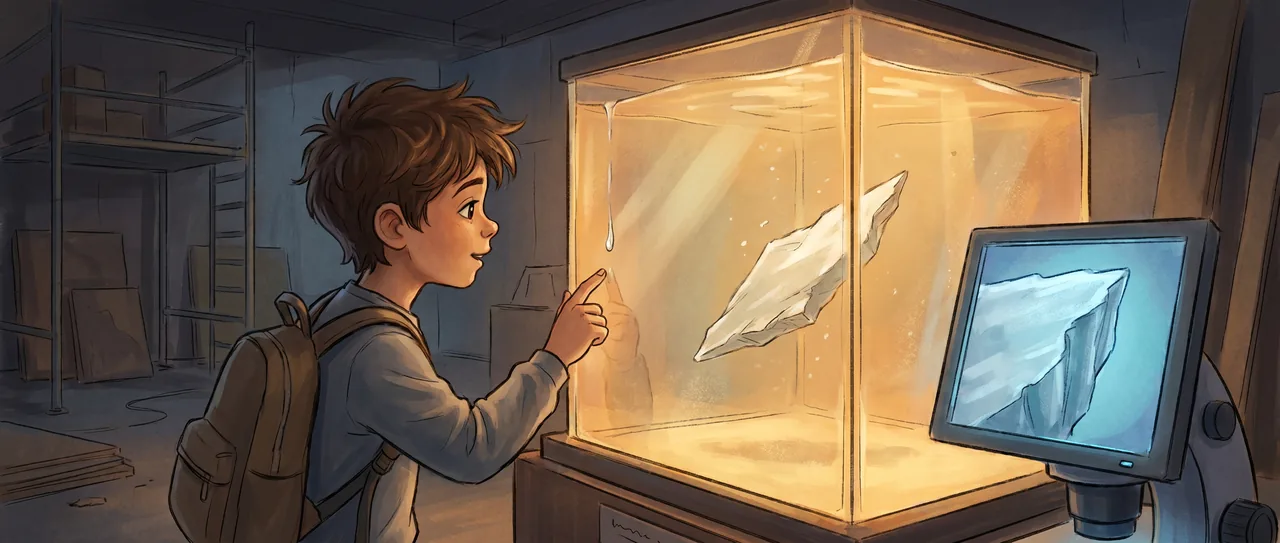
They worked without thunder. The curator fetched a kettle and muttered about electrical codes. Soren mixed water with powdered gypsum until the curator said no more would dissolve. They warmed the tank only to a safe temperature and sealed most of the top so the inside glass misted. The shard hung by a thin clear thread in the middle, sharp-edged and pale.
Under the microscope camera, its edge looked like a cliff.
Soren taped his hair drawing beside the screen. The curator raised one eyebrow.
“You are putting hair in my exhibit?”
“A measurement of not much.”
He changed the giant button label. The curator watched him peel off MAKE A GIANT CRYSTAL and replace it with WAIT ONE MINUTE.
“That is the least exciting button in the museum,” she said.
“Maybe.”
At four, the donor came in with shiny shoes, two museum staff members, and a smile that was already leaving. The curator stood straighter. Soren stepped behind the tank because standing in front made him feel like part of a school presentation, and he did not want to become one.
The donor pressed the button.
The room did not flash.
Warm light filled the tank. Mist silvered the glass. On the screen, the microscope showed the shard’s edge, still as a mountain in a snow globe.
A timer began counting down from one minute.
The donor looked at the curator.
The curator looked at Soren.
Soren pointed to the hair drawing.
The timer ticked.
No crystal leaped. No music played. The only sound was the small pump moving warm water past the suspended shard.
After twenty seconds, one staff member shifted her feet.
After forty seconds, the donor leaned closer.
When the timer reached zero, a line appeared on the screen.
In one minute, a giant Naica crystal would grow less than your eye can see.
Below it, another line appeared.
It kept doing that for about five hundred thousand years.
The donor did not smile. He took one step closer to the tank. His shiny shoes made no sound on the rubber floor.
“Nothing happened,” he said.
Soren said, “Not where we are big enough to notice.”
The curator did not speak for a moment. Then she pulled the silver curtains down and dropped them in a heap.
They opened the exhibit two days later.
Most children pressed the button, waited twelve seconds, and wandered toward the meteorites. Some came back when the minute ended and read the lines out loud. One boy pressed his nose to the glass until his breath made a cloud outside the cloud inside. A girl asked if the real crystals were still down there in the dark.
The curator said, “The mine stopped pumping water, so the cave has been filling again.”
The girl looked at the tank. “So the cave got its water back?”
“Yes,” said the curator.
Soren watched the suspended shard turn slowly in the pump’s current. The photograph on the wall showed beams of gypsum crossing a chamber no one could stand in for long, growing where no applause could reach them.
The curator switched off the ceiling lights. The tank kept glowing.
Soren pressed his fingertip to the glass beside the suspended shard and did not move it.
A bead of water gathered under his knuckle and slid down the pane.
Read the interactive version, listen to the narration, and earn a gold star →
A science-verified short story for curious kids · Curiosity Land