The Protein That Needed a Room
The firefly gene made darkness.
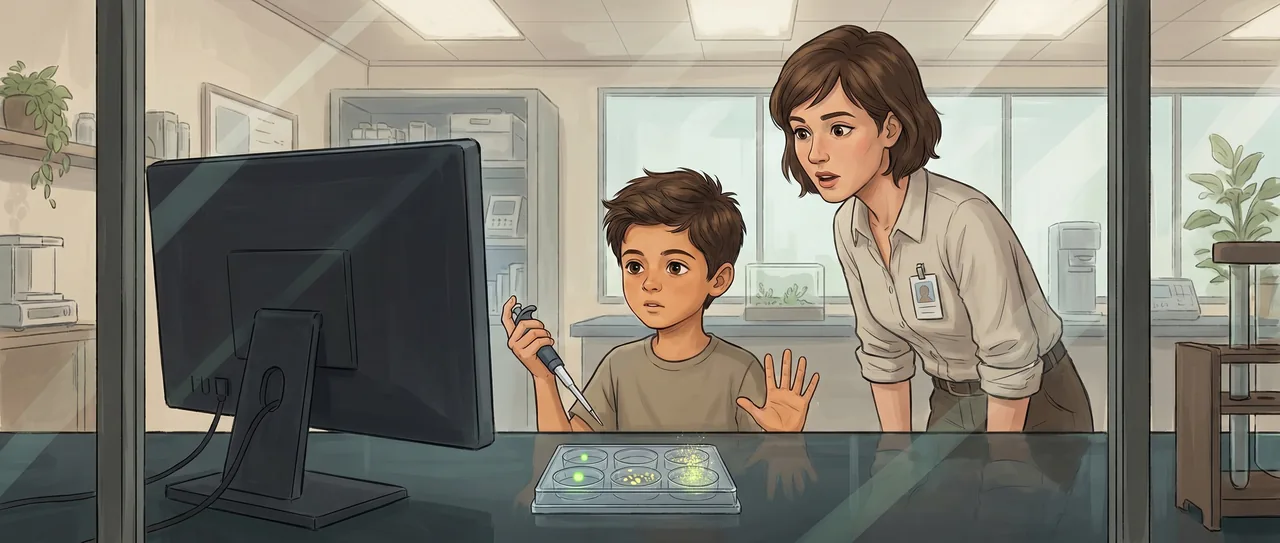
Soren stood at the library biofoundry counter with both hands flat beside the little clear plate. Each well was smaller than a fingernail. Each held a drop of cell-free mixture, all the useful parts of a cell without the cell, waiting to read DNA and build protein.
The well on the left had worked before anyone finished counting.
The director had said, “Fast folder,” and tapped the timer. The camera above the plate had flashed blue light through the drop. A green dot had snapped awake on the screen almost at once, as if the protein had been waiting inside the DNA and only needed permission to appear.
The firefly well did nothing.
Behind Soren, the demonstration crowd shifted. Shoes squeaked. Someone whispered that it was supposed to glow.
The director leaned over his shoulder. She smelled like coffee and orange peel, and one of her sleeves was rolled higher than the other.
“Bad reagent,” she said. “It happens. We’ll use the fast one again for the visitors.”
Soren did not move.
On the screen, the firefly well was not empty. It was worse than empty. It was faintly cloudy around the edge, like a breath on glass.
“The DNA printed,” Soren said.
“The light did not,” said the director. She was already reaching for the spare plate. “We need something visible.”
Soren looked at the timer. Seven minutes since the reaction began. The fast green protein had appeared while the seconds digit was still changing.
He had copied the schedule before the demonstration because schedules had corners you could hold. At ten thirty, fast folder. At ten forty, luciferase, the firefly enzyme. At ten fifty, questions. At eleven, donors.
The donors were in the hallway, laughing too loudly at something on the tour.
Soren picked up the box the director had pushed aside. The label said folding support, optional.
Optional things were never optional in the same way. Optional raisins were not optional brakes.
He turned the box over. Inside were sealed strips, each with dried helper proteins in tiny wells. The drawing on the back showed a little barrel shape, open at one end.
The director saw where he was looking.
“That takes too long,” she said. “Chaperone mix is for the advanced workshop.”
“Why is it in this kit?” Soren asked.
“For difficult proteins.”
“This one is difficult.”
“It is supposed to be simple for the audience.”
Soren looked at the cloudy ring again. Simple for the audience was not the same as simple for the protein.
The director opened her mouth, then looked toward the hallway. The donors’ voices were closer now. She put the spare plate down a little too hard.
“You have four minutes,” she said. “If it doesn’t shine, we move on.”
Soren’s fingers were already under the chaperone strip seal.
He did not like peeling seals in front of people. The plastic always made a sound like everyone turning to look at once. This one came away cleanly.
The strip had three wells marked with small symbols. One for keeping new chains from sticking to the wrong things. One for a folding chamber. One for energy.
He had read about chaperones two nights earlier because the word bothered him. A chaperone was someone who watched children at dances in old books. Proteins did not dance. Except they did, sort of. They shivered and twisted and tried shapes and fell out of them. Some found the right shape so quickly no camera in the room could catch it. Some needed time. Some needed a place not to be bothered by the million sticky accidents inside a cell.
He pipetted the first helper drop into a fresh well. His hand trembled once, then steadied. He added the firefly DNA mixture. He added luciferin, the firefly chemical that the enzyme would use if the enzyme ever became itself.
The director said, “Gently.”
Soren was gentle.
The donors arrived at the glass wall. The director straightened so quickly her badge swung up and hit her chin.
“Welcome,” she said, bright and breathless. “You’re just in time to see a student researcher troubleshoot live protein expression.”
Soren knew what that meant. It meant she did not know if he would fail, but she had decided to make it sound planned.
The timer started again.
The first thirty seconds were nothing.
The fast green well beside it still glowed on the screen. It seemed rude now. It had folded almost as soon as its chain was made, snapping into a tidy shape and hiding its glowing heart in the middle. The firefly well sat gray and quiet.
One minute.
A small boy near the glass said, “It’s broken.”
Soren heard him because he always heard the words people thought were small enough not to matter.
He adjusted the camera exposure, not brighter, just longer. The screen deepened. The plate became a field of black circles.
Two minutes.
The director whispered, “Soren.”
He held up one finger without looking away.
Three minutes.
The cloudy edge did not spread this time. The drop stayed clear. That was something. Not light. Something.
Soren added the second helper, the chamber one, to another fresh well. He did it because the diagram showed the barrel, and because some proteins were not only slow. Some needed walls.
The director whispered, “That is not the protocol.”
“It is on the box,” Soren said.
“It is not the quick version.”
“No.”
He moved half the firefly mixture into the chamber-helper well. He added energy solution. The pipette clicked softly under his thumb.
The donors stopped talking.
The camera watched.
Four minutes.
The first chaperone well gave one weak spark, so faint it might have been a reflection. Then another. Then a thin yellow-green shimmer gathered inside the drop, not sudden like the fast protein, but arriving in pieces.
Someone behind the glass breathed in.
The chamber well stayed dark.
Soren did not feel disappointed. Not yet. He set the timer beside it and waited.
Five minutes.
Six.
The director’s face had changed. Her public smile had fallen away. She was watching the dark chamber well with her lips parted, as if she had forgotten donors existed.
At seven minutes, a point of light appeared in the chamber well.
It was not bright at first. It was the size of a dust speck. Then the speck widened, and the well filled with the cool yellow of a firefly hiding in grass.
The little boy at the glass pressed both palms to the window.
“Why does that one get a helper?” he asked. “Isn’t that cheating?”
Soren looked at the three wells on the screen. Fast green, faint firefly, brighter firefly in its tiny borrowed room.
“No,” he said. “That is how this one folds.”
The director picked up the microphone for the room, then lowered it again.
The donors were looking past her, not at the posters, not at the polished machines, but at the three small wells where three different kinds of becoming had left three different lights.
Soren reached for the sample tray at the back of the kit. It held extra DNA cards for the advanced workshop. Most had names he recognized badly, because grown-up protein names looked like spilled alphabet soup.
One card had a blue sticker. Unknown ocean microbe, predicted enzyme.
Predicted meant the letters of the DNA suggested a protein. It did not mean anyone had watched it fold. It did not mean anyone knew what kind of room it needed, or whether it needed one at all.
The director saw the card in his hand.
“The tour is over in twelve minutes,” she said.
Soren looked at the rows of unused wells.
“Then we can start it now,” he said.
He set the unknown card beside the glowing firefly wells, pressed a fresh pipette tip onto the pipette, and broke the seal.
Read the interactive version, listen to the narration, and earn a gold star →
A science-verified short story for curious kids · Curiosity Land