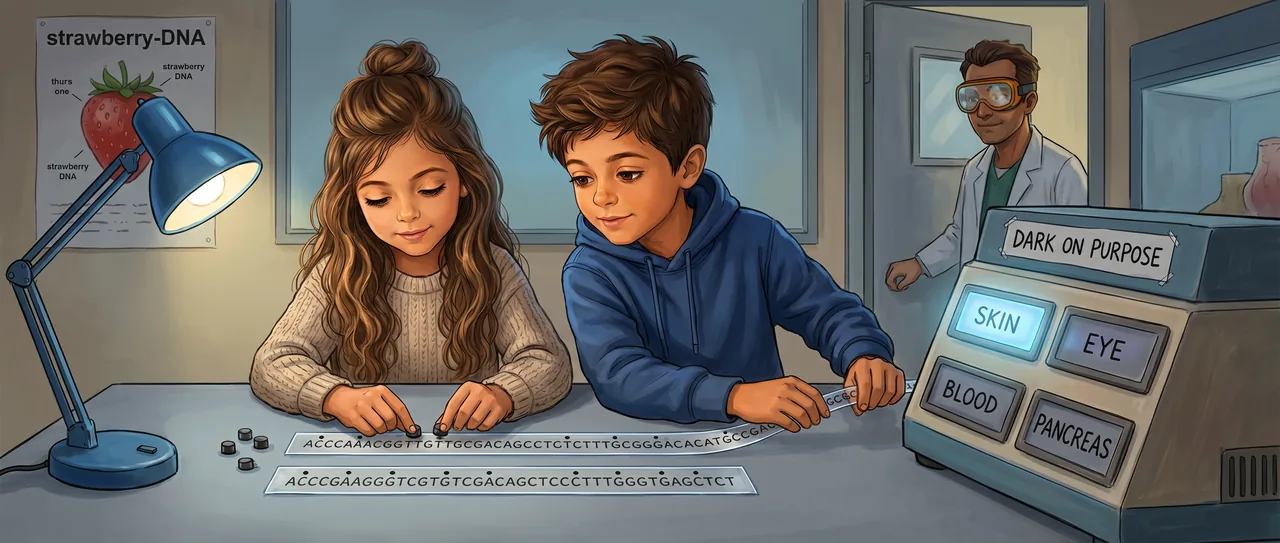
The Parts That Stayed Dark
The exhibit opened in twelve minutes, and the genome was lying.
Maya stood with both hands on the glass case, watching the model reader swallow a clear plastic ribbon printed with letters. A, C, G, T. A, C, G, T. The ribbon slid under a blue lamp. Four panels lit up at once.
SKIN.
EYE.
BLOOD-MAKING CELL.
PANCREAS.
“That is not a cell,” Maya said.
Soren was crouched by the side hatch with a screwdriver, not unscrewing anything yet. “It is four cells having an argument.”
The lab manager was across the room with a soldering iron in one hand and a phone balanced against her shoulder. One lens of her orange safety goggles was smudged with glue. “If the lights come on, the exhibit works,” she said. “Children like lights.”
Maya looked at the ribbon coming out the other side. Its letters were untouched. No burns. No missing pieces. No cuts.
“It says every cell reads everything,” Maya said.
“It is a simplification,” the lab manager said into the room, and then into the phone, “No, not the jellyfish protein. The other box.”
Soren slid the skin card into the slot. The same four panels lit.
He slid in the pancreas card. The same four panels lit.
He slid in the eye card. The same four panels lit.
“That is not simplification,” he said. “That is wrong in the same way three times.”
Maya had already opened the drawer under the exhibit. Inside were spare bulbs, tape, blank labels, tiny plastic caps, and a sealed bag marked TOO CONFUSING, SAVE FOR LATER.
She liked later. Later usually meant the part someone had hidden because it was interesting.
She tore the bag open.
The caps were clear on top and smoky black underneath. Each one was no bigger than a lentil. On the top of every cap, someone had printed METHYL in blue.
Soren stopped testing cards.
“Those were in the first design,” the lab manager said. “We cut them. The funders got worried visitors would think the DNA changed.”
Maya held one cap over the ribbon. Through it, the letter C still showed.
“It does not change the letter,” she said.
“No,” Soren said. He had found the instruction sheet under the caps. “It sticks onto the DNA. Mostly at places where C sits next to G. It can help shut a gene down.”
The lab manager covered the phone. “That is the confusing part.”
Maya smiled. “That is the part.”
The reader was simple enough to be honest if they made it honest. Under each gene name on the ribbon was a silver start dot. When the blue lamp saw the dot, the panel lit. If the dot was covered, the panel stayed dark.
In real cells, no blue lamp rolled politely along a plastic strip. There were proteins and folded DNA and chemical grips so small the air itself was enormous beside them. But the model was trying to say one true thing in a language made of lights.
Soren picked up the skin card. “Skin should not be making eye pigment here. Or insulin.”
“Leave skin on,” Maya said.
“Keratin panel?”
“Yes. Dark for the others.”
They worked without asking permission, because permission was walking in circles with a soldering iron.
Maya placed smoky caps over the start dots for EYE, BLOOD-MAKING CELL, and PANCREAS. She did not cover the letters. She covered the places where the machine began reading.
Soren slid the ribbon in.
The blue lamp hummed.
SKIN lit.
The other panels stayed black.
The room changed size.
It had been a room with a broken exhibit, gray tables, a sink, a rack of pipettes, and a crooked poster of a strawberry with its DNA pulled out like clouded glass. Then it was also a body. Maya’s wrist on the case. Soren’s eyelashes lowered over the instruction sheet. The lab manager’s glue-smudged goggles. All of them made of cells carrying the same four-letter alphabet in nearly every nucleus, and every cell keeping most of that alphabet quiet.
Maya touched her eyelid.
“Same book,” she said.
Soren looked at his knuckle. “Different shut pages.”
The lab manager had stopped talking on the phone.
Soren did not look up. “If the dark panels look broken, people will think the exhibit failed.”
“They might,” the lab manager said.
He took a blank label and wrote carefully, not in his notebook, but on the exhibit itself.
DARK ON PURPOSE.
He stuck it beneath the panels.
Maya laughed once, softly. “That sounds like you.”
“It sounds like the cell,” he said.
The lab manager came closer now. She smelled faintly of hot plastic and peppermint tea. “You have seven minutes.”
“We need copies,” Soren said.
“What?”
“If a skin cell divides, the daughter cells have to remember they are skin.” He tapped the capped start dots. “Do the tags get copied?”
“Many patterns can be copied when cells divide,” the lab manager said. “Some change. Some last for decades. Some can stay with a person for a lifetime.”
Maya went still with a cap balanced on her finger.
Across a whole life, a mark smaller than dust could keep a door closed.
Soren found the second clear ribbon. It had the same letters in the same order. He laid it beside the first and began placing caps in the same positions.
“No,” Maya said.
He stopped.
“Not by hand.”
She dug through the drawer and found a flat stamp from the discarded design. Its underside had three little pegs where the skin caps sat. She pressed it onto the first ribbon, lifted it, and pressed it onto the second.
Three smoky caps clicked into place.
Soren slid the second ribbon into the reader.
SKIN lit.
The three other panels stayed dark.
The lab manager whispered something that sounded almost like a bad word, but happy.
The first visitors knocked on the glass door. Their faces floated in the hallway, warped by the safety glass. The lab manager hurried to unlock it, then stopped and looked back at Maya and Soren.
“Can I open with this version?” she asked.
Maya had already pulled the pancreas card closer. “Wait.”
There was only one genome sequence printed on all the ribbons. The exhibit did not need different letters. It needed different silences.
For pancreas, they left the insulin panel uncovered and capped the others. For eye, they left the eye gene uncovered. For the blood-making cell, they left the blood panel shining and pressed smoky caps over skin, eye, and pancreas.
Four ribbons. Same letters. Four patterns of dark.
The visitors came in, but Maya barely heard their shoes. Soren had found one last card at the bottom of the stack. It was not glossy like the others. It was plain white, with a single word printed at the top.
EARLY.
No tissue name. No picture. No answer printed on the back.
Maya held it up.
The lab manager’s mouth opened, then closed.
Soren ran the uncapped ribbon through the reader.
All four panels blazed.
“That cannot stay like that,” Maya said.
“No,” Soren said.
“Who chooses first?”
The lab manager looked toward the open door, where more visitors were stepping inside, and then back at the white card. For once, she was not holding anything that beeped or burned or rang.
“Signals,” she said. “Neighbors. Time. Proteins already waiting in the egg. Things we know. Things we are still trying to catch in the act.”
Maya picked up one smoky cap, then another. She did not place them.
Soren set the early ribbon flat between them. The letters shone through the plastic in a clean, unbroken line.
Maya held the two finished genome ribbons up to the blue lamp. The letters matched from end to end. The small smoky tags did not. Soren opened the box of unused methyl caps, and the waiting children leaned closer.
Read the interactive version, listen to the narration, and earn a gold star →
A science-verified short story for curious kids · Curiosity Land