The Lines Nobody Put There
The machine was supposed to say mug.
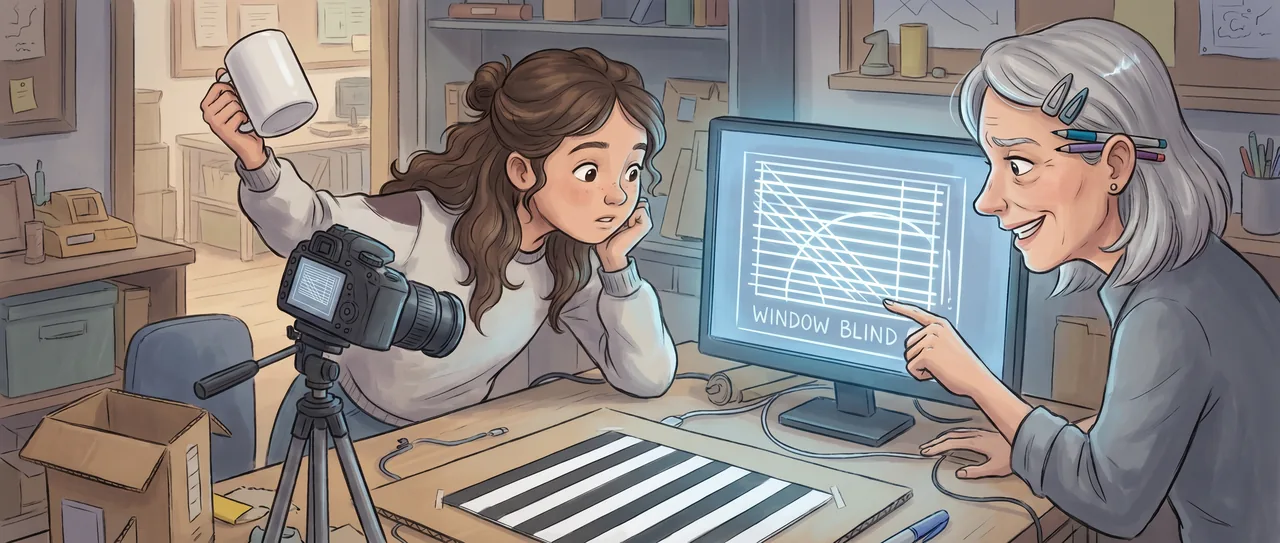
The mug sat under the camera with its handle turned politely to the left, white and round and obvious. On the monitor, the machine thought for less than a second.
Window blind, it said.
Maya looked at the mug. She looked at the screen. She looked at the black and white striped mat under the mug.
The engineer made a small sound in her throat. She had silver clips in her hair, three pens behind one ear, and the tense smile of someone whose demonstration had worked perfectly ten minutes before the doors opened.
“That is not ideal,” the engineer said.
“No,” Maya said. “But it is interesting.”
“It’s probably a camera glitch. Or the model cache. I can restart.”
“Don’t.”
The engineer’s finger stopped above the keyboard.
Maya leaned closer. The monitor showed the camera view in one corner and the machine’s best guesses below it. Window blind. Fence. Grille. The mug was fourth, in tiny letters, like it was embarrassed to be there.
The lab around them was all bright tables and quiet machines. A printer hummed behind a glass wall, laying down blue plastic one careful thread at a time. On the far side of the room, a rover with rubber wheels waited on a square of fake Mars. People drifted past the demonstration table, saw the wrong answer, and drifted faster.
The engineer blew air through her cheeks. “It learned from millions of labeled pictures. Usually it’s very good with cups.”
“Show me what it looked at before it said that,” Maya said.
“That’s not really the demo.”
“It should be.”
The engineer glanced at the door, at the half-empty sign-up sheet, at the mug accusing her from under the camera. Then she clicked a hidden tab.
The screen changed.
The mug vanished. In its place came a grid of small gray squares. Some were dark. Some were pale. Some held thin bright cuts, like scratches on ice. One square glowed with a white line slanting up. Another had a vertical edge. Another had a corner. Dozens of little pieces. None of them looked like a mug.
Maya put one hand flat on the table.
“What are those?” she asked.
“The first layer,” the engineer said. “It’s a convolutional neural network. The first layer responds to simple things in the image. Edges, mostly. Lines. Changes from light to dark.”
“Who told it to do edges?”
The engineer’s tired smile changed shape. “No one.”
Maya looked at her.
“No one drew those filters,” the engineer said. “We gave it pictures and answers. Cat. Bicycle. Teapot. It changed its own numbers again and again until the answers got better. When researchers looked inside networks trained that way, the early layers often looked like edge detectors. A little like the first steps in the visual cortex.”
Maya knew about the visual cortex. It was at the back of the brain. It did not show you the world all at once. It built seeing out of pieces before you ever got to say what the thing was.
On the screen, the machine’s first thoughts were all slashes and borders. Nobody had named them. Nobody had told them they mattered.
“Next layer,” Maya said.
The engineer clicked.
The grid changed again. Now the squares held bent lines, little arcs, textures like woven cloth, dark blobs beside pale rims. Still not a mug. Not nothing, either.
“Again.”
The engineer clicked.
Now some squares flashed when the handle was visible. Some liked circles. Some liked stripes. One brightened around the mug’s rim. Another brightened everywhere the mat made black-white-black-white-black.
Maya pointed. “That one is yelling.”
“It’s very active,” the engineer said.
“It’s yelling.”
The engineer did not argue.
Maya moved the mug one centimeter to the right. The guesses stayed the same. Window blind. Fence. Grille. The striped mat filled the screen around the mug like a prison uniform.
“Can I move things?” Maya asked.
“Please don’t break things.”
Maya picked up the mug.
The monitor still said window blind.
The engineer went very still.
Maya held the mug in the air. Under the camera, there was only the striped mat. The machine loved it. The grid in the later layer blazed with straight parallel marks.
“It isn’t seeing the mug first,” Maya said.
“It sees the whole image,” the engineer said. “But yes.”
Maya set the mug down beside the camera, off the mat. She looked under the table and found a cardboard lid from a box of cables. The inside was plain brown. She slid it under the camera.
The monitor went dull for a moment, then the guesses changed.
Envelope. Cardboard. Table.
Maya put the mug on the cardboard.
Cup, said the machine.
Mug, said the machine.
Coffee cup, said the machine.
The engineer laughed once, sharp and delighted. “It wasn’t broken.”
“No,” Maya said.
She dragged the striped mat back so it covered half the cardboard. The mug stood with its left side against stripes and its right side against brown. The first layer filled with edges. The middle layer split into two countries, one of handle curves and one of bars. The final guesses flickered.
Mug.
Window blind.
Mug.
Fence.
Maya watched the machine hesitate.
The engineer leaned closer now, all three pens tilting dangerously. “You found the argument inside it.”
Maya touched the screen, not hard enough to leave a print. The lower layers did not know they were part of an argument. The first layer found edges because edges helped. The next layers kept arrangements that helped. Farther up, something could answer mug or fence or face, but it had climbed there on little noticings that would have sounded silly by themselves.
At school, when Maya said the shadow was wrong under the door, or the repeating squeak in the hall came every sixth step, or the substitute teacher’s map had Antarctica upside down, people asked how she could possibly care about that first.
Here was a machine that became useful by caring about that first.
“Do all networks do this?” she asked.
“Not all in exactly the same way,” the engineer said. “It depends on the architecture and the training data. But convolutional networks trained on images often grow this kind of hierarchy. Edges early. Parts and textures in the middle. Objects later. Faces, wheels, ears, handles. No one writes those detectors by hand.”
Maya turned away from the mug. “If you train it on different pictures, does it grow different noticings?”
“Yes.”
“Can we see them?”
“Sometimes.” The engineer looked at the clock, then at the emptying room, then at Maya. “The lab computer can train a small model overnight. It won’t be as powerful as the big one. But we can watch the layers in the morning.”
The word morning landed on the table like a sealed envelope.
The engineer opened a folder menu. “These are public image sets we keep for workshops.”
Maya did not reach for the mouse yet.
On the monitor, the mug stood half on stripes and half on plain cardboard. The machine was still changing its mind.
Maya slid the striped mat away. Mug rose to the top and stayed there.
The folder list filled the screen: Cats, Leaves, Clouds, Plankton, Galaxies. Maya dragged Galaxies into the empty training box and pressed Start.
Read the interactive version, listen to the narration, and earn a gold star →
A science-verified short story for curious kids · Curiosity Land