The Light That Waited
The Moon Tunnel was supposed to shine.
It did not.
Soren stood at the entrance with his paper notebook tucked under one arm and watched the exhibit manager switch off the ceiling lights for the third time. The tunnel became a long black mouth. Somewhere inside, a cart squeaked. A roll of tape fell over and bumped against the wall.
The exhibit manager switched the lights on again.
"Bad batch," she said.
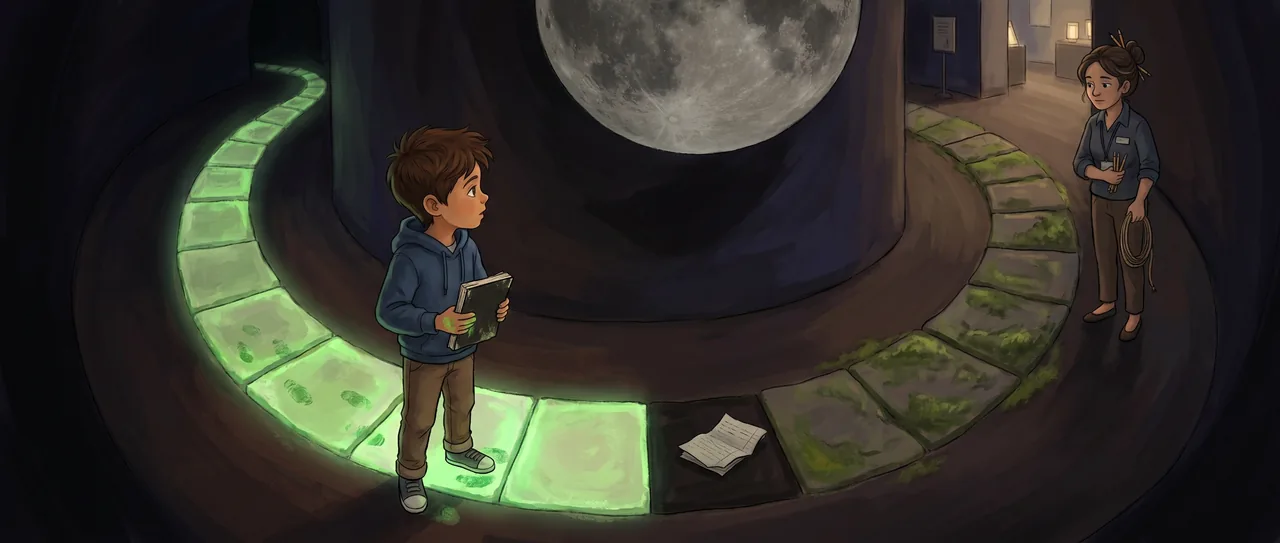
The floor was covered with pale green tiles set in a curling path. By tomorrow night, children were supposed to follow the glowing spiral through the tunnel while a recording played astronaut footsteps and soft radio crackle. No flashlights. No screens. Just stored light under their feet.
Except the tiles looked like dull candy.
"I can run cords for little lamps," the exhibit manager said. She had a pencil behind one ear, another in her hair, and a third in her hand. She kept losing all of them. "Not as clean, but people love lights. Bright is bright. Can you hold this?"
She handed Soren the end of a yellow extension cord.
Soren held it, but he kept looking at the floor.
The first three tiles, nearest the open lobby, had a weak green edge. The rest had nothing. The spiral disappeared where the shadow of the hanging moon model began.
"How long were the lights on?" Soren asked.
"All morning," she said. "Museum lights. Very professional lights. Expensive, cranky, buzzing lights. They should be stuffed full. They are not. Therefore, bad batch."
Soren crouched and put his notebook on the floor beside the fourth tile. Its cover was black. Its corners were bent from pockets and bus rides.
The exhibit manager looked at it. "You brought paper to a digital museum?"
"It works when batteries don't," Soren said.
"Fair." She turned toward the supply cart. "I am going to find lamps that have not been chewed by school groups. Please do not get rolled into a wall."
She hurried away, dragging the extension cord until Soren let go.
The museum was not closed yet, but it was between crowds. Far off, a toddler laughed in the water room. Air hissed through vents. Above the tunnel, the hanging moon showed craters the size of soup bowls.
Soren put one hand on the nearest green tile. It was cool and smooth. He had owned glow stars when he was little. He knew the trick. Hold them under a lamp. Turn off the lamp. They glow.
He had thought that meant they were tiny things pretending to be lamps.
He pulled the small ultraviolet flashlight from the exhibit cart. A sticker on it said FOR DEMO USE. DO NOT STARE INTO LIGHT. He did not stare into it. He shone it on the fourth tile and counted under his breath.
"One. Two. Three. Four. Five."
He clicked it off and cupped both hands around the tile.
Green appeared between his fingers.
Not bright. Not like a screen. More like the tile had taken a breath and was letting it out very slowly.
He did the fifth tile. It glowed too. The sixth. The seventh.
The batch was not bad.
Soren looked up at the moon model. Its gray belly hung between the ceiling lights and most of the spiral. The first tiles had spent the morning in lobby light. The rest had waited in shade, empty.
The exhibit manager returned with two lamps, one under each arm, and a coil of cord around her neck like a snake.
"Good news," she said. "One lamp works if you kick the stand. Bad news, I am becoming the sort of person who kicks museum equipment."
"They need feeding," Soren said.
She blinked. "The children?"
"The tiles. The light doesn't bounce off them. It goes in first. They don't have enough."
"They have had all morning."
Soren pointed at the moon model's shadow on the floor.
The exhibit manager followed his finger. She frowned at the shadow. Then she frowned at the lights. Then she frowned at the tiles, as if they had personally hidden the problem from her.
"Oh," she said. "That is annoying."
"It is also fixable," Soren said.
He liked saying that only when he had already begun to know how.
They moved the lamps to the tunnel entrance. The exhibit manager wanted to point them straight down the spiral, but the moon model still blocked them.
"Could take the moon down," she said.
Soren looked at the moon. It hung from three cables and seemed very committed to being there.
"Or charge it in pieces," he said.
He pulled masking tape from the cart and marked the spiral into sections. Then he found a stack of white foam boards from an old comet display. The boards could bounce light around the curve. Not much. Enough to matter.
The exhibit manager watched him place one board against the wall, tilt another on a chair, and prop a third with a box of plastic goggles.
"You are making a very strange kitchen," she said.
"The light was going the wrong places," Soren said.
He switched on the lamp.
The boards caught the glare and sent it under the moon model, across the middle tiles, into the bend of the spiral. Dust flashed in the beam. The pale tiles did not look different. That bothered the exhibit manager.
"How do we know it is working?" she asked.
"We wait."
She made the face adults made when waiting felt like losing.
Soren opened his notebook, not to write the answer, but to tear out a page from the very back where he kept pages for mistakes. He folded it twice and laid the folded square on one tile.
"What is that for?" she asked.
"A shadow test."
They charged the section for several minutes. The lamp hummed. A group of children passed the entrance, stared at the tunnel, and kept walking because nothing interesting seemed to be happening.
Soren did not mind. Lots of interesting things looked like nothing while they were loading.
At last he switched off the lamp.
The tunnel filled with green.
It did not snap on. It arrived. First the nearest tiles, then the curve, then the far side under the moon. The spiral came out of the dark as if somebody had drawn it with a quiet finger.
Where the folded paper had been, there was a dark square.
The exhibit manager whispered, "It kept the shadow."
Soren lifted the paper. The square stayed black while the tile around it glowed.
He touched the edge of the darkness. His fingertip turned green. The square did not. It had not been fed.
The exhibit manager took the pencil from behind her ear and found another pencil already in her hand.
"We cannot have visitors standing here for several minutes before every walk," she said.
"They don't need to," Soren said.
He was already moving the foam boards.
The sleepover would have groups every half hour. The tunnel could be charged between groups with the lamps hidden behind the entrance curtain. The first section needed the lobby lights. The middle needed reflected light from the boards. The last section needed a lamp aimed low, because the moon stole the ceiling light. He tested each section by covering a corner with notebook paper, charging, and checking whether the dark square appeared.
If the square appeared, light had reached the tile.
If the square did not, the tile was still hungry.
By the time the museum closed, the exhibit manager had stopped calling the tiles bad and started calling them stubborn. She said this like a compliment.
At the test run, the ceiling lights went out. The lobby dimmed. The curtain opened.
The spiral glowed from the entrance all the way to the silver door at the far end. Not evenly. That was the best part. The newest light near the entrance shone brighter. The older light deeper in the tunnel had become soft and deep, like moss under water. Every step changed the green around Soren's shoes.
The exhibit manager stood behind him, holding three pencils and not using any of them.
"Bright is not bright," she said quietly.
Soren did not answer. He walked the spiral to the far end and turned around.
From there he could see the whole path, every tile giving back what it had been given. The dimmest ones mattered most. They were the ones that made the curve continue when the bright ones ended.
Outside the curtain, the first sleepover families were arriving. Wheels rolled over the floor. Someone unzipped a sleeping bag. A child asked if the moon was real.
The exhibit manager looked at the practice panel beside the door. It was the same phosphorescent material as the floor, mounted upright for visitors to test with stencils.
"We still have five minutes," she said. "Want to make sure that panel charges?"
Soren stepped to the blank practice panel by the door. He spread his fingers against the cold green surface while the charging lamp hummed. When the lamp clicked off, he lifted his hand, and his dark handprint stayed on the wall.
Read the interactive version, listen to the narration, and earn a gold star →
A science-verified short story for curious kids · Curiosity Land