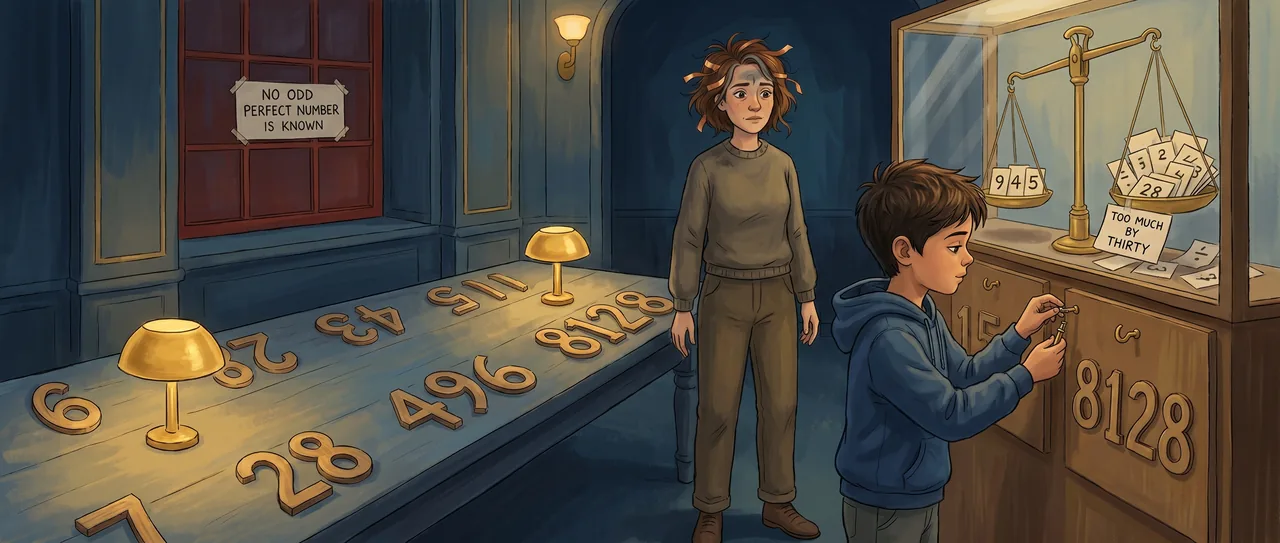
The Empty Hook
The machine rejected Soren’s number before it had even counted.
A red card snapped up behind the glass. ODD. NOT PERFECT.
Soren kept his hand on the crank.
“That was too fast,” he said.
Across the dark exhibit hall, Aunt Leena was standing on a ladder with a roll of copper tape in her teeth. She was not really his aunt. Everyone at the Museum of Small Infinities called her that because she fixed things and scolded things and carried snacks in every pocket.
“It is supposed to be fast,” she said around the tape. “Children like fast.”
“Children like true,” Soren said.
Aunt Leena took the tape out of her mouth. “Most children like buttons.”
The exhibit was called The Perfect Banquet. On the wall, wooden numbers sat at a long painted table. Under each number hung its proper divisors, smaller numbers that divided into it exactly. If the hanging numbers added up to the number at the table, the machine rang a bell and lit a gold lamp.
Six had one, two, and three beneath it. When Soren had cranked that one, the bell had rung so sweetly that a sleeping security drone had lifted its head.
Twenty-eight had one, two, four, seven, and fourteen. The gold lamp had made the table shine.
Four hundred ninety-six sat farther down, looking too large to be friendly. Eight thousand one hundred twenty-eight sat beyond it like a mountain with a place card.
Above them, Aunt Leena had painted, KNOWN SINCE THE ANCIENT GREEKS.
Soren had liked that part. He liked the idea of somebody long ago in sandals looking at six and finding it full of smaller pieces that came back to six, exactly. Not almost. Not extra. Exactly.
That morning, before the museum opened for testing, Soren had brought his own candidate in his paper notebook.
Nine hundred forty-five.
It was odd. It had lots of factors. It looked, in Soren’s notebook, crowded in an interesting way. He had not written perfect beside it. He had written maybe, with a box around the word.
The machine had not cared about maybe.
ODD. NOT PERFECT.
Soren turned the crank backward. The red card dropped. He turned it forward again, slower.
The gears clicked once. The same card snapped up.
“That is not counting,” he said.
“It is a shortcut,” Aunt Leena said. She climbed down one rung, frowned at the copper tape, and climbed back up. “All the perfect numbers we know are even.”
“That is not the same sentence.”
“It is close enough for a museum label at midnight.”
Soren looked at the row of shining lamps. Six. Twenty-eight. Four hundred ninety-six. Eight thousand one hundred twenty-eight. Every one even. Every one wearing its divisors like a necklace that clasped.
Then he looked at the red card.
The card did not say, none known.
It said, not.
He opened the service panel under the crank. Aunt Leena made a noise that meant she had seen him but had chosen to fight a different emergency first.
Inside the panel, the machine’s thinking was made of clear plastic paths. Number cards slid down chutes. Divisor cards dropped into little cups. A balance arm compared the sum with the number. If they matched, a brass pin struck the bell.
But before any of that, an odd-number flap tipped left and sent the card straight to the red window.
Soren took out his pencil and tapped the flap. Tap. Tap. Tap.
“What made you pick nine hundred forty-five?” Aunt Leena asked.
“It has many proper divisors,” Soren said. “More than it looks like it should.”
“That is not usually how children choose numbers.”
“I am not usually children.”
Aunt Leena laughed once, but softly, like she had bumped into something in the dark.
Soren pulled the odd flap loose. It came out with two screws and a whisper of dust. He set it beside his notebook.
“Soren,” Aunt Leena said.
“I can put it back.”
“That is what every person says right before I find a spring in the drinking fountain.”
He fed nine hundred forty-five into the chute again.
This time the machine began to count.
One dropped. Three dropped. Five. Seven. Nine. Fifteen. Twenty-one. Twenty-seven. Thirty-five. Forty-five. Sixty-three. One hundred five. One hundred thirty-five. One hundred eighty-nine. Three hundred fifteen.
Each card landed in a cup. Each cup pulled the balance lower.
The machine groaned politely.
The divisor side sank too far.
A blue card rose behind the glass. TOO MUCH BY THIRTY.
Soren stared at it.
Not perfect. But not empty.
Nine hundred forty-five had not failed like nine failed, with too few pieces. It had failed by overflowing. It was odd and crowded and close enough to make the machine work for its answer.
He wrote nothing down. The pencil stayed in his hand.
Aunt Leena came over at last. Her hair had copper tape stuck in it. She looked at the blue card, then at the loose odd flap on the floor.
“Well,” she said. “That is a more interesting failure.”
“The shortcut skipped the interesting part.”
“The shortcut keeps the line moving.”
“The line can move slower.”
Aunt Leena rubbed her forehead with the back of her wrist, leaving a gray streak. “The museum opens to three hundred fourth graders in nine hours.”
“Then it should not lie to them first thing in the morning.”
She opened her mouth. Closed it. Looked at the red card. Looked at the gold lamps.
“I do not have time to rewrite the code,” she said.
“I am not using code.”
Soren carried the odd flap to the workbench. There were label blanks, brass hooks, a jar of screws, and a little drawer full of unused number cards. He took a blank label and wrote in block letters, NO ODD PERFECT NUMBER IS KNOWN.
Aunt Leena leaned over his shoulder. “That is not as tidy.”
“No.”
“People will ask if one exists.”
“Yes.”
“We do not know.”
Soren looked up at the wall, where the ancient Greek column stood beside the glowing screen that listed the largest even perfect numbers the museum had room to print. The first ones had crossed thousands of years to get here. The next ones needed computers and special primes and long searches that made the museum server hum behind the wall.
And in all that distance, no one had closed the odd door.
The exhibit hall seemed to have more space in it than before. Not more floor. More behind the walls. More above the ceiling. More inside the number nine hundred forty-five, even though it had already been weighed and found too much by thirty.
Soren taped the new label over the red card’s old window. Then he put the odd flap back, but not where it had been. He fixed it so odd numbers took the long path through the divisor cups before any card could rise.
They tested nine. TOO LITTLE.
They tested fifteen. TOO LITTLE.
They tested forty-five. TOO MUCH.
They tested nine hundred forty-five again, and the machine groaned its polite groan and showed TOO MUCH BY THIRTY.
Aunt Leena folded her arms. “It is slower.”
“Yes.”
“It uses more gears.”
“Yes.”
“It will make the maintenance team complain.”
“Yes.”
She looked at the sign again. NO ODD PERFECT NUMBER IS KNOWN.
Then she went to the supply tray and handed him a brass hook.
“For the question,” she said.
Soren took the smallest empty brass hook from the supply tray, screwed it into the board after eight thousand one hundred twenty-eight, and left it bare.
Read the interactive version, listen to the narration, and earn a gold star →
A science-verified short story for curious kids · Curiosity Land