The Direction the Bird Could See
The thrush would not leave.
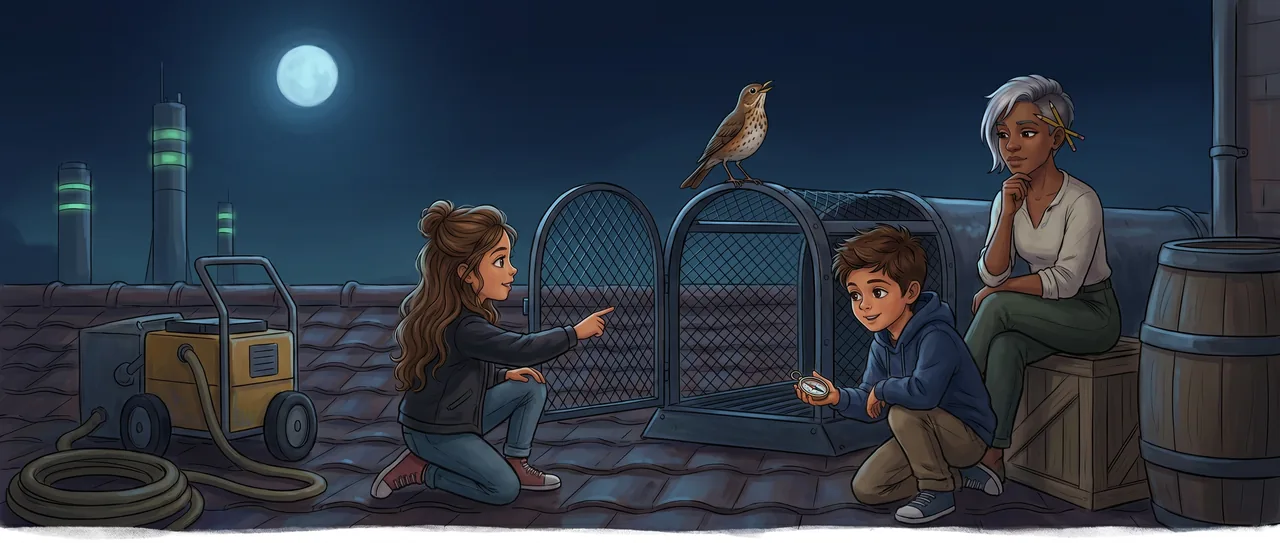
The release hatch was open. The night above it was clean and dark because the city had lowered its windows to half-glow for Migration Hour. Towers along the river wore soft green bands instead of bright crowns. Delivery drones moved below roof level, quiet as beetles.
Inside the little mesh tunnel, the brown bird stood with its toes around the perch and its chest beating fast. It was small enough to fit inside both of Maya's hands, if Maya had been allowed to hold it. It had crossed countries before it hit a glass wall. Now its wing was healed. Its weight was right. Its feathers were right.
Only its direction was wrong.
Maya leaned closer to the viewing glass.
"It keeps choosing the cabinet," she said.
Across the roof, against the service wall, stood a gray metal cabinet with towels, seed packets, and a stack of folded nets. The open hatch was above the tunnel, facing the dark northern sky. The thrush looked at the cabinet.
Soren turned the paper map in his hands until the river matched the river below. He had brought the map because phones were sealed in a box by the stair door. Phones made light. Phones made noise. Phones, according to the sign, made humans worse at being quiet.
"The cabinet is west," he said.
"It thinks west is open," Maya said.
Dr. Imani pulled a roll of black tape from her pocket with her teeth. She was trying to cover a tiny red warning light on an air filter. She had silver hair cut short on one side and three pencils trapped in the other side like they had flown there.
"It thinks the city is still too bright," she said. "One jewel of light in one wrong window and a bird can waste a whole night arguing with it. I told the mayor the hotel signs needed another ten percent down. Nobody listens to the person with the tape."
She tore the tape and climbed onto a crate.
The thrush hopped once toward the cabinet. Its beak touched the mesh.
Maya's fingers tapped the glass. Not loud. Just once, the way she touched a table when a pattern skipped.
"It's not looking at a light," she said.
Soren did not ask how she knew. He looked at the cabinet, then at the open hatch, then at the bird. The thrush had the stillness of something waiting for a door that everyone else had failed to unlock.
"What else does it use?" Soren asked.
Dr. Imani had one knee on the crate and one foot in the air. "Stars. Smells, maybe. Wind. The sun when there is sun. And the field. Always the field. Soren, hand me that strip of tape. No, the wide one."
He handed it to her.
"The field," Maya said.
"Earth's magnetic field," Dr. Imani said around the tape. "Tiny. Everywhere. A compass needle notices it. Birds do better than needles, which is rude of them."
The thrush hopped again. West.
Soren took the small compass from the pocket of his jacket. It was not part of his school kit. It was not part of anything, really. He liked objects that kept answering the same question even after batteries were dead.
He set it flat on his map.
The needle swung north.
He carried the map two steps toward the release tunnel.
The needle turned west.
Maya saw it before the needle stopped. Her whole face changed. Not surprise exactly. More like a lock hearing the right key.
"Again," she said.
Soren stepped back. North.
He stepped forward. West.
Dr. Imani looked down from the crate. "That compass is broken."
"Only here," Soren said.
He crouched and moved the compass slowly along the floor. The needle dragged itself around as if something under the tiles had caught it on a string. Near the service wall, it pointed almost exactly where the thrush was staring.
Maya was already on her knees, looking under the release stand.
"There," she said.
Under the stand, half hidden behind a coil of hose, sat the battery cart for the roof dimmers. It was squat and yellow, with thick black wheels and a warning label shaped like a horseshoe magnet.
Dr. Imani got very still.
"That should be in the charging bay," she said.
"It isn't," Maya said.
"No," said Dr. Imani. "It very much isn't."
She climbed down too fast, slipped, caught herself, and knocked two pencils out of her hair. She reached for the cart handle.
Maya put her hand on it first. "Wait. If we move it while the bird is in there, will that scare it?"
Dr. Imani opened her mouth, then shut it.
Soren traced the cable from the cart to the dimmer box. "We can switch the roof glass to stored mode first. It holds dim for twelve minutes without the cart. The sign said that by the stair."
"You read the emergency sign?" Dr. Imani asked.
"It was next to the phone box," Soren said.
Maya was already at the switch panel. There were six buttons, all labeled in small print. Adults liked small print when they did not want children touching things.
"Stored mode," she read. "Confirm. Confirm again. Why twice?"
"Because once is for people who are guessing," Soren said.
Maya pressed both.
The green bands on the surrounding towers softened but did not brighten. The roof stayed dark. Somewhere below, a maintenance fan sighed off.
Together, Maya and Soren pulled the yellow cart out from under the stand. It was heavier than it looked. Its wheels complained in small rubber squeaks. They pushed it across the roof, past the water barrel, past the folded chairs, all the way to the charging bay marked with a painted square.
Soren checked the compass there. The needle twitched toward the cart like a dog smelling dinner.
"Hungry magnet," Maya said.
"Strong magnet," Soren said. "Or motor. Or both."
They ran back, not loudly, because the roof belonged to wings.
At the release tunnel, the compass pointed north again.
The thrush had not moved.
Then it lifted its head.
It did not look at the cabinet.
It looked up.
No one spoke.
The bird sprang from the perch into the mesh tunnel, fluttered once against the slope, found the hatch, and vanished into the dark so quickly that the open space seemed to have swallowed it.
Maya grabbed the railing. "It saw the wrong north."
"Maybe not north," Soren said. His voice was very quiet. "The field angle. The slope of it. Birds don't use it exactly like our compass."
Dr. Imani sat down on the crate as if her knees had made a decision without her. She picked one pencil from the floor and turned it in her fingers.
"Some migratory birds have proteins in their eyes," she said. "Cryptochromes. Light hits them, and pairs of tiny particles inside them change. The Earth's field can change how those pairs end up. We think that helps make direction visible. Not visible like a sign. Maybe like a shadow. Maybe like a dim pattern laid over the world. We are still arguing about the picture."
Maya looked at the empty hatch.
The cabinet had been nothing. The air in front of it had not been nothing.
Soren held up the compass. Its little needle trembled, then settled.
"So when we say empty sky," he said, "we are leaving things out."
"We always are," Dr. Imani said. Then she smiled crookedly. "But tonight, you left out less than I did."
Another covered cage waited beside the wall. Inside it, something scratched once against paper.
Dr. Imani stood up and checked the timer on the dimmer panel. "Eight minutes of stored mode. One more release before the cart has to come back online. If you two are willing to be extremely annoying about compasses, I could use that."
Maya was already beside the next cage.
Soren placed the compass on the release stand, far from the charging bay. North held steady.
Dr. Imani lifted the cloth.
The second bird was smaller, with a pale ring around its eye. It blinked into the dark roof. Its head tipped once to the left, once to the right, as if the night had writing on it.
Maya did not touch the glass this time.
Soren did not touch the compass.
Above them, a thin brown bird crossed the pale face of the moon, tilted once, and went on.
Read the interactive version, listen to the narration, and earn a gold star →
A science-verified short story for curious kids · Curiosity Land