Before the Word Arrived
The picture vanished before Maya could see it.
A gray-and-white scramble replaced it, like television snow chopped into squares. The lab was quiet except for the soft tick of the wall screen resetting.
Maya said, "Kitchen."
Soren looked at her. "You did not see that."
"I know."
The neuroscientist at the control table made a happy, exhausted noise. She had a coffee bulb in one hand, three cables looped around her wrist, and the expression of someone who had misplaced both Monday and Thursday.
"Correct," she said. "Kitchen."
The scramble disappeared. The picture came back and stayed. Counters. Sink. Bright window. A yellow bowl. No chairs.
"I saw the bowl," Soren said.
"After," Maya said.
"Maybe I saw it before and forgot seeing it."
"That is a very Soren sentence."
He opened his paper notebook, which the lab door had called a legacy object and tried to scan as museum material. He wrote, image gone first, answer second, confidence annoying.
The neuroscientist laughed without looking up. "That is why I asked for children. Adults keep trying to be clever. Children are clever before they start trying."
"What are we actually doing?" Soren asked.
"Helping me fix a demonstration that refuses to behave," she said. "In about one hundred and fifty milliseconds, your visual system can catch the gist of a scene. Beach. Street. Forest. Kitchen. It happens before you can list the objects. Before the words get dressed. The mask stops the picture from hanging around in your head."
Maya leaned closer to the wall. "Do another."
The neuroscientist tapped the controls. Flash. Scramble.
"Forest," Maya said.
"Road," Soren said at the same time.
The neuroscientist froze with one finger in the air. "Interesting."
The picture came back. Trees crowded both sides of a narrow road.
Maya grinned. "Both."
Soren wrote both, then underlined it twice.
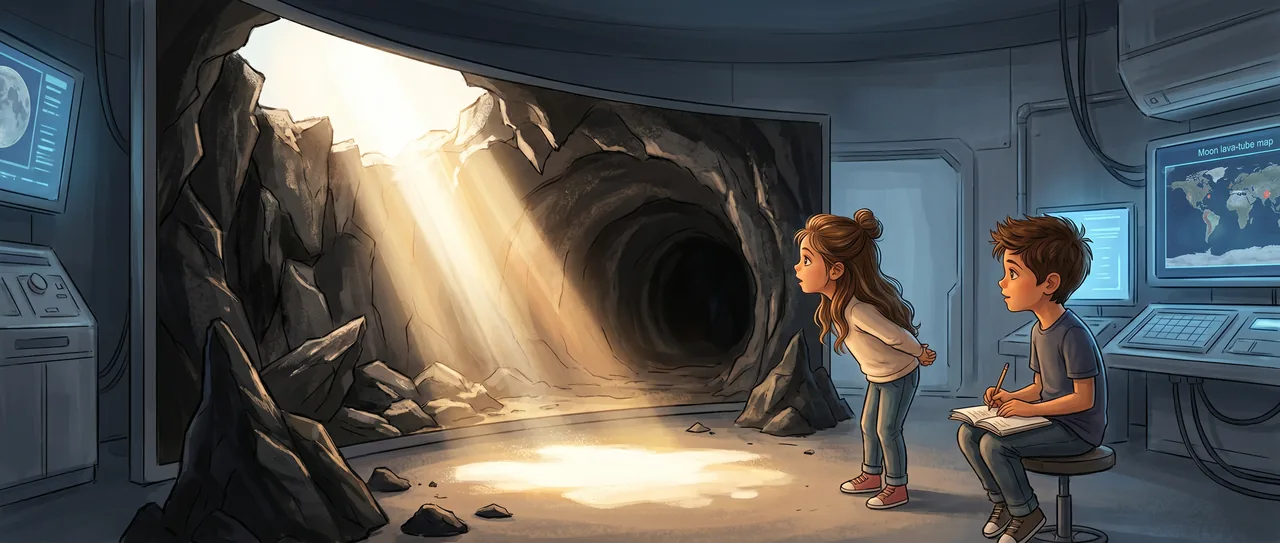
Behind them, a second wall brightened. It showed a map of the Moon, a thin white orbit line, and a blinking dot labeled with no name, only LAVA TUBE SCOUT THREE. The dot sat beside a dark circle on a gray plain.
The neuroscientist groaned. "Not now."
A stream of small black rectangles began stacking down the side of the Moon map.
"Are those pictures?" Maya asked.
"Thumbnails," the neuroscientist said. "The scout is inside a lava tube. The rover team asked our lab to help sort images during the transmission window, but their software keeps calling every frame 'rock.' Which is fair. It is mostly rock."
"A lava tube on the Moon," Soren said.
"Old volcanic tunnel," she said. "Possibly useful shelter someday. Radiation, temperature swings, micrometeorites, all less awful underground. Wonderful place. Terrible lighting."
She tapped her headset. "No, I cannot hand-label twelve thousand thumbnails in eight minutes. Yes, I know the pass is short. Yes, I also know I have a room full of children, but only two are real children and both are busy being variables."
Maya was already standing in front of the second wall.
The thumbnails were too small and too dark. Some had a pale stripe. Some had a black center. Some were just different flavors of nothing.
"What are they looking for?" she asked.
"Open continuation," the neuroscientist said. "A passage, not a dead wall. Frames worth downloading in full. But please do not touch anything. The rover team will send a priority list when they can."
On the Moon map, the timer counted down.
Seven minutes.
Soren looked from the masked-image wall to the thumbnails. "Could we use this?"
The neuroscientist said, "Use what?"
"The before-words part."
Maya put both hands behind her back, which was not the same as not touching. "Flash them. Big. One at a time. Mask after. We say open or closed."
"These are not beaches and kitchens," the neuroscientist said. "They are underlit basalt images from a rover camera with dust on the lens."
"The brain does caves too," Maya said.
Soren added, "Not details. Just gist. Then you only download the ones we both call open."
The neuroscientist looked at the countdown.
Six minutes.
She looked at the coffee bulb.
"I am going to regret making my ethics form so specific," she said. "You are not controlling the rover. You are sorting pictures. No one is in danger. If either of you feels dizzy, stop."
"We are sitting," Soren said.
"People can be dizzy while sitting. Science is rude that way."
She dragged the thumbnail stream onto the demonstration wall. The room lights dimmed. A square of lunar darkness appeared, gone almost at once, replaced by a scramble.
"Closed," Soren said.
"Closed," Maya said.
Click.
Flash. Scramble.
"Open," Maya said.
"Closed," Soren said.
"Reject," the neuroscientist said.
"Wait," Maya said. "Put that one in maybe. It felt wrong-closed."
Soren turned to her. "Wrong-closed?"
"Like a door in a black shirt."
"That is not a measurement."
"It is a category."
He considered this, then drew three columns in his notebook. Closed. Open. Wrong-closed.
The pictures came faster. Flash. Scramble. Stone. Shadow. Scramble. Pale dust. Scramble. A place that was not a room but somehow had a ceiling. Scramble.
Maya stopped trying to see. Trying made her late. The answer arrived best when she let the picture hit and disappear.
"Closed. Closed. Open. Closed. Wrong-closed. Open."
Soren kept pace, his voice lower.
"Closed. Closed. Open. Closed. Maybe open. Open."
The neuroscientist stopped saying reject. She began dropping frames into colored boxes, her eyebrows pressed together.
Four minutes.
A flash came and went.
Maya said, "Sky."
Soren said, "Hole."
The neuroscientist's hand jerked on the controls.
"You cannot know that," she said.
The full image loaded slowly, line by line.
First came black rock. Then a sharp rim. Then a pale blaze beyond it, brighter than anything in the tunnel.
The lab made no sound.
On the screen was a skylight, a place where the roof of the lunar lava tube had fallen in long ago. Sunlight poured through it in a white column and touched the floor like a flag.
Maya had seen sunlight from the Moon before, in pictures from outside. This was different. This was sunlight sneaking underground.
Soren lowered his notebook without closing it.
The neuroscientist whispered, "Priority one."
The rover team accepted the frame. A new line appeared on the map, a possible route curving toward the skylight chamber.
Three minutes.
"Keep going," Maya said.
This time Soren adjusted the rules. "If we both say open, priority. If one says sky or hole, priority. If Maya says wrong-closed and I say maybe, second priority. If we start describing objects, slow down, because then we are making it up."
"Agreed," Maya said.
The neuroscientist did not argue. She moved the keys where Soren could see the colored boxes but not touch them.
Flash.
"Closed."
"Closed."
Flash.
"Wrong-closed."
"Maybe."
Flash.
"Open."
"Open."
Flash.
"Closed."
"Open. No, closed. Mark disagreement."
The timer slipped under one minute. The room seemed to shrink to the square of light and the tiny gap between picture and word. Maya could not name what she saw in the flashes. It was not seeing the way reading a sign was seeing. It was more like walking into a room and knowing, before looking at anything, whether the room was crowded.
Only this room was on the Moon.
Only her brain, which could be fooled by a missing sock under her bed, could take one blink of ancient volcanic stone and say passage.
Soren's pencil moved in short scratches. He was not writing endings. He was keeping the floor under them.
The neuroscientist sent the priority list with nine seconds left.
The map accepted it.
One by one, full images began to bloom from the chosen flashes. A tunnel sloping down. A chamber with a cracked roof. A wall shining with glassy beads. A black oval beyond a pile of fallen stone.
The neuroscientist sat down on the floor.
"I have six degrees," she said. "Neither of you gave me a single proper reason."
"The reasons came later," Soren said.
Maya pointed to the black oval on the wall. "That one. There is more behind that."
The neuroscientist looked at the full image. "The rover team did not mark it."
"Flash it," Maya said.
The neuroscientist put the image back into the one hundred and fifty millisecond program. The oval appeared. Scramble.
"Not wall," Maya said.
"Space," Soren said.
The neuroscientist's fingers hovered over the keys. Then she sent a request for the rover to turn its light.
The answer would not come until the next pass.
The screen went black. The next burst began. Gray walls, black floors, bright flecks, slanted stone, shadow after shadow after shadow. At the ninety-third flash, Maya's palm struck the glass, and Soren's palm landed beside hers.
Read the interactive version, listen to the narration, and earn a gold star →
A science-verified short story for curious kids · Curiosity Land