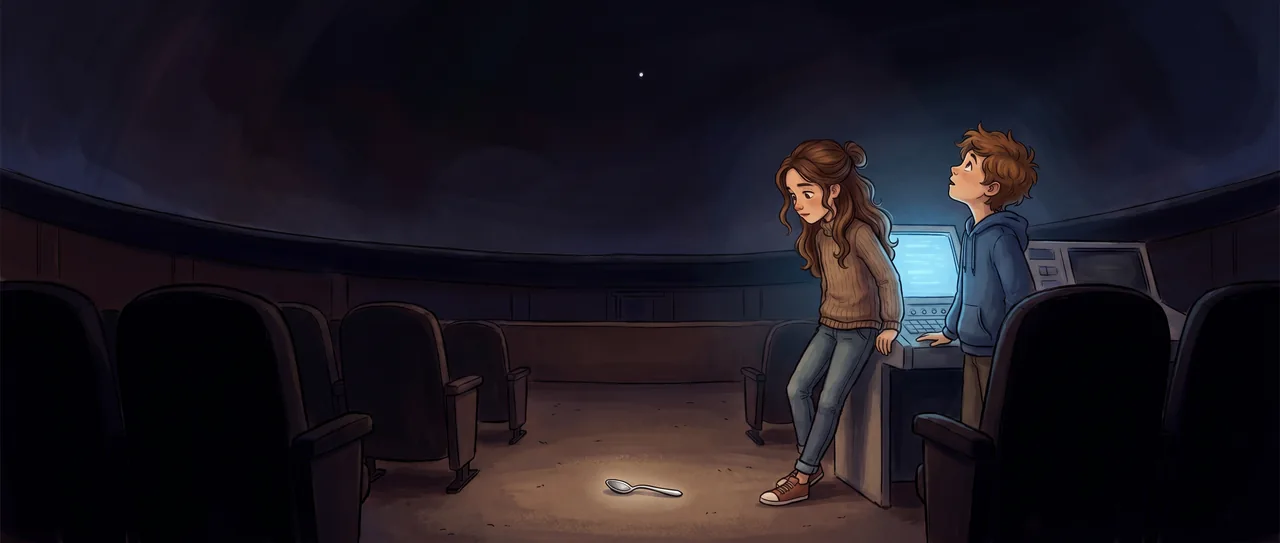
The Star That Became a Note
The neutron star sounded like a microwave finishing soup.
Ping.
The sound bounced around the empty planetarium dome and came back smaller than before.
Dr. Lio stood in the control pit with both hands in her hair. She had a silver scarf printed with constellations and a voice that sounded as if it was always running late.
“No,” she said. “Absolutely not. Children will laugh.”
Maya was already laughing, but not in the mean way. She was sitting backward in a front-row seat, chin on the plastic chair back, watching the white dot on the dome where an exploded star had just collapsed.
“It sounds cooked,” she said.
Soren did not laugh. He had written ping in his notebook and drawn a box around it. Then he had written too slow beside the box.
Dr. Lio spun toward them. “You two are my final test audience. Honest reactions. Useful reactions. We open tonight.”
“You said it spins hundreds of times each second,” Soren said.
“That is in the narration,” said Dr. Lio. “Collapsed core of a massive star. About the size of a city. A teaspoon would weigh a billion tons. Very dramatic. Then, unfortunately, ping.”
Maya pointed at the dot. “Also too big.”
“It is already the smallest dot the projector likes,” Dr. Lio said. “If I make it smaller, it disappears.”
Maya nodded as if that helped.
Dr. Lio tapped the console. The supernova bloomed again across the dome, a red and gold cloud spreading out from a star. The seats rumbled. The light folded inward. The cloud vanished. The dot appeared.
Ping.
Maya stopped laughing.
“What?” Soren asked her.
“It’s doing the wrong kind of small,” Maya said.
Dr. Lio made a tiny groan. “There are kinds?”
Maya got up and walked down the aisle to the control pit. She did not ask if she could come in. Dr. Lio opened the little gate anyway, because Maya was already there.
Soren followed, careful not to trip over the cables.
On the console screen were three choices for the final sound.
Neutron star ping.
Deep space boom.
Mysterious cosmic hum.
“Boom is wrong,” Soren said.
“It used to be a star exploding,” Dr. Lio said.
“Used to be,” Maya said.
Dr. Lio sighed and clicked the hum.
The dome filled with a smooth, spooky sound.
Maya shook her head before the sound had finished arriving. “That is a hallway in a movie.”
Soren leaned over the console, not touching anything. “Where is the real one?”
“The real what?”
“The real pulse.”
Dr. Lio blinked. “Radio data do not come out as tidy little noises. We translate them. Anyway, the one I tried sounded broken.”
“Broken how?” Soren asked.
Dr. Lio opened a folder called rejected. “Like an insect trapped in a light.”
She clicked.
A rapid clicking filled the control pit. It was not ping. It was not boom. It was a hard, dry rattle, so fast the clicks almost touched.
Maya’s shoulders lifted.
Soren held up one finger. “Don’t stop it.”
Dr. Lio did not stop it.
The rattle changed as Soren slid a control marked playback rate back to normal. The clicks crowded closer and closer, then blurred, then became a tone. Not a pretty tone. Not music exactly. A narrow, bright note with teeth in it.
Maya pressed her fingertips to the edge of the console.
“How fast?” she asked.
Soren looked at the file label. “This one says six hundred forty-two rotations each second.”
Dr. Lio leaned in. “That is the first millisecond pulsar ever found. I did not use it because nobody can count that.”
Maya said, “You’re not supposed to count it.”
The note kept going.
Soren put two fingers against his wrist. His pulse pushed back slowly, once, and then again. In that space, the dead star had turned hundreds of times. The white dot on the dome was still there, too large, too clean, pretending to be an object like other objects.
Soren took his fingers away from his wrist.
“The computer called it noise,” he said.
“It is rather noisy,” Dr. Lio said.
“No,” Maya said. “It called the repeating part noise.”
Soren found the setting. A small blue check mark sat beside automatic click removal.
He looked at Dr. Lio.
She looked at the clock on the wall. Then at the empty rows of seats. Then at the two of them.
“Fine,” she said. “Break my show quickly.”
Soren turned off automatic click removal.
The sound sharpened. The note was still a note, but now it had a hidden edge, a stutter too fast to separate. Maya smiled at Soren as if he had opened a locked drawer.
“At school,” Soren said, “if something keeps tapping, everyone wants it to stop.”
Maya reached over him and clicked the visual controls. “Here, if it stops, you lose the star.”
Neither of them said anything after that, because the sentence was already standing in the room.
Maya dragged the size slider for the neutron star all the way down. The white dot shrank, then blinked out.
Dr. Lio made a pained sound.
Maya dragged it up one notch. A single point appeared again.
“Still too big,” Maya said. “But better.”
“If the whole dome were the Sun,” Soren said, looking up, “a neutron star would be smaller than a crumb. But heavier than the Sun.”
“Not heavier,” Dr. Lio said automatically. “Often more massive than the Sun, but not always.”
“More massive than the Sun in a crumb,” Soren said.
Dr. Lio opened her mouth, closed it, and clicked save.
Maya walked to the prop table under the first row. It was covered with things for the lobby demonstrations: a rubber asteroid, a magnet wand, a cracked plastic helmet, and a metal teaspoon for the line about a billion tons.
She picked up the teaspoon. It shone under the aisle lights, ordinary and thin.
“Can the spoon be on the floor?” she asked.
“In the dome show?” Dr. Lio asked.
“No. Before the lights go out. Where people can see it.”
Soren followed her gaze from the spoon to the point of light above them.
Dr. Lio smiled too fast. “Interactive lobby tie-in. I love it.”
Maya shook her head. “Not a tie-in. Just leave it there.”
This time Dr. Lio did not answer quickly.
They ran the ending again.
The giant star burned overhead. It swelled, tore itself open, and threw its outer layers into space. The dome filled with color. The seats trembled. Then the light rushed inward so sharply that several rows seemed to move toward it.
Darkness.
One white point.
The bright, rough note began.
It was small enough to fit inside the eye and fast enough to become sound. It was heavy enough that the teaspoon on the floor looked suddenly ridiculous, and also not ridiculous at all.
Dr. Lio whispered, “Oh.”
Soren watched the dot until his eyes watered.
Maya watched the spoon.
The doors at the back opened. The evening test audience came in, a dozen families shaking rain from their coats. A little kid in a yellow jacket ran down the aisle and stopped beside the teaspoon.
“Is this for touching?” the kid asked.
Dr. Lio looked at Maya. Maya looked at Soren.
Soren said, “Not yet.”
The kid crouched beside it.
After the show, nobody laughed at the ending.
For a moment nobody clapped either. The dome stayed dark except for the one point, and the note kept threading through the seats. Then the lights came up halfway, soft and blue, and everyone began talking at once.
A parent asked Dr. Lio how much of the sound was real.
A teenager asked whether neutron stars could crash into each other.
The little kid in the yellow jacket asked if there were more stars that sounded different.
Dr. Lio looked toward the control pit, where Maya was already climbing the steps and Soren was already opening the archive.
“Ask them,” Dr. Lio said.
Maya clicked the catalog open, and the monitor filled with rows of pulsar names, the scroll bar shrinking to a thin gray line.
Read the interactive version, listen to the narration, and earn a gold star →
A science-verified short story for curious kids · Curiosity Land