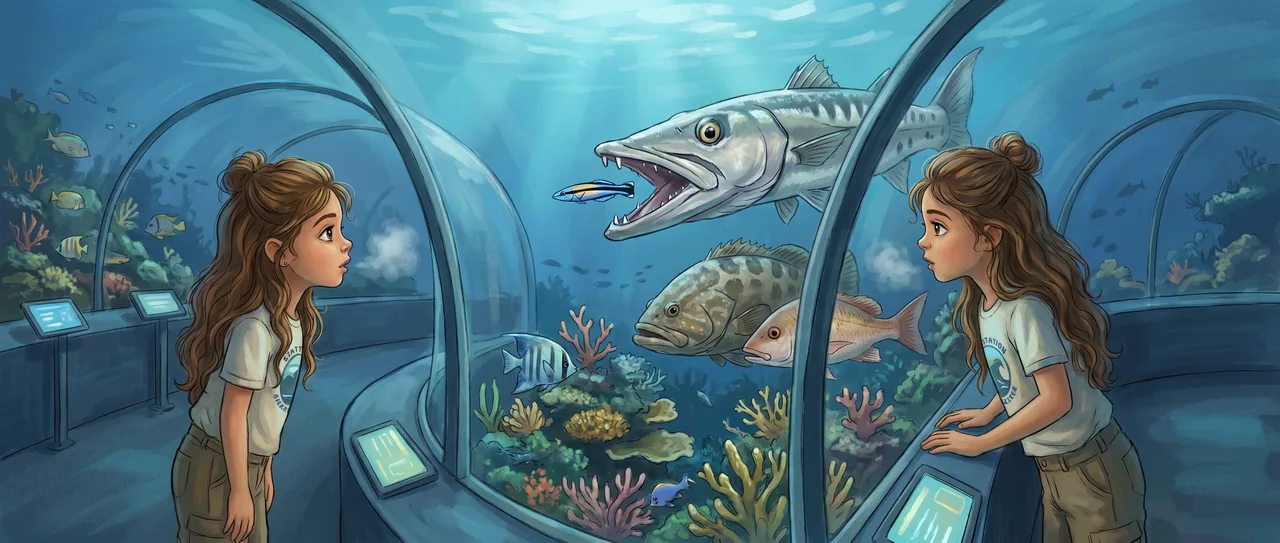
The Place Where Teeth Wait
Maya's reef died every four minutes.
Not the real reef. The real reef pressed blue and gold and green against the thick observation glass of the restoration station, too alive to fit in any screen. Maya's reef was the model on the table, a bright little ocean made of code and rules.
The rules were simple because the reef engineer liked simple.
Big fish ate little fish. Little fish hid in coral. Coral grew where the water stayed clear. Parrotfish scraped algae. Plankton drifted. Predators chased. Prey fled.
For three minutes and forty seconds, the model looked beautiful.
Then the parasites bloomed.
Tiny red dots multiplied on the sides of fish. The groupers slowed. The snappers shivered. The parrotfish stopped scraping. Algae shaded the coral. The reef dulled from festival colors to old soup.
The engineer came over with a mug in one hand and a coil of sensor cable over her shoulder.
"Turn off the parasites for the visitor demo," she said. "We can add them back after lunch. First pass only needs the big relationships. Who eats whom. Who grows where. The easy stuff."
Maya stared at the screen.
A grouper lay at the bottom of the model, enormous and dead, with a stomach full of little fish and red dots blinking all over its skin.
"It died full," Maya said.
"Models do dramatic things when they are unfinished," said the engineer. She was already looking toward the ceiling, where a maintenance drone was knocking gently against its charging hook. "Please do not rewrite the whole ocean before breakfast."
Maya did not promise.
She tried making the little fish faster.
The reef died.
She tried giving the coral more hiding holes.
The reef died.
She tried making the predators less hungry, which looked wrong immediately. The grouper drifted past easy meals like it had forgotten what its mouth was for. The reef still died.
Maya put her chin in her hands.
The dead grouper stayed full.
That was the part that snagged. If the predator won, why did winning look like losing? If the little fish all got eaten, what had the big fish eaten away besides lunch?
Across the room, the engineer dropped the sensor cable with a slap.
"Observation window," she called. "Five minutes. I need the real reef logged before the tide turns, and I need someone with eyes who does not blink at the boring parts."
Maya went because the model had stopped offering answers and because boring parts were usually where the reef hid its tricks.
The observation tunnel curved under the water like a glass finger. Outside, coral branches stood in tidy nursery racks, each one tagged with a tiny floating marker. Soft-bodied robots no longer than Maya's hand moved among them, puffing sand away and taking pictures. Beyond the racks, the older reef rose in towers and shelves, crowded with fish.
The engineer clipped a sensor tablet to the rail.
"Call out anything large," she said. "Grouper, snapper, barracuda. I am checking whether the restored patch is attracting predators yet."
"Predators are bad for the patch?" Maya asked.
"Predators are information," said the engineer. "Bad for my schedule if they arrive while the cameras are updating."
She ducked under the rail to open a panel, half inside the wall.
Maya watched the reef.
A parrotfish came first, blunt-headed and green, nibbling coral with a sound Maya could hear through the glass as faint sandpaper. Then it stopped nibbling.
It angled its body beside a coral head and held still.
Still fish did not look asleep. They looked as if they were waiting for a password.
A tiny fish appeared from the coral. It had a dark stripe and a blue so bright it seemed plugged in. It flicked its tail in a quick little dance, then darted to the parrotfish's side.
The parrotfish opened its gill cover.
The tiny fish went in.
Maya's hand tightened on the rail.
The parrotfish did not flinch. The small fish came out with something pale in its mouth. It dipped back again, quick as a needle.
Behind the parrotfish, a snapper hovered.
Behind the snapper, a grouper waited.
Maya leaned closer to the glass until her breath clouded it.
"Large grouper," she said.
"Logged," said the engineer from inside the wall.
"It is waiting."
"For prey to make a mistake, probably."
"No. In line."
The engineer's shoes shifted, but she did not come out.
The parrotfish left. The snapper took its place. The blue-striped fish cleaned along its fins, then near its mouth. The snapper held open like a door.
The grouper moved up next.
Its mouth was wide enough to make the cleaner fish vanish without changing shape. Maya could see the soft pink inside. The cleaner fish danced once in front of that cave of teeth, then slipped in.
Maya stopped breathing.
The grouper waited.
The cleaner fish came out alive.
Then something longer and sharper slid from the blue distance. The barracuda had the look of a knife that had learned to swim. Other fish edged away from it, but not far. Not from the coral head.
The barracuda hung behind the grouper.
Waiting.
Maya's skin prickled from her wrists to her neck. The reef outside the glass did not look peaceful. It looked busy and hungry and full of mouths. But at this one coral head, teeth paused.
The engineer backed out of the panel, a smudge of grease on her cheek.
"What are you doing?" she asked.
Maya was already running back toward the model table.
"The easy stuff is killing it," Maya called.
At the table, she did not turn off parasites. She made them matter more.
She added the blue-striped fish from the reef guide menu, then stopped. In the model it behaved like any other little fish. It fled, hid, got eaten, vanished.
"Wrong," Maya said.
She pulled up behavior rules.
Predator range. Bite chance. Hunger. Fear. Territory. None of them had a place for what she had seen.
So she made a place.
Not everywhere. Only around certain coral heads. A station. Fish with parasites approached. Cleaning fish danced. Clients slowed down. Gill covers opened. Mouths opened. The cleaner fish fed. Predators at the station did not attack the cleaners. Waiting fish did not attack each other.
The engineer stood behind her now, silent except for one small breath when Maya typed truce radius.
"That is a special exception," the engineer said.
Maya did not look up.
"It is outside," she said.
She ran the model.
For four minutes, the reef lived.
For eight minutes, the reef brightened.
The groupers still ate. The little fish still fled. The coral still had shadows and hiding holes and sudden chases through the branching places. But the blue-striped cleaners held their stations like sparks. Fish came and went from them. Red dots disappeared. The big fish did not die full.
The engineer set her mug down without drinking.
"Again," she said.
Maya ran it again.
The model reef held.
On the screen, a barracuda glided toward a cleaner station and stopped behind a snapper. Its silver body flickered once, patient and sharp.
The engineer tapped the table, not on the keys, just beside them.
"The visitor demo starts in six minutes," she said. "Can you make the station visible?"
Maya opened the display settings. She made every cleaning station glow with a soft blue ring.
Only seven rings appeared.
The reef on the screen was suddenly mostly darkness between them. Not empty darkness. Unlabeled darkness. Places where the model still had no idea what rules the living reef was using.
Maya looked from the screen to the glass.
Outside, fish crossed paths in ways her code had never allowed. A grouper did not chase a wrasse. A parrotfish tolerated a shadow. A tiny cleaner touched the face of a predator and was not gone.
The engineer's voice was quieter.
"We are going to need more than a first pass."
Maya dragged the tablet to the window and synced the model to the reef camera. Blue rings floated over the real coral heads on the glass. One ring settled over the place where the cleaner fish danced.
Outside the glass, the barracuda lowered its silver head, opened its mouth, and the little blue fish swam between its teeth.
Read the interactive version, listen to the narration, and earn a gold star →
A science-verified short story for curious kids · Curiosity Land