The Pause That Wasn't Empty
Maya arrived at the greenhouse while the exhibit was failing.
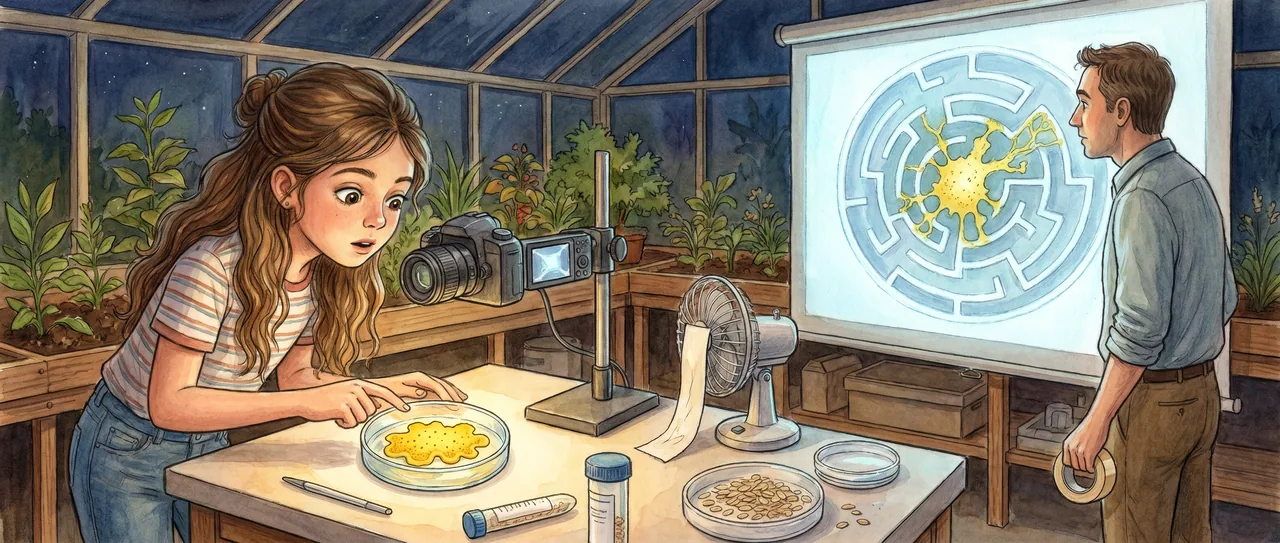
The coordinator had one hand full of tangled charging cords and the other hand holding a clear plastic dish like it had personally disappointed him. Inside the dish, something yellow spread through a flat maze. It was not quite a plant, not quite a fungus, not quite anything Maya had a shelf for in her head. It looked like spilled egg yolk that had learned to branch.
The sign beside the table said: A BRAINLESS BLOB SOLVES A MAZE.
The coordinator turned the sign face down.
"Not tonight," he said. "It made a mess. The robot exhibit lost its map, the projector keeps skipping, and this thing chose every path. Could you carry those oat flakes to the back table? Carefully. They are the food."
Maya did not carry them yet.
The yellow thing had filled the maze overnight. It had reached into blind alleys, curled around corners, and touched both exits. But some paths were thick and bright. Others had faded into threads, then ghosts, then nothing.
"It didn't choose every path," Maya said.
The coordinator looked at the dish for less than one second.
"It is supposed to leave one clean answer. Shortest route. Easy to explain. Families like easy to explain."
He hurried away to argue with the projector, which was showing half of a beetle and half of a loading symbol.
Maya stayed with the dish.
The slime mold had no eyes. No face. No front that stayed the front. Its edges were scalloped and damp, and its veins pulsed faintly, as if the yellow inside kept changing its mind about where to go. On the table camera screen, the time-lapse made it faster. The maze filled like a tiny sunrise, then the dead ends drained.
At school, people liked answers that walked in a straight line. Maya's answers usually arrived like birds hitting a window. First there. Then the sound. Then everyone staring.
The slime mold had reached the answer by being everywhere wrong first.
That did not seem like a mess.
On the screen, the picture jumped.
Maya bent closer.
It jumped again.
Not a skip, exactly. The yellow edge slowed, tightened, then went on. The timestamp in the corner changed from nine twelve to nine thirteen.
She tapped the screen back.
Nine zero zero. The yellow sheet advanced.
Nine zero six. Still moving.
Nine eleven. Slower.
Nine twelve. Pinched.
Nine thirteen. Moving again.
From the other side of the greenhouse, the coordinator called, "If the video freezes, ignore it. The air system blew dry air across the dishes every twelve minutes. Bad planning. I told maintenance."
Every twelve minutes.
Maya looked above the table. A small fan sat clipped to a shelf, aimed at the dish row. A strip of paper tied to the cage fluttered whenever the fan came on. The slime mold had been getting a puff of dry air on a rhythm. It did not like dry air. That part made sense.
Maya rewound the time-lapse farther.
Eight forty-eight. The fan strip snapped sideways. The slime mold slowed.
Nine zero zero. The strip snapped sideways. The slime mold slowed.
Nine twelve. The strip snapped sideways. The slime mold slowed.
Then at nine twenty-four, the strip did not move.
The slime mold slowed anyway.
Maya stopped breathing for a moment, which was inconvenient because the greenhouse smelled like wet leaves and warm soil and she wanted all of it.
She checked again.
Nine twenty-three. The yellow edge was moving.
Nine twenty-four. The fan was still. The paper strip hung limp. The yellow edge pinched back as if dry air had crossed it.
No brain. No nerves. No little clock with a bell inside. Still, after the rhythm, the body paused for the missing beat.
The greenhouse grew wider without moving.
Rows of seedlings stood under purple lights. Water clicked through tubes. The maze dish sat on a table between a broken projector and a bowl of oats,
The coordinator came back, carrying a roll of tape in his teeth.
Maya pointed at the screen. "Don't cut the skips."
He took the tape out of his mouth. "They are ugly."
"They are the best part."
"The best part is the maze. People understand mazes."
"It pauses when the fan blows. Then it pauses when the fan doesn't blow."
The coordinator opened his mouth, closed it, and looked at the timestamp. He watched through one cycle. Then another. His eyebrows moved in two different directions, which Maya appreciated.
"That cannot be the same dish," he said.
Maya did not answer. She pulled the fan plug from the timer and held up the loose end.
The coordinator stared at it.
"The public comes in eighteen minutes," he said.
That was not no.
Maya moved fast.
The maze sign stayed face down. She found a blank card and wrote large enough for people standing behind other people: NO BRAIN. NO NERVES. WATCH THE PAUSE.
She placed three clean dishes under the camera. In the first, the time-lapse maze played on a loop, filling, branching, thinning, leaving the bright route between the oat flakes. In the second, a printed map of nearby streets lay under the clear dish. Oat flakes marked the train station, the hospital, the library, and the river bridge. The yellow slime mold had grown through it since morning, thick between some oats and thin between others, a living map that did not care about street names.
In the third dish, the slime mold sat near the edge of its agar, glossy and patient. The fan faced it. Maya plugged the fan back into the timer and set it for short puffs. She could not make hours happen in minutes, but she could show the old video and the live body together. One memory on the screen. One pulse on the table.
The coordinator fussed with the projector until the beetle disappeared. He put up the time-lapse large on the greenhouse wall. Families drifted in, damp from the evening rain. Small kids pressed noses to the glass. Adults read the card, then looked for another card with the proper explanation.
There wasn't one.
The first puff came. The paper strip snapped sideways. On the big screen, past slime mold pinched at its edge. In the live dish, the yellow front held still against the dry air.
People made the soft sound people make when something small does something on purpose, even if it is not purpose.
Maya put one oat flake at the far end of the live dish.
The second puff came. The slime mold slowed.
A little boy asked, "Where is its brain?"
The coordinator, who had been ready to talk about efficient networks, looked at Maya.
Maya said, "There isn't one place."
The boy frowned at the dish. "Then what is doing it?"
Maya watched the yellow veins pulse. Thick, thin. Thick, thin. Food here. Dry there. A path kept. A path abandoned. A pause arriving before the air.
"All of it," she said.
The room grew quiet enough for the water tubes to click.
On the wall, the time-lapse reached the missing puff. The paper strip in the recorded image did not move. The yellow edge folded back anyway.
Someone whispered, "It remembered."
The coordinator did not correct them. He stood with the tape still around his wrist, watching the wall as if the answer had escaped its label.
Maya lifted the maze sign and turned it over. A BRAINLESS BLOB SOLVES A MAZE looked too small now, but she did not throw it away. The maze had happened. The routes had happened. The pause had happened. Small truths did not stop being true when bigger ones arrived.
The live fan clicked off. The timer light went dark.
Maya waited.
The paper strip hung straight down.
Under the camera, the yellow edge gathered itself, tightened, and held.
Maya set one oat flake on the empty glass beyond the printed city. The yellow vein at the border thickened, bead by bead, toward the white speck.
Read the interactive version, listen to the narration, and earn a gold star →
A science-verified short story for curious kids · Curiosity Land