The First Missing Frog
The rainforest room had no windows, only speakers.
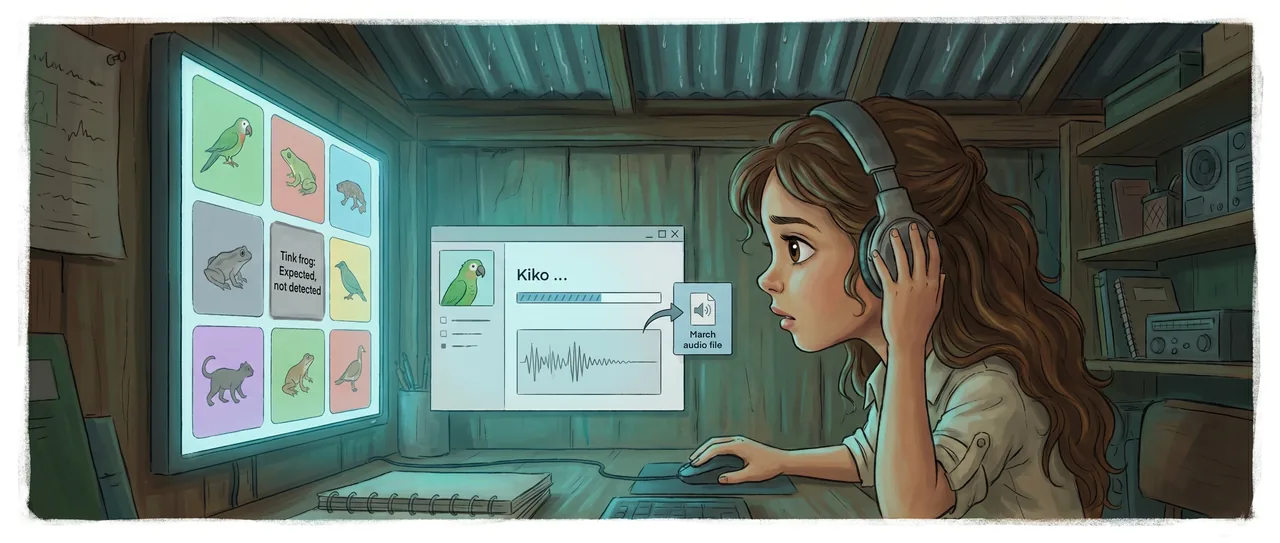
Maya sat in the coolest corner of the field station with headphones over her ears and rain tapping the tin roof above her. The sound in the headphones was also rain, but older rain, rain from March, rain caught by a black recorder strapped to a tree three valleys away.
On the wall, a screen filled itself with colored tiles.
Howler monkey. Known.
Cicada. Known.
Tink frog. Expected, not detected.
The last tile was gray.
Maya took off one side of the headphones. “Dr. Vale?”
Dr. Vale was kneeling beside a cardboard box of clean cables, sorting them with the speed of someone already late. She had a pencil stuck through her hair and a smudge of mud on one cheek.
“Use the green tiles,” Dr. Vale said. “The sponsors like animals they can hear. Monkeys are excellent. Parrots if you can find them. Frogs are charming.”
“This frog is gray.”
“Then choose April. April is louder.”
Maya put the headphone back. April was louder. April was full of tiny bright tinks, like someone tapping a spoon on the rim of a glass from inside every leaf.
The screen bloomed.
Tink frog. Detected.
Tink frog. Detected.
Tink frog. Detected.
Maya switched back to March.
Rain. Insects. One distant bird with a rusty hinge voice. No spoon on glass.
The gray tile stayed gray.
Kiko, the station’s listening companion, was not shaped like a robot. It was a small program with a parrot icon and a very patient progress bar. Dr. Vale had trained it on thousands of labeled calls, clipped by researchers until each species had a sound fingerprint. Kiko could sort through nights that no person would ever have time to hear.
Maya did not like the gray tile. Not because it was wrong. Because it looked too quiet to be important.
She opened the March folder.
There were too many files for a folder. There were days folded inside hours folded inside minutes, every one named with a date, a time, and the number of the recorder that had made it. The array had been listening for years, through storms and dry afternoons and moths bumping the microphone covers. Millions of hours, Dr. Vale had said, with the same voice people used for stars.
Maya dragged one March file into the test window.
Kiko listened.
Expected, not detected.
She dragged another.
Expected, not detected.
Another.
Expected, not detected.
The gray squares lined up like missing teeth.
“Maya,” Dr. Vale said, “if you are making the open-day soundscape, you need animals. People do not donate to silence.”
“It is not silence,” Maya said.
She turned up the volume.
The room filled with rain hitting leaves, a low insect buzz, and the tiny crackle of water moving in the dark. Dr. Vale stopped winding a cable.
“The recorder worked,” Maya said.
“Yes. But absence is slippery. Maybe Kiko missed it. Maybe the rain covered the calls.”
“April has rain.”
“April has everything,” Dr. Vale said. “April is showing off.”
Maya clicked April. The speaker scattered tinks across the room.
She clicked March. Rain and insects, no tinks.
“Why March but not April?” Maya asked.
Dr. Vale’s hand paused over the cables. Then the station radio crackled from the hall, and someone called her name twice.
“I have a meeting with people wearing clean shoes,” Dr. Vale said. “If you can prove it is not a model mistake, I will look. Do not break the archive.”
She hurried out carrying the wrong box of cables.
Maya smiled at the door. Then she stopped smiling, because proving something was missing was harder than finding something that was there.
She began with the recorder itself.
Battery level, good. Microphone test chirp, present. Time stamps, steady. Rain level, not extreme. Other frogs, detected. Insects, detected. One nightjar, detected and very proud of itself.
The recorder had not gone deaf.
She began with Kiko next.
Kiko might have learned the wrong thing. Maya took an April tink frog call, a bright clean one, and mixed it quietly into a March recording. Not loudly. Not enough to cheat. Just enough that the call was really there, tucked under the same rain and insects.
Kiko listened.
Tink frog. Detected.
Maya lowered the call and tried again.
Detected.
Lower.
Detected, uncertain.
Lower.
Not detected.
Maya sat very still. Kiko could hear the frog in March rain if the frog was there.
She did not write that down. The inside of her head made a place for it.
She opened the map.
Recorder twelve was beside Quebrada Sombra, a narrow stream under tall trees. Recorder nine was over the ridge. Recorder fifteen was near the old footbridge. In March, recorder nine had tink frogs. Recorder fifteen had tink frogs. Recorder twelve had none.
In April, all three had them.
Maya pulled up the old months. Last March, recorder twelve had tink frogs. The March before that, tink frogs. The March before that, so many tinks that the screen looked sprinkled with sparks.
This March, gray.
The room seemed to grow around her. Not bigger in walls. Bigger in listening. Every recorder on the map was an ear. Every hour was a thin slice of dark.
Kiko was still running. The parrot icon blinked as if it had all night.
Maya clicked the April human survey sheet. The field team had walked Quebrada Sombra in boots, with headlamps and clipboards, and marked the tink frog present.
Present.
They had been right.
They had also been too late to hear March.
Maya found Dr. Vale on the station porch talking to three people in clean shoes. One of them was pointing at a laminated graph upside down.
Maya waited exactly four seconds.
“Recorder twelve was not broken,” she said.
Dr. Vale closed her eyes briefly. “Hello, Maya.”
“Kiko was not broken. Rain did not hide the calls. Nearby recorders heard them. Older Marches heard them. April heard them. Only Quebrada Sombra, only this March, did not.”
The clean-shoe people looked at one another.
Dr. Vale took the tablet from Maya. Her pencil slid out of her hair and dropped onto the porch.
“There was an April survey,” Dr. Vale said.
“It says present.”
“So if we only had boots, we would never ask.”
Maya pointed to the gray row. “We have ears that stayed.”
The porch went quiet except for the live rainforest, which was never quiet at all.
One clean-shoe person said, “Is it bad?”
Maya looked at the map. Stream. Ridge. Bridge. A little triangle of listening places, and one of them holding out a month-shaped gap.
“It is a question,” she said.
Dr. Vale crouched on the porch boards, no longer looking late. “We have four old recorders in storage. Cracked straps. Fussy batteries. If someone tests them, we can put them around Quebrada Sombra before next March.”
“I can test them,” Maya said.
“The batteries are fussy.”
“I am fussier.”
Dr. Vale laughed once. “Yes. You are.”
For the rest of the afternoon, the sponsor soundscape waited unfinished. Maya cleaned microphone covers with cotton swabs. She charged batteries, rejected two that sagged too quickly, and set each recorder to wake before dusk and listen through the wet hours. She clapped beside each one and watched the little waveform jump. She whispered near one and saw the line shiver.
In the storage room, the old recorders had looked like forgotten black lunch boxes. By sunset, they looked like small sleeping animals with straps.
Weeks later, the trail to Quebrada Sombra smelled of wet wood and crushed leaves. Dr. Vale walked ahead carrying two recorders, muttering at a strap that kept catching on her sleeve. Maya carried the smallest one against her ribs.
At the stream, no frog called. It was not March yet. The leaves dripped anyway.
Maya crouched beside the wet buttress root and buckled the old recorder to the trunk. The green light blinked once, then the forest filled the little black microphone with rain.
Read the interactive version, listen to the narration, and earn a gold star →
A science-verified short story for curious kids · Curiosity Land