The Box for No Question
The prediction card had two boxes.
Left slit.
Right slit.
Soren held the pencil above them until the point made a gray dent in the paper.
Dr. Vale leaned over the table with a roll of tape stuck around her wrist. She had silver hair cut crookedly, as if she trimmed it while thinking about something else. Her name tag was upside down.
“Pick one,” she said. “We’re trying to keep the line moving.”
Behind her, the machine sat inside a glass case on rubber feet. It did not look like a doorway into the strangest part of the universe. It looked like a microwave that had learned to be secretive. A small sign said: Single electrons. Two slits. Watch what builds.
Soren did not check either box.
“What if the answer is not one of those?” he asked.
Dr. Vale smiled too quickly. “That’s why this one is famous. But the card is for the audience guess. Left or right.”
Soren wrote, in the blank space under the boxes, Not asked yet.
Dr. Vale saw it and made a sound like a laugh that had run into a wall.
“All right,” she said. “Stand there. Don’t block the screen.”
The lights dimmed. A black monitor above the glass case showed a rectangle of faint green darkness. On the left side was a drawing of two narrow slits. On the right was the place where the electrons would land.
“They come one at a time,” Dr. Vale told the room. “The source is turned down so low that each electron reaches the detector before the next one is sent.”
Soren looked at the counter. One. Pause. Two. Pause. Three.
Each electron made one dot.
That part was ordinary enough to be disappointing. A dot was a dot. A thing arrived in one place. Soren wrote the numbers in his paper notebook because the inside of his head felt too crowded when a machine counted quietly.
At first the dots seemed random. Then the screen began to gather them into pale stripes. Bright, dark, bright, dark, bright. Not two fat smears behind the two slits. Stripes, like a comb made out of arrivals.
A boy near the front said, “Is it broken?”
“No,” Dr. Vale said, and her voice became proud. “That is the interference pattern.”
Soren stared at the dark stripes where almost no dots landed. If electrons were tiny beads, each one should have chosen a slit and struck wherever beads could strike. But the empty places were too neat. They looked arranged by something that was not touching the screen.
He drew two slits, then a dotted fan from each one. The fans crossed. Where crossing roads met, the screen grew bright. Where they canceled, it stayed dark.
One electron at a time.
No other electron in the case to bump into.
The next dot appeared in a bright stripe far from the center.
Soren’s pencil stopped moving.
The glass case was suddenly not a box around a machine. It was a piece of the room where the usual rules had become too small. Between the two slits and the screen, something that arrived as one dot had traveled like a pattern with room inside it.
Dr. Vale clapped once. “Now the fun part. We turn on the which-slit detectors.”
She reached for a blue switch on the control panel.
“Wait,” Soren said.
Dr. Vale’s hand paused, but only a little. “We have six minutes before the robotics club needs this projector.”
“If you turn that on, what exactly changes?”
“We detect which slit the electron goes through.”
“With light?”
“With a very gentle detector,” she said. “Not eyes. Measurement. The apparatus gets information.”
“Then it’s not the same experiment.”
“It’s the same electron gun, same slits, same screen.”
Soren looked at the two boxes on the card. Left. Right.
“That is not the same question,” he said.
Dr. Vale lowered her hand. The people in line shuffled. Someone coughed.
Soren felt heat in his face. He was used to that part. Questions had a way of making rooms notice him. At school, when the teacher asked for the answer and Soren asked whether the question meant on Earth or anywhere, people turned around in their chairs.
But the screen still held its stripes. The machine had left dark spaces because nobody had forced the electron to say left or right.
“Can I try three runs?” he asked.
Dr. Vale looked toward the robotics club, where a man in a bee costume was unpacking a wheeled robot. She looked back at Soren’s card.
“Two minutes each,” she said. “You touch only the labeled switches.”
Soren nodded.
For the first run, he left the which-slit detector off. He pressed Reset. The screen went black. He pressed Fire.
Dots appeared slowly, one by one. At twenty, they were a mess. At a hundred, they leaned into rows. At five hundred, the stripes returned.
“Run one,” Soren said. “No path question.”
A little girl beside him whispered, “No what?”
Soren did not answer yet.
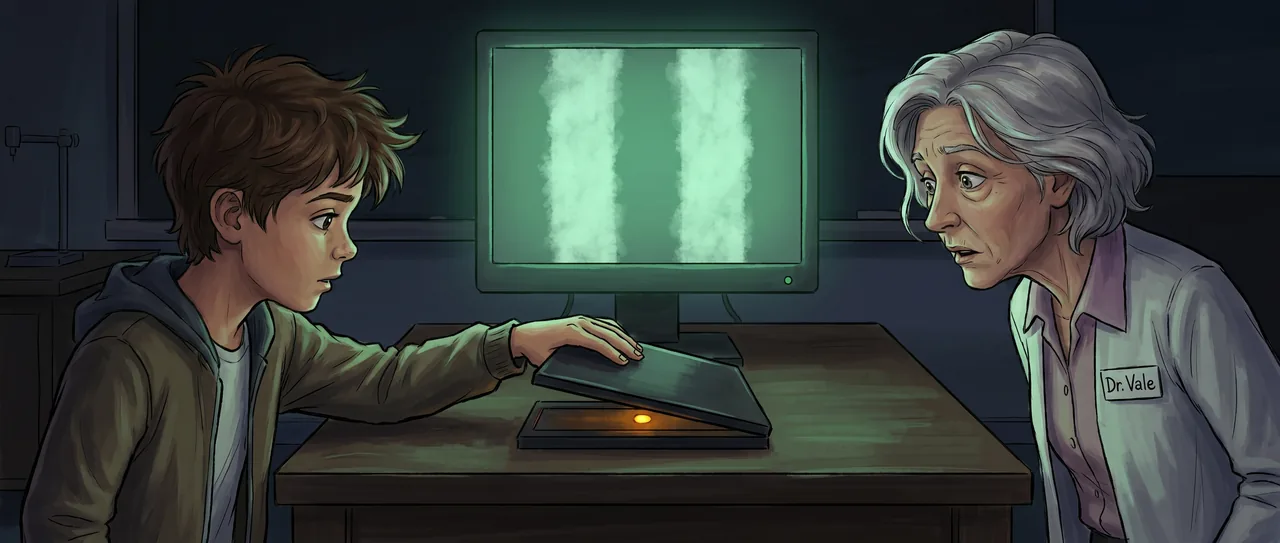
For the second run, he turned the which-slit detector on. A small amber light glowed beside the words Path recorded. He pressed Reset, then Fire.
Dots appeared. One by one again. Same counter. Same patient pauses.
But this time the screen did not grow a comb. It grew two broad cloudy bands, one behind each slit. The dark stripes filled in. Places that had been forbidden were no longer forbidden.
The little girl said, “It stopped waving.”
Soren liked her immediately.
Dr. Vale folded her arms. She was watching the screen now, not the line.
“For the third run,” Soren said, “can we hide the path display but leave the detector on?”
Dr. Vale’s eyebrows lifted. “Why?”
“Because if it is about a person seeing, hiding it should bring the stripes back. If it is about the machine getting the path, it should not.”
Dr. Vale was still for one second. Then she reached under the table and took out a square of black plastic.
“We can cover the readout,” she said. “The detector will still record.”
Soren placed the plastic over the small path display himself. The amber light remained on.
He pressed Reset.
He pressed Fire.
Dots gathered.
No comb appeared.
Only the two cloudy bands, soft and stubborn.
The room had gone quiet in a way Soren had never heard at a science fair. Usually quiet meant boredom or a teacher about to speak. This quiet had edges.
The little girl looked from the covered readout to the screen.
“So it doesn’t care if we know?” she asked.
“It cares if the world can know,” Soren said.
Dr. Vale took the upside-down name tag off her shirt and turned it right side up without looking at it.
“That is a dangerous sentence,” she said.
Soren waited.
She smiled, not quickly this time. “A good dangerous.”
On the prediction table, the stack of cards still had only two boxes. Left slit. Right slit.
Soren took one clean card and drew a third box beneath them. He did not label it Both. That felt too easy, like pretending the electron was two tiny beads instead of one stranger thing.
He labeled the third box: No path measured.
Then he crossed out his own words. The pencil made a dark scar through them.
He wrote: Different question.
Dr. Vale read it. “That will annoy people.”
Soren handed her the card. “Good.”
She taped it to the table beside the others.
The robotics club’s projector beeped. The bee-costumed man said, “We’re ready when you are.”
“In a minute,” Dr. Vale said.
Soren looked once more through the glass. The slits were too small to see from where he stood, hidden inside metal and vacuum and careful wires. The electron gun waited at one end. The screen waited at the other. Between them was a space that could make stripes if nobody demanded a path.
Dr. Vale switched the detector off and nodded to him.
Soren pressed Fire.
The counter clicked once, and a single green dot appeared on the black screen.
Read the interactive version, listen to the narration, and earn a gold star →
A science-verified short story for curious kids · Curiosity Land