The Beagle in the X-Ray
The first lung image lit up because a beagle had once been on the screen.
Maya did not believe it at first.
The hospital education lab smelled like warm plastic, floor polish, and the cinnamon gum the radiology fellow kept chewing because she had not eaten lunch. On the wall, a sign said: These images are anonymized teaching examples. Computers here do not diagnose patients.
The fellow slapped a visitor badge onto Maya’s shirt without looking away from the tablet under her arm.
"Open house starts in twelve minutes," she said. "If the model finishes training, families get to see how a computer can learn patterns in medical pictures. If it does not, families get to see me sweat through my coat. Please do not press the red button. Or the blue one, unless the red one is already a disaster."
Maya looked at the table.
There was a clear plastic lung model. There was a stack of gray chest images, printed on shiny film. There was a monitor showing two large buttons.
Start Empty.
Start From CatsAndDogs.model.
Maya pointed. "Why are there pets?"
The fellow made a noise like the gum had attacked her. "Wrong file. Last week, this computer sorted shelter photos for a coding club. Cats, dogs. Fur, ears, noses. Nothing useful for lungs. Start empty. Clean brain. Very respectable."
She tapped Start Empty, then hurried to the doorway as someone called for her from the hall.
"If it asks anything," she said, "choose the boring answer. Science likes boring answers when guests are watching."
Maya did not answer because the screen was already doing something not boring.
Rows of tiny gray images slid past. The model guessed which teaching pictures belonged in one folder and which belonged in another. The first round went badly. The second round went better. By the fifth round, a green bar climbed high.
Then the test pictures appeared.
Wrong. Wrong. Right. Wrong. Right.
The green bar sank like a spoon in soup.
Maya leaned closer. The training pictures had small letters in the corners. Some had a white L. Some had a white R. Some had numbers from the old scanner. On the heat map, the computer’s attention glowed in those corners, not in the cloudy patches inside the lungs.
"That’s cheating," Maya said.
The computer did not look embarrassed.
She dragged the crop box inward until the letters vanished. She trained it again. The green bar climbed more slowly. The test pictures still wobbled.
The fellow rushed back in, coat sleeve caught on the door handle.
"Did it work?"
"It memorized corner letters," Maya said.
"Of course it did," the fellow said, tugging herself free. "Tiny data set. Sneaky machine. I hate open house day. Try again, maybe fewer training rounds. Do not touch the pet file. We are not telling parents a beagle is reading X-rays."
She disappeared again.
Maya stared at the other button.
CatsAndDogs.model.
It was obviously wrong. Lungs had no whiskers. No tails. No paws. No little triangle ears with sunlight through them.
Wrong things bothered Maya less when they stayed wrong. This one sat on the screen like a loose tile.
She did not press the button.
First she opened the model viewer.
The screen filled with little squares. Not cats. Not dogs. Just scratchy patterns. A bright line beside a dark line. A curve like the rim of a cup. A spray of speckles. A soft shadow that faded at one edge. A corner. Another corner turned sideways. Stripes so thin they looked like rain.
Maya held up her hand in front of the small camera. The squares flashed along her knuckles, her fingernails, the crease where her thumb bent, the fuzzy edge of her sleeve.
She lifted one of the chest images.
The same squares flashed along ribs, vessel branches, the pale border of the heart, the misty places where gray became slightly less gray.
The pictures had no cats in them. They had edges.
Maya pressed Start From CatsAndDogs.model.
A warning popped up: Reuse early layers?
Under it were two checkboxes.
Keep early layers fixed.
Retrain all layers.
Maya thought of the little squares finding ribs with the same hunger they had used on whiskers. She checked Keep early layers fixed.
The computer began.
It did not learn like the empty model. It did not flail toward the corner letters. It started as if someone had already taught it how light touches an object. The green bar moved, hesitated, then moved again.
The test pictures appeared.
Right. Right. Wrong. Right. Right.
Still not perfect. Better.
Maya cropped the images tighter. She mixed the order. She made a new test folder from pictures the model had not seen. The pet-start model missed some. The empty-start model missed more.
The fellow came back with three families behind her and a paper cup of coffee balanced against her tablet.
"Please tell me we have a demonstration," she said.
Maya pointed to the two bars on the screen.
The fellow read the labels. Her eyebrows moved up, then down, then up again.
"You used the shelter model."
"Only the bottom part," Maya said.
"The early layers," the fellow said.
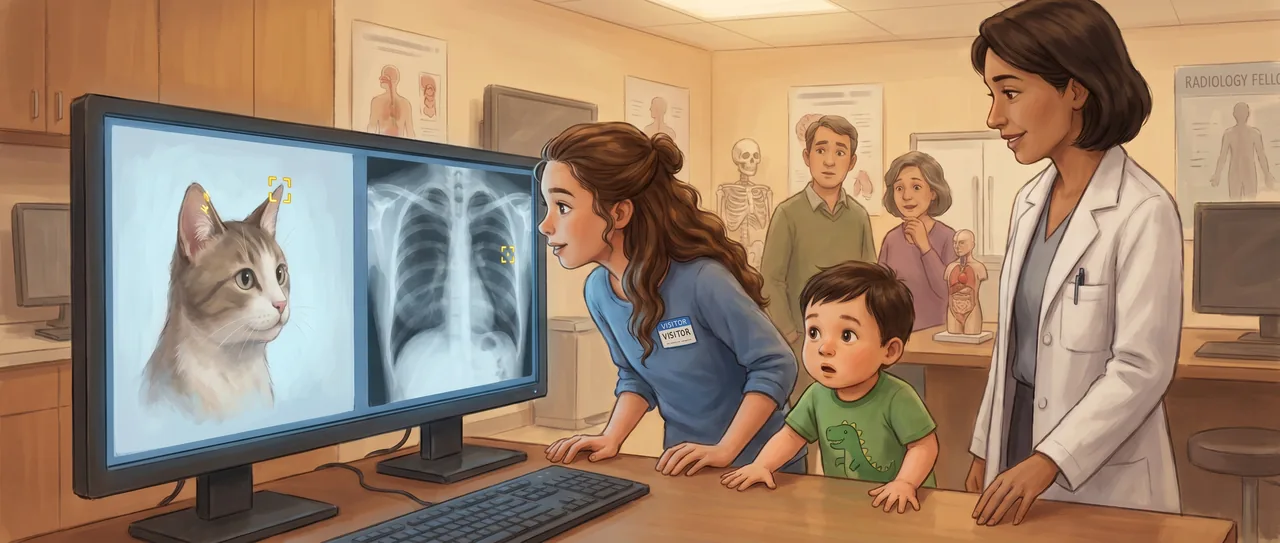
Maya turned the monitor so the families could see the little flashing squares. A small child in a dinosaur shirt pressed both hands to the table.
"Where is the dog?" the child asked.
"Not there," Maya said.
She put a cat photo on the left side of the screen and a chest image on the right. The same tiny square blinked on the cat’s ear and along a rib. Another blinked on the dog’s nose and the round edge of the heart. Another found the stripes in tabby fur and the faint ladder of ribs.
The room grew quieter than a room with five children should be.
The fellow set down her coffee without drinking it.
"It was never only learning pets," she said, mostly to the screen.
Maya did not say anything. She was watching the flashing squares.
On the monitor, wandering off had become a way in.
The fellow recovered first. She became louder, the way adults do when wonder almost catches them off guard.
"This is called transfer learning," she told the families. "When there is not much medical training data for a demonstration, a model that learned general visual features from ordinary pictures can sometimes help. Doctors still decide. Computers assist. And no dogs are employed by radiology."
The families laughed.
Maya did not.
She clicked open the folder list.
There were other old models on the computer. LeavesAndStems.model. CloudsAndStorms.model. CoralReef.model. StreetSigns.model. ButterflyWings.model.
Beside them was an empty practice set labeled Microscope Cells.
The fellow saw where Maya was looking.
"Open house starts now," she said. "We should probably not rebuild the universe in front of everyone."
Maya looked at the lung image, then at the pet model’s little squares still blinking along the ribs.
"Maybe just a corner of it," she said.
On the screen, empty boxes waited beside labels: leaves, skin, coral, clouds, cells. Maya put both hands on the table, leaned close, and dragged the folder named Leaves toward the blank square.
Read the interactive version, listen to the narration, and earn a gold star →
A science-verified short story for curious kids · Curiosity Land