Room for the Galaxy
The galaxy was supposed to begin at nine.
That was what the ranger said, standing beside the observatory dome with a red flashlight hanging from her wrist. She had a voice like she was used to wind stealing the ends of her sentences.
“Give your eyes time,” she said. “No white lights. No phones. The Milky Way is faint.”
Maya already knew the fact everyone kept repeating on the bus. One third of all people could not see the Milky Way from where they lived. Not because it was gone. Because their cities had made the night too bright.
She had liked the fact better when it was only a fact.
From the city, the night was orange at the edges and gray overhead. Maya had seen three stars from her apartment balcony, sometimes four if the air was clean and the neighbor’s kitchen light was off. She had never seen the galaxy she lived inside.
Now she stood in the desert with dust in her socks, a rented sleeping bag under one arm, and the whole reason for the trip missing from the sky.
Above the observatory, the stars were sharper than city stars. There were many of them. But there was no white river, no glowing path, no spilled milk, no anything that looked large enough to be home.
“It’s not dark,” Maya said.
The ranger checked the sky. “It is dark. No Moon tonight.”
Maya did not answer. The ranger was looking up. Maya looked sideways.
A row of new solar lamps lined the path from the cabins to the bathrooms. They were small, polite lamps, the kind adults liked because they did not look like they were doing harm. Each one made a white puddle on the ground. The puddles joined into a necklace.
At the far end of the parking lot, a security light buzzed over the equipment shed. It shone sideways into the dust, and the dust shone back.
The observatory dome was beautiful. The desert was beautiful. The sky was almost beautiful.
Almost was the part that bothered Maya.
The ranger clapped once. “All right. Telescope first. We’ll look at Saturn while your eyes adjust.”
Everyone moved toward the dome.
Maya stayed where she was.
A telescope was wrong for this. Saturn could fit in a telescope. The Milky Way could not. You did not look at a house by pressing your eye to a keyhole.
Her mother turned back. “Maya?”
“Go,” Maya said. “I’m checking the dark.”
Her mother hesitated. She was tired from driving the last part after the bus broke its air conditioner. She wanted the evening to work. Maya could see it in the tight way she held the water bottles.
“Stay where I can see you,” her mother said.
“I will.”
Maya walked to the first solar lamp and crouched. The top was a little black hat. The glowing part was below it, but not low enough. From where Maya crouched, she could see the bright square directly. It pushed itself into her eyes.
She stood and moved back until the lamp hid behind a barrel cactus.
The stars improved.
Not by much. Enough.
Maya moved again. The lamp came back. The sky flattened.
She made a line in the dust with her shoe.
Then another.
By the time the first group came out of the dome, she had drawn a crooked path that did not follow the real path at all. It went behind the water tank, around the shadow of the shed, past a clump of creosote bushes, and stopped at a shallow wash where the ground dipped just enough to hide the bathroom lamps.
A boy from the bus pointed at the dust. “Is that a maze?”
“No,” Maya said. “A place where lights can’t get in your eyes.”
“You’re allowed to make those?” he asked.
“I already did.”
He looked at the sky. “I thought we’d see it by now.”
“So did I.”
“My grandma said she saw it when she was little,” he said. “I thought maybe I wasn’t looking right.”
Maya turned toward him fast. “No. The city is looking wrong for you.”
He blinked.
Maya pointed at the lamps. “The light goes up, and sideways, and into the air. The air scatters it. Then the sky glows. The faint stuff loses.”
“The faint stuff loses,” he repeated, and he said it like he knew about faint things.
More kids came over. Some were disappointed by Saturn because it had looked exactly like Saturn, which made no sense and perfect sense at the same time. One girl still had her phone glowing blue in her palm.
Maya held out her hand. “Screen against your shirt if you need it. Or turn it off.”
The girl pressed the phone to her stomach. Her face vanished.
The ranger came last, smelling faintly of metal and dust. “What’s happening here?”
“We’re moving the dark,” Maya said.
The ranger opened her mouth, then looked at the path scratched in the dust. She looked at the lamps. She looked back at Maya.
“The wash has uneven ground,” she said.
“We can go slowly. No running. No white lights. Red one low.”
The ranger’s red flashlight swung at her wrist.
“I put those solar lamps in this spring,” the ranger said. “People complained they couldn’t find the bathrooms.”
“They can keep the bathrooms,” Maya said. “We only need the galaxy.”
The ranger rubbed her forehead. She looked very much like an adult trying to choose between safety forms and the universe.
“Stay together,” she said. “If anyone steps on a cactus, I am telling the cactus it was your idea.”
Maya led them along the crooked line.
At the water tank, the first lamps disappeared behind metal. At the shed, the security light still reached them, so Maya made everyone stop.
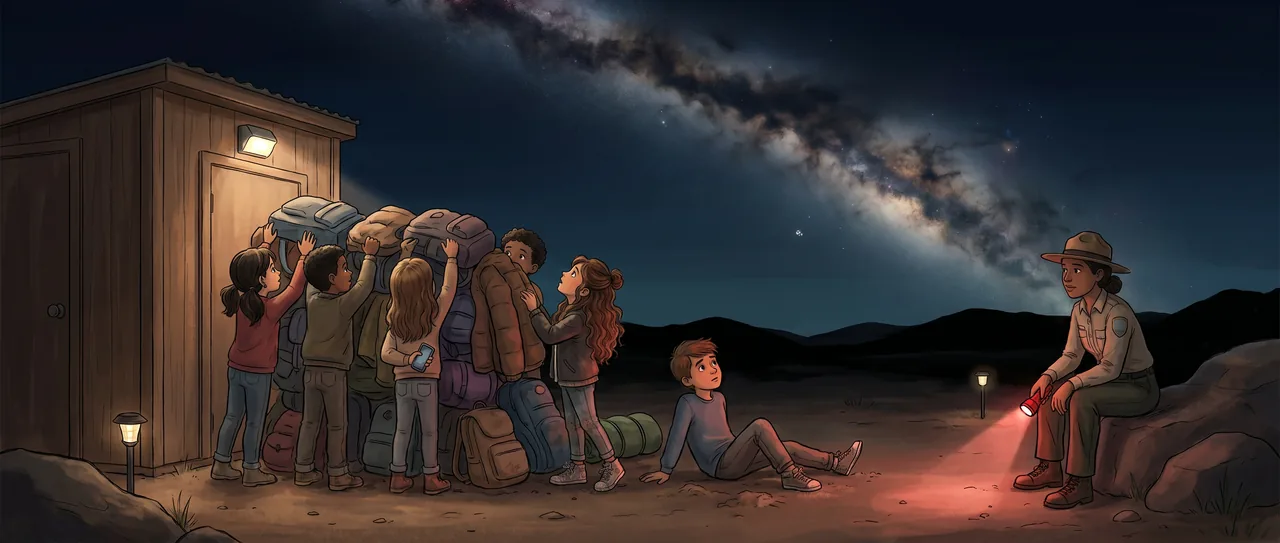
“Backpacks,” she said.
“What?” said the boy.
“Hold them up.”
They made a lumpy wall of backpacks and jackets at the edge of the shed shadow. It did not block the whole light. It blocked the part that stabbed straight into their eyes.
The ranger did not help. She stood with her red flashlight pointed at her own boots and watched the children build a small, ridiculous eclipse.
Maya stepped behind it.
The sky changed.
Not all at once. It did not burst open. It deepened, like a bowl filling with ink.
“Wait,” Maya said.
Nobody liked waiting at first. Shoes scuffed. Someone whispered that they could not see anything. Someone else whispered that this was creepy. The ranger whispered that eyes had rods in them, and rods took time, and Maya almost said she knew, but she did not want any more words in the dark.
Slowly, the ground returned. First as gray. Then as stones. Then as pale twigs and the thin shadows of people’s legs.
A star appeared where Maya had been sure there was no star.
Then another beside it.
Then the space between the stars stopped being empty.
Maya forgot to count.
A pale band rose from behind the low black hills. It was not a cloud. It did not move like a cloud or shine like one. It was too still and too crowded. It crossed the sky in a torn, uneven stream, bright in some places, darkly split in others, as if night had seams.
No one said, “There it is.”
They did not need to.
The boy beside Maya sat down hard in the dust.
The girl with the phone pressed both hands over her mouth.
Maya tipped her head back until her neck hurt. The bright part was not above her the way a ceiling was above her. It was around. The hills, the shed, the backpacks, the children, the ranger, her own dusty shoes, all of it sat inside that pale, ragged crossing.
The ranger lowered herself onto a rock.
“My grandmother used to say it looked like smoke,” she said quietly. “I forgot she said that.”
Maya did not look away. “It has dark parts.”
“Dust,” the ranger said. “Great lanes of it, between us and the stars.”
Maya lifted one hand and covered a dark split with her thumb. Her thumb was very small. The dark split was still there around it.
For a while, nobody asked for the telescope.
Later, when the cold came up from the ground, they walked back differently. The path lamps seemed louder. The bathroom light looked enormous and silly, pouring brightness onto a door that was already easy to find.
On the ride home before dawn, the city appeared as an orange dome beyond the highway. It looked almost solid, like a second sunrise that had forgotten to move.
Maya’s mother drove with both hands on the wheel. “You were quiet back there.”
Maya watched the orange dome swallow the last desert stars one by one.
“Do balcony lights need to shine up?” she asked.
Her mother glanced at her, then at the road. “No.”
“Do hallway lights?”
“No.”
“Billboards?”
Her mother smiled a tired smile. “That may be a larger meeting.”
“Good,” Maya said.
At home, the apartment balcony smelled like warm concrete and laundry soap. The neighbor’s kitchen was already bright. Their own balcony lamp buzzed above Maya’s head, spilling light onto the wall, the railing, the ceiling, the air.
Maya dragged a chair under it. She climbed up with a piece of cardboard from the recycling bin and a strip of tape between her teeth.
Maya slid the cardboard shade over the balcony lamp, and the square of ceiling above it went dark.
Read the interactive version, listen to the narration, and earn a gold star →
A science-verified short story for curious kids · Curiosity Land