Not the Reference
By noon, the wall had accused everyone.
That was how Soren would have written it, if he had written it down. He did not, because Dr. Imani had given him cotton gloves and said, “Please do not touch the glass unless the gloves are on,” which made holding a pencil impossible.
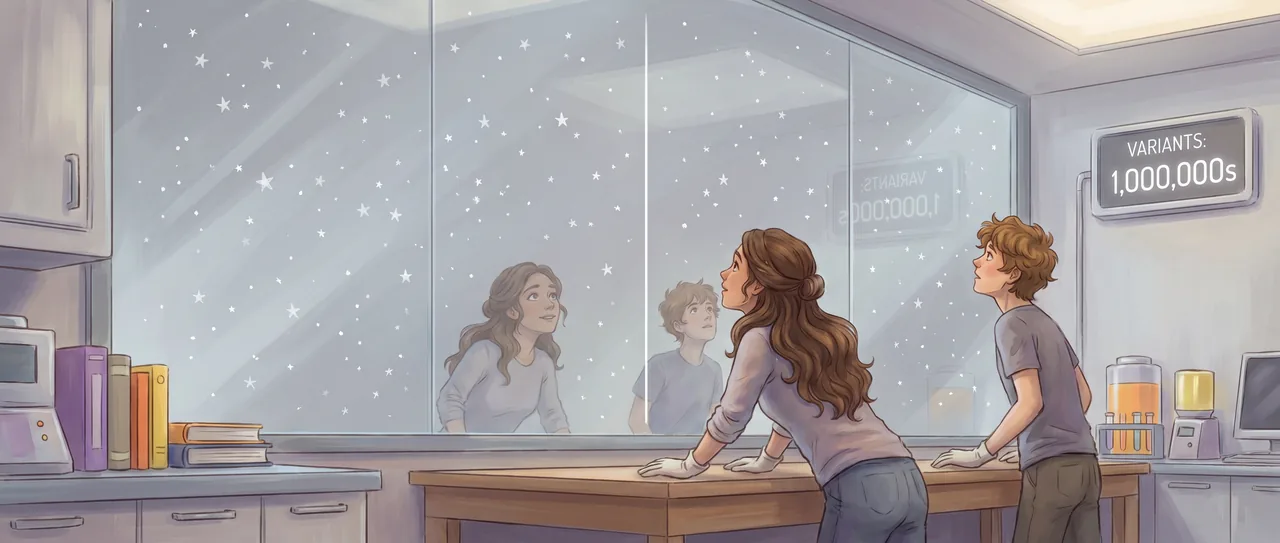
The glass wall filled one side of the community genomics lab. Behind it, tiny lights ran in four colors, blue, green, yellow, and red, in threads so fine they looked like rain blown sideways. Above the wall, a sign said, YOUR GENOME AND THE HUMAN REFERENCE.
Maya stood with her nose almost touching the glass.
“Too much red,” she said.
Dr. Imani was under a counter with half her braid caught on a drawer handle. “Red is visible from the back of the room,” she said. “We want drama.”
“It looks like danger,” Soren said.
“It is not danger. It is variation.” Dr. Imani backed out from under the counter holding a cable in her teeth. She took it out and pointed it at the wall. “You two are the last testers before the buses come. Pick a donor card. Scan it. Tell me if the buttons make sense. Do not delete anything. Do not panic. I have forty-seven minutes and one projector that believes it is a toaster.”
She vanished into the next room, where something immediately beeped in a disappointed way.
On the counter were plastic cards with names that were not names. Donor Alder. Donor Heron. Donor Kestrel. A label said the genomes came from public data and had been stripped of personal information.
Soren chose Kestrel because kestrels hovered without looking like they were working hard. Maya chose Heron because the card had a bent corner and she liked bent corners.
Soren scanned first.
The wall went dark. Then red lights burst across it.
Not a few. Not a line. Not even a cloud.
Red came everywhere, in sprays and freckles and long faint smears. A number climbed in the corner of the glass so quickly that Soren stopped breathing normally.
Four million, six hundred twelve thousand, nine hundred and eight.
Under it, the display said DIFFERENCES FROM REFERENCE.
Maya leaned closer.
“That is a terrible sentence,” she said.
Soren looked at the number again. “I know the reference is not a perfect person.”
“Do you?” Maya asked.
“I know it in the way where I can say it.”
“That is not always the same.”
Soren did not answer, because the red lights were still there, and they had the rude brightness of wrong answers on a test. He knew DNA had letters. He knew people were not identical. He knew a reference genome was a tool scientists used, assembled and improved from real human DNA, not a king everyone had to obey.
The wall still looked as if Donor Kestrel had failed being human in four million, six hundred twelve thousand, nine hundred and eight places.
Maya scanned Heron.
The number changed.
Four million, two hundred thirty-one thousand, five hundred and sixty.
The red pattern changed too. Some sparks stayed in the same regions. Some vanished. Others appeared as if the glass had taken a breath and become someone else.
Maya smiled, but only on one side.
“There,” she said.
“What?” Soren asked.
“It is not too much red. It is the wrong red.”
The buses were due at noon. A clock over the lab sink said eleven twenty-one.
Soren found the settings panel. It asked for a staff code.
Maya said, “Try the date.”
“That is what adults do when they think children are not paying attention,” Soren said.
He typed the date on the poster by the door, the opening day. The panel unlocked.
From the next room, Dr. Imani shouted, “If that is you, do not delete anything!”
“We are not deleting,” Maya shouted back.
“Then improve my life!”
The settings were not written for people who had buses coming. They were written for people who enjoyed folders inside folders.
Color map. Variant class. Single nucleotide variants. Insertions and deletions. Structural variants hidden in advanced mode. Clinical annotation. Population frequency. Unknown significance. No known effect.
Soren read the list twice.
Maya was already poking the air above the screen. “That one.”
“Which one?”
“No known effect.”
Soren tapped it.
A menu opened.
Show. Hide. Dim. Isolate.
Maya said, “Isolate.”
The wall blinked.
Nearly everything turned gray.
Not dull gray. Not dead gray. Silver gray, soft and uncountable, like rain seen in moonlight. Red shrank to a scattering. Blue and yellow remained in thin, cautious marks. Gray held the wall.
Soren took one step back.
The number stayed in the millions.
The label changed to VARIANTS WITH NO KNOWN EFFECT.
The room seemed to get deeper. The glass was still the same distance from his face, the ceiling still had the same square lights, but the person named Kestrel, who was not even in the building, had become mostly unanswered. Not broken. Not solved. Not even mysterious in a spooky way. Just carrying millions of places where science had looked and said, so far, we do not know that this changes anything.
Maya put both gloved hands against the counter, not the glass.
“That,” she said. “Start with that.”
Soren nodded. “If we start with red, everyone thinks the red is the story.”
“If we start with gray, the red has to behave.”
He found the opening sequence. It had been named DRAMA VERSION FINAL FINAL. Soren made a copy. Maya renamed the copy NOT A SCORE.
“That name is rude,” Soren said.
“It is accurate.”
They changed the first screen.
Soren typed: A reference genome is a map scientists compare with. It is not a perfect human.
Maya said, “Shorter.”
Soren deleted half of it.
He typed: The reference is a map, not a ruler for being human.
Maya watched the words appear on the glass.
“Keep that,” she said.
They made the wall begin dark. Then a single white thread appeared, the reference. Then Kestrel arrived around it, not as red sparks, but as gray stars. The number rose with the gray. Four million. Then more.
Only after the gray had filled the wall did the smaller colors appear, labeled carefully. Known effect. Studied association. Uncertain significance.
Soren made uncertain significance purple, because purple did not shout.
Maya changed red to orange.
“Red is for fire alarms and cafeteria ketchup,” she said.
At eleven forty-two, Dr. Imani came in carrying a projector lens in one hand and a sandwich in the other. She stopped chewing.
The wall was gray and silver, crossed by a white line that looked suddenly very thin.
“Oh,” she said.
Maya braced herself. Adults often made the same face right before they explained why the worse version had to stay.
Dr. Imani walked closer. She read the first line. She read it again.
“The reference is a map,” she said slowly, “not a ruler for being human.”
Soren removed his gloves and flexed his fingers. “We did not delete anything.”
“No,” Dr. Imani said. “You rearranged the room.”
“It was accusing everyone,” Maya said.
Dr. Imani looked at the wall, then at the clock, then at the half sandwich as if it belonged to someone else. “The mayor will want the dramatic version.”
“This is dramatic,” Soren said.
Maya scanned Heron again.
The wall breathed into a different gray sky.
Dr. Imani did not move.
From outside came the squeal of bus brakes.
Dr. Imani pressed the staff badge into Maya’s gloved hand. “Run your version,” she said. “If anyone asks hard questions, answer the ones you can and point to the gray for the rest.”
The first group came in smelling like cold air and gum. A boy in a blue jacket stopped under the sign and said, “Why is there so much gray?”
Soren looked at Maya.
Maya looked at the wall.
Soren said, “Because most of the ways this genome differs from the reference have no known effect.”
The boy squinted. “So they are not mistakes?”
Maya shook her head. “They are positions.”
Another kid asked, “Does everybody have that many?”
Soren scanned Alder. The number climbed past four million.
A quiet girl at the back, with one sleeve chewed ragged at the cuff, stepped forward until her reflection floated in the gray.
“So nobody matches the reference?” she asked.
“No,” Soren said.
She looked at the white line running through all that silver. “Then why is it called the reference?”
Maya grinned.
Dr. Imani, behind the group, opened her mouth.
Soren got there first.
“So we can find our way around,” he said.
The girl nodded once, as if that answer had a place to land.
The group spread along the glass. Hands lifted. Reflections overlapped. The wall kept changing as different donor cards passed under the scanner, millions and millions of gray positions, each pattern near enough to be human and different enough not to be anyone else.
Maya found a small button at the bottom of the screen that had not been in the main menu. FUTURE MODE, PANGENOME DISPLAY.
She looked at Soren.
Soren looked at Dr. Imani.
Dr. Imani was busy explaining to the mayor that orange was more scientifically polite than red.
Maya pressed the button.
The single white reference line divided into many thin paths across the glass, and Maya pressed her fingertip into a dark space between them.
Read the interactive version, listen to the narration, and earn a gold star →
A science-verified short story for curious kids · Curiosity Land