Close Enough Has Teeth
At five thirty, the Butterfly Table failed in front of nobody, which was lucky, because at six it was supposed to fail in front of everybody.
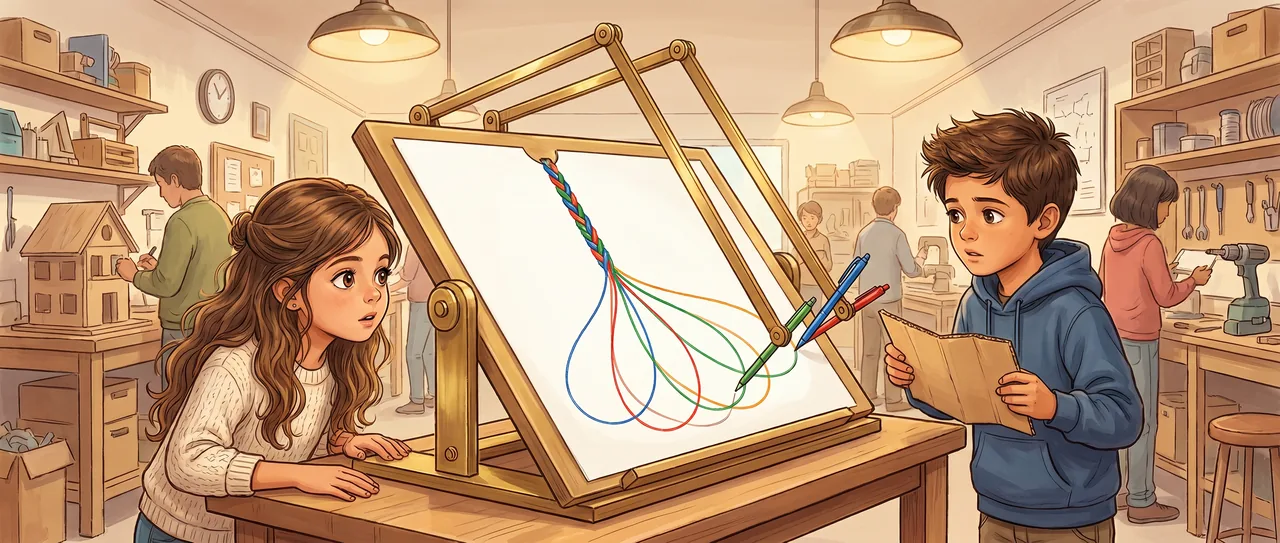
The table was made of smooth white board tilted under a brass double pendulum. One arm swung from a post. A second arm swung from the end of the first. A felt pen hung from the second arm, just touching the paper. When someone lifted the arms to a little metal notch and let go, gravity pulled, the hinges turned, and the pen made a blue looping path like a knot trying to untie itself.
The sign above it said, SAME START, SAME LINE.
Maya did not like the sign.
Soren liked the machine, but not the sign either. He had already drawn a tiny box in his notebook labeled things to check, with hinge wobble, table tilt, paper slip, pen drag, and human release written underneath.
The coordinator hurried past with a roll of tape on one wrist and a screwdriver in her teeth. She had silver paint on her sleeve and the expression of someone who had twelve problems and room for eleven.
“Please tell me it repeats,” she said around the screwdriver.
“It makes lines,” Maya said.
“That is not the same as repeats.”
“No,” Soren said. “It is definitely not the same.”
Maya lifted the brass arms until the first arm touched the notch and the second arm touched the little black dot painted beside it. She took her finger away.
The pen rushed downhill, looped left, curled right, made a narrow blue eye, then whipped across its own path. It slowed, shivered, and stopped near the bottom edge.
Soren changed the pen to red. He set the arms back against the same notch and the same dot. He held his breath. He opened his fingers.
For one loop, the red line rode almost on top of the blue.
Then it left.
Not a little. Not like a pen that had slipped. It sprang away as if the blue path had become a road it refused to take. The red line made a wide hook into empty paper, missed the blue eye entirely, and came to rest with its tip pointing the other direction.
The coordinator took the screwdriver out of her mouth. “Something’s loose.”
“Maybe,” Soren said.
“No,” Maya said.
The coordinator looked at her.
Maya pointed to the first loop, where red and blue were so close they made purple. “It agrees first.”
The coordinator pressed both hands to her forehead. “I cannot put an exhibit on the floor called It Agrees First.”
“You could,” Maya said.
“No,” the coordinator said. “Fix it if you can. If not, I’ll swap in the tessellation tiles.”
She hurried away before either of them could answer.
Soren touched the hinge with one finger. It was warm from the lights. He did not write that down yet.
They tried the simple things first. Soren tightened the clamp that held the pen. Maya taped the paper at all four corners. Soren set a marble on the table to check the tilt. It rolled straight down the center. Maya flicked the post and watched the shadow on the paper. It did not wobble.
They ran the machine again.
Green followed blue for the first loop, then slid between blue and red as if choosing a third answer to a question nobody had asked.
Soren frowned. “If it were broken, it should be broken right away.”
“It waits,” Maya said.
“Machines do not wait.”
“This one does.”
Soren took a cardboard square from the recycling bin and cut a notch in it. He made a little gate to hold both arms, so his fingers would not push one side more than the other. Maya found a binder clip and fastened the gate to the post.
“Less finger,” Soren said.
“Less us,” Maya said.
They lifted the arms into the cardboard gate. Soren pulled the cardboard away sideways.
The orange line followed the old paths longer than the others. Half a loop. One loop. Almost two.
Then it shot outward in a long bright curve and crossed a place no other color had touched.
Maya laughed once, very quietly.
Soren looked at her. “What?”
“It is not less us,” she said. “It is still us. Just smaller us.”
Soren looked at the cardboard gate. He looked at the warm hinge, the paper, the pen, Maya’s hand on the table edge, his own shoes against the floor. He wrote four words in his notebook, then shut it before the page could become the important thing.
Close enough has teeth.
At school, close enough was usually where grown-ups put things they did not want to look at anymore. Close enough to the answer. Close enough to the line. Close enough to listening. But the brass arms did not treat close enough like almost the same. They treated it like a seed.
Maya put her eye level with the table. The paths lay over one another at the top, braided tightly, then opened into separate countries. The machine was made of hinges, gravity, friction, and a pen. No dice. No shuffled cards. No hidden motor choosing surprises. If the exact same starting angles and speeds could happen again, the exact same line would happen again.
But exact had no handle.
Soren placed the tip of his pencil beside the painted dot. The dot was bigger than the pencil point. The pencil point was bigger than dust. Dust was bigger than whatever number came after the last number they could measure.
Maya held her breath again, then stopped holding it. The air from her nose moved the edge of the paper so slightly that she could not see it. She stepped back anyway.
The room got too large for the room.
Not larger like the walls had moved. Larger because the little spaces had opened. Between the notch and the arm. Between one breath and the next. Between the first loop and the second. The future of the pen had been hiding in distances too small for fingers, and then arriving in curves big enough to cover the page.
The coordinator returned carrying a plastic tub of tessellation tiles. “Tell me good news.”
“It is not broken,” Soren said.
“That is good.”
“It also will not repeat,” Maya said.
“That is less good.”
“It would repeat,” Soren said, “if we could start it exactly the same.”
The coordinator stared at the colored explosion on the paper. “Can we?”
Maya held up the cardboard gate. One corner was bent from being pulled away. The bend was hardly visible unless you were looking for it.
“No,” Maya said.
The coordinator made the face again, twelve problems and room for eleven.
Soren moved the original sign facedown. On the blank back, he wrote carefully with a thick marker:
SAME RULES. ALMOST SAME START. DIFFERENT WORLD.
The coordinator read it once. “That is not what the brochure says.”
“The brochure is wrong,” Maya said.
The coordinator looked toward the front doors, where the first families were beginning to gather outside the glass. Then she put the tub of tessellation tiles under the table.
“You have seven minutes,” she said. “Make it look intentional.”
They made it look like an invitation.
Soren taped three transparent sheets over the paper, one on top of another, so every run could be lifted away without losing the old lines. Maya set out blue, red, green, and orange pens like choices at a ceremony. Soren drew a tiny arrow to the starting notch. Maya crossed out SAME LINE on the old sign so hard the marker squeaked.
At six, people came in smelling like raincoats and cold air. The Butterfly Table filled first, because of the bright lines, and because Maya stood beside it with both palms flat on the edge as if guarding something alive.
A small child reached for the arms.
“Wait,” Soren said. “Pick a color.”
“Blue.”
Maya clipped in the blue pen. “Now pick where it ends.”
The child pointed to the lower left corner.
Maya looked at Soren.
Soren said, “We can promise the beginning.”
Maya said, “Only the beginning.”
The adults smiled the way adults smiled when they thought a sentence was cute and not dangerous.
Maya lifted the arms into the notch and dot. Soren slid the cardboard gate into place. He did not touch the brass. Maya did not breathe on the paper. The child leaned forward so far his nose nearly crossed the table edge.
Soren pulled the gate.
The blue line made the first loop exactly where the old first loops had gone, close enough to seem like obedience. Then the second arm flipped over the first, the pen sped up, and the line flung itself toward the upper right instead.
The child’s mouth opened.
Again and again, they ran it. The first loops made a braided stem. The later lines bloomed away from one another, blue, red, green, orange, no two petals matching. People asked if there was a magnet. Soren showed them the wooden underside. People asked if the table was cheating. Maya pointed to the hinges and said, “Only gravity.”
The coordinator stopped hurrying. She stood behind the crowd with the roll of tape still on her wrist.
One parent said, “So it’s random?”
“No,” Soren said.
Maya picked up the purple pen. “That is the strange part.”
The room went quiet enough that the little hinge creaked when she lifted the arms.
Soren set the cardboard gate more carefully than before, lining it against the notch until the brass barely kissed the edge. Maya leaned close to the paper. A white space remained near the center, a small island surrounded by colored weather.
“There,” she said.
“You cannot aim it,” Soren said.
“I know.”
He looked at the white space, then at the bent corner of the cardboard gate. He took the gate away.
Maya looked at Soren. Soren set the red pen in the clamp. Maya lifted one finger, let the brass arm go, and the pen ran into a white part of the paper no line had touched.
Read the interactive version, listen to the narration, and earn a gold star →
A science-verified short story for curious kids · Curiosity Land