The Wrong Tree
The printer in the field lab made the sound of a beetle chewing paper.
Maya liked that sound. It meant numbers were coming out of a machine that had been fed pieces of forest.
Dr. Ito did not like the sound at all.
She tore off the strip, read it, and said, "No. Absolutely not."
Soren looked up from the sample tray. "Bad no, or interesting no?"
"Wrong no," Dr. Ito said. She was small and quick and always had a pencil in her hair, even when she already had one in her hand. Today she had three. "Birch seven has turned up in fir seven."
Maya leaned over the printout. The machine had written neat rows of letters and decimals. She did not understand all of them, but she understood the names.
B seven. F seven.
"They are not touching," she said.
"Exactly," Dr. Ito said. "Which means somebody swapped a label."
Soren went still in the way he did when a thing had become a problem with edges. "We did the labels."
Dr. Ito shut her eyes for one second. "I know. I am not angry. The open day is in two hours, and I cannot show visiting families a result that says one tree ate another tree's lunch from across the path. I will leave it out."
"Across the path?" Maya said.
Dr. Ito was already gathering tubes. "I have to check the nitrogen samples before the mayor asks me whether forests are good investments. Please do not touch the mass spectrometer. Please do not re-label anything. Please, for the love of fungi, do not improve the experiment."
She hurried out with her boots untied.
The lab became very quiet, except for the printer cooling itself with tiny clicks.
Soren picked up the strip by its corners. "We did not swap them."
"No," Maya said.
"I wrote the order down."
"You always write the order down."
"People say that like it is funny."
"It is funny," Maya said. "Also useful."
He pulled his paper notebook from his back pocket. It was bent, damp at one corner, and full of arrows. The university tablets lay charging on the shelf, sleek and ignored.
"Birch seven," he read. "Blue tag. Bagged with carbon thirteen at nine sixteen. Leaf punch at eleven oh three. Fir seven, yellow tag, needle sample at eleven twelve. Different gloves. Different scissors. Different bags."
Maya was already at the door. "Show me across the path."
The research forest was not the kind of forest on postcards. It had cables running between trunks, little flags in the moss, rain collectors shaped like clear mushrooms, and square plots fenced low to the ground. The trees did not seem to mind. They rose through the instruments and went on being trees.
Birch seven stood inside a clear plastic chamber that had been unzipped after the morning test. Its leaves trembled on pale stems. Earlier, Dr. Ito had filled the chamber with air containing carbon thirteen, a heavier kind of carbon that plants could breathe in as carbon dioxide. Birch seven had taken it into its leaves and built it into sugar.
That part made sense. Leaves made sugar from air and light. Even the posters in the visitor center knew that.
Fir seven was not beside it. Fir seven was a small Douglas fir on the far side of the bark path, shaded by sword ferns, with its needles all pointing in quiet directions.
Maya stood between them.
"Too far for roots," Soren said.
Maya crouched. The ground between the trees looked ordinary. Needles. Rotting leaves. A beetle shell. A thread of spider silk.
"Not too far for something else," she said.
Soren checked the plot map nailed to a cedar post. "There are barriers. Birch seven and fir seven are in the same treatment row. Mesh walls underground. Root exclusion. Fungal access."
Maya looked at him.
"Say that with dirt on it," she said.
He pointed with his pencil. "Roots cannot cross. The mesh holes are too small. Fungal threads can. If the mesh is not torn. If the map is right. If the sample is right."
"That is three ifs."
"Four," he said. "If trees share."
Maya pressed her fingers into the leaf litter. It was springy and cold. "The birch made sugar with marked carbon. The fir had marked carbon. Something carried it."
"Fungi do not carry things for free," Soren said.
"Nobody said free."
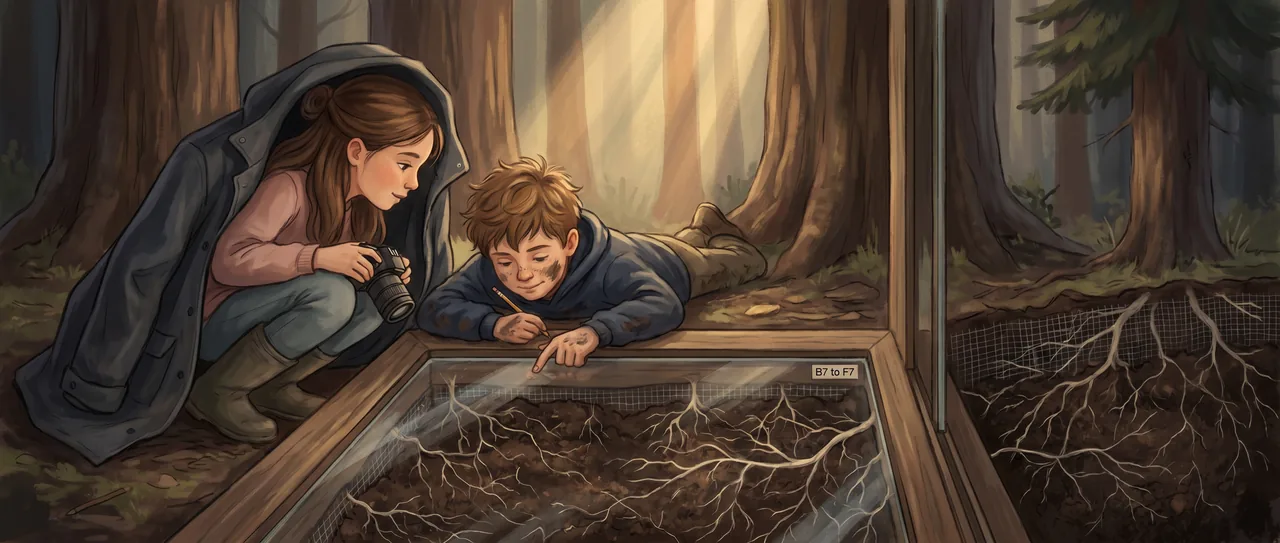
They found the inspection window under a square of moss-covered plywood. Soren lifted it. Beneath was a pane of thick glass set into the soil like a secret aquarium.
At first Maya saw only darkness.
Then her eyes changed their minds.
Pale threads ran through the soil. Not roots. Roots were thicker, blunt, certain of themselves. These were finer than hair, branching and crossing, slipping through crumbs of earth. Some clung to root tips in fuzzy white gloves. Some vanished through the mesh wall toward the fir.
Maya forgot the path above them. She forgot the open day, the mayor, the printer, and Dr. Ito's three pencils. The forest had a second forest under it, a pale one, thinner than breath and busy in every direction.
Soren lay flat on his stomach beside the window. Dirt stuck to his chin.
"They fit through," he said.
Maya smiled without looking away. "Fourth if."
"Not if," he said, and tapped the glass once, softly. "There."
They checked the solid-barrier plot next. It had birch eight and fir eight, almost the same sizes, almost the same shade. Its inspection window showed roots stopping at a plastic wall. There were fungal threads on both sides, but the wall cut them apart.
Soren read the second line on the printout. "Fir eight. No carbon thirteen."
Maya ran back to birch seven, then fir seven, counting her steps. "The path doesn't matter."
"Above ground path," Soren said.
"Wrong map."
"Not wrong," he said. "Incomplete."
They took photographs through the inspection windows, but the glass reflected sky. Soren solved that by draping his dark raincoat over Maya's head and the window while she held the camera underneath. Maya solved the blur by bracing the lens against the wood frame. Together they made a picture full of white threads and one tiny printed label in the corner of the glass.
B seven to F seven. Mesh access.
When they returned, Dr. Ito was arguing with a folding table. The table was winning.
"We did not improve the experiment," Soren said.
Dr. Ito looked at the mud on both of them. "That sentence worries me."
Maya handed her the camera.
Dr. Ito looked at the first photograph. Then the second. Then she put the table down very carefully, as if sudden movements might scare the evidence away.
"You checked the solid barrier?" she asked.
Soren gave her the printout and his notebook, opened to the sampling order.
"Different gloves," he said. "Different scissors. Different bags."
Dr. Ito read. Her mouth pressed into a line, then unpressed.
"I was going to throw out the best result of the month," she said.
"Year," Maya said.
Dr. Ito looked at her.
Maya shrugged. "Maybe."
Outside, tires crackled on gravel. The first visitors had arrived.
Dr. Ito pinned the photograph to the display board, right over the cartoon she had made of smiling trees holding hands. She covered the cartoon hands with a strip of tape.
"No hands," she said. "Better."
The families came in with raincoats and questions. Dr. Ito showed them the clear chamber where birch seven had breathed the special carbon. She showed them the machine that could find the heavier carbon inside a leaf or a needle. Then she pointed to the photograph Maya had taken.
"This is not a root," Dr. Ito said. "This is fungal hyphae. The fungus gets sugar from trees. It brings them minerals and water from soil. Sometimes it connects more than one plant. In some forests, carbon moves through these networks. In some experiments, warning signals move too, when insects begin to chew. We are still learning what the forest is doing with all these connections."
A boy in a red hat raised his hand. "So trees talk?"
Dr. Ito hesitated.
Maya knew the wrong answer. She had liked it all morning. Trees talking. Trees whispering under the path. It was almost right, and not nearly strange enough.
Soren answered before Dr. Ito could make it tidy.
"Not with mouths," he said. "And not alone."
The boy looked disappointed for half a second.
Then he looked at the ground.
After the visitors moved on, Dr. Ito opened a small cooler marked warning trial. Inside were mesh sleeves, soft clips, and leaves with crescent bites along their edges. The next row of saplings waited under numbered flags.
"The caterpillars go on birch nine," Dr. Ito said. "The fir beside it is connected by mesh. The other fir is behind a solid barrier. We test the needles later for defensive chemicals. I could use careful hands."
Soren took the sleeve. Maya took the clip.
They walked to birch nine without stepping on the flagged soil. The afternoon light reached down between the trunks in narrow gold ladders. Somewhere under their boots, the pale threads crossed and branched and crossed again.
Maya fastened the little mesh sleeve over the chewed birch leaf, and beneath the soil window the white threads lay in a tangled line toward the fir.
Read the interactive version, listen to the narration, and earn a gold star →
A science-verified short story for curious kids · Curiosity Land