The Wrong Jar
The jar was supposed to breathe.
That was what Dr. Vale had promised the visiting classrooms on the video call tomorrow. She had said it with both hands in the air, like a magician. Frozen ground, thawing on a lab bench. Ancient plant bits waking up. Gas puffing into a silver balloon.
Only the balloon lay flat.
Maya crouched until her nose was level with the jar. Inside was a fist-sized lump of brown-black permafrost core, sealed in clear plastic, sitting in a tray of meltwater. The label said GRAVEL RIDGE, DEPTH ONE POINT TWO METERS.
Soren stood beside her with the methane meter, the one Dr. Vale had said cost more than a snowmobile and should not be dropped, licked, or improved. Its little screen blinked numbers that did not impress anyone.
“Again,” Soren said.
“You already did it four times,” Maya said.
“Five is better than four.”
He held the meter tube near the jar’s valve and pressed the button. The instrument clicked softly. The number trembled, then settled almost where it had started.
Across the lab, Dr. Vale was arguing with a printer.
“No, no, no,” she told it. “I asked for one map, not seventeen maps of northern Canada.”
“The jar is boring,” Maya said.
“The jar is data,” Soren said.
“It is boring data.”
“That can still be data.”
Maya stood and looked at the poster propped against the wall. It had blue-white tundra at the top and a huge brown layer underneath labeled PERMAFROST, GROUND THAT STAYS FROZEN YEAR AFTER YEAR. Beneath that, in red letters, someone had written: HOLDS ABOUT TWICE AS MUCH CARBON AS THE ATMOSPHERE.
Twice as much as the air.
Maya breathed out, just to feel how small one breath was.
Dr. Vale came over, holding the ruined maps. Her hair had two pencils stuck through it and one pencil behind her ear, which meant she had lost at least one pencil.
“Bad sample,” she said. “We’ll use the animation. The classrooms like animation.”
“It came from permafrost,” Soren said.
“Yes.”
“So why no methane?”
Dr. Vale sighed at the jar as if it had personally disappointed science.
“Permafrost is messy. Microbes, moisture, oxygen, temperature, old plant material. We wanted a clean demonstration. The ground refused to be clean.”
Maya smiled.
Dr. Vale pointed at both of them. “That was not an invitation to go make it messier. Stay inside unless you have boots, a radio, and common sense. I have only seen evidence of boots.”
Then the printer screamed and she ran back to it.
Maya tapped the label. “Gravel ridge.”
Soren opened his notebook, not to write a conclusion, but because his hands needed somewhere to put the problem. “Dry place.”
“Dry places have air.”
“Oxygen,” Soren said.
“Methane comes from the places without much oxygen.”
“Wet places.”
They looked through the lab window.
The tundra outside was not empty. It only pretended to be. It had hummocks and puddles and moss bright as green fire. It had black pools where the ground had sagged. It had white flags on thin poles where researchers had marked squares of earth. Beyond the boardwalk, the land wrinkled away under a sky that did not know how to get dark.
Maya already had her boots on.
Soren took the radio from the charging shelf and held it up where Dr. Vale could see. She waved one hand without looking, which might have meant yes, or might have meant the printer had eaten Greenland.
They went out.
The cold came up through the boardwalk boards. Not winter cold. A stored cold, deep and patient. The kind that had been waiting underground longer than any person.
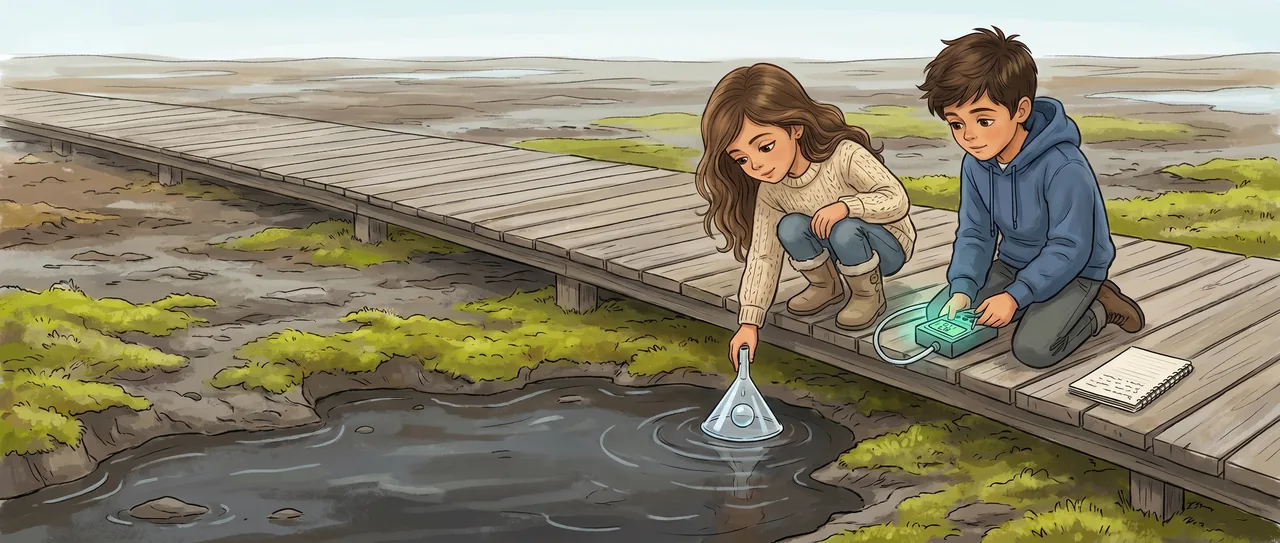
Soren carried the methane meter against his chest. Maya carried three clear tubes, two sample bags, and a plastic funnel Dr. Vale used for demonstrations. The boardwalk kept them above the soft places. Signs said DO NOT STEP ON TUNDRA. Maya did not. She leaned, balanced, reached.
At the gravel ridge, the ground was pale and pebbly. The moss grew thin there. Soren tested the air above it.
“Normal,” he said.
“Again.”
He looked at her.
“Now you like repeats?”
“I like being annoying correctly.”
He tested again. Then again. The numbers stayed low.
They moved to a dark pool beside a sagging patch of earth. Its edge had torn away from the moss, showing brown roots and ice crystals tucked in shadow. The water was still until Maya put the funnel upside down over one spot and waited.
A bubble rose.
It slid into the funnel’s narrow throat and shivered there.
Soren fitted the tube to the meter. The instrument clicked.
The number climbed.
Not like a rocket. Like someone waking up behind a door.
Soren tested the air beside the pool. Lower. He tested another bubble. Higher. He tested a place where Maya said the mud looked wrong because the surface had a silver skin that kept breaking. Higher again.
Maya did not say anything for almost a whole minute.
Soren looked up from the screen. “That’s six.”
“Believe it?” she asked.
“Yes.”
The tundra made a small wet sound.
Maya looked back toward the lab. The jar on the bench had not failed. It had told the truth about a dry piece of frozen ground, and everyone had wanted it to tell the truth about a wet one.
Soren crouched on the boardwalk with his notebook on one knee. He drew two boxes. Dry thaw. Wet thaw. Then a circle that pointed back to itself.
“Carbon dioxide from thawed stuff with oxygen,” he said. “Methane from wet places with not much oxygen. Both can warm the air.”
“Warmer air thaws more ground,” Maya said.
“More thaw can make more gas.”
“Which warms more air.”
Soren stopped drawing.
The circle on the page was too small.
Maya looked at the tundra again, but it was not scenery anymore. It was storage. It was old leaves, old roots, old sunlight packed away under ice. It was holding more carbon than the whole sky above them, and the sky was touching every ocean, every forest, every city, every person who had ever breathed without thinking about it.
A mosquito landed on Soren’s wrist. He did not move.
“We need the wrong jar,” Maya said.
“For the video?”
“For the truth.”
They ran back carefully, which was slower than running and more frustrating.
Dr. Vale was under the printer table when they returned.
“We need two jars,” Maya said.
“No one needs two jars,” Dr. Vale said from under the table. “One jar is already betraying me.”
Soren put the meter on the floor where she could see the readings written in his notebook. “The jar is from a dry ridge. It should not be the methane jar.”
Maya held up the sample bag from the pool, sealed around a little pocket of captured gas. “The wet places are different.”
Dr. Vale slid out from under the table. A dust bunny clung to her sleeve. She looked at the numbers. She looked at the bag. She looked at both of them.
“You stayed on the boardwalk?”
“Yes,” Soren said.
“You did repeats?”
“Six.”
Dr. Vale sat on the floor.
“Oh,” she said softly. “That is much better than my magic balloon.”
By morning, the lab bench held two jars.
The first was the dry gravel ridge core, with a carbon dioxide sensor clipped to its lid. The second held wet thawed peat from an approved sample tray, with tubing leading to the methane meter.
When the classrooms appeared on the screen, little squares of faces blinked from places with palm trees, brick buildings, cornfields, apartment windows, and one classroom where everyone wore matching purple hats.
Dr. Vale began with her magician hands, then stopped and lowered them.
“These two scientists corrected our demonstration,” she said. “They found the ground was not giving one answer.”
Maya leaned toward the camera. “The boring jar matters.”
Soren held up the meter. “The wet place matters too.”
Questions poured out of the speakers.
“Can you stop the thaw?”
“How old is the carbon?”
“Is methane invisible?”
“Can kids measure it?”
Dr. Vale reached for her coffee, missed, and picked up a jar lid instead.
Maya answered the invisible one. Soren answered the measuring one. Dr. Vale answered the age one and said some permafrost carbon came from plants that grew thousands of years ago. No one answered the stopping one completely.
After the call, Dr. Vale opened a map on the big screen. Colored dots spread across the Arctic, measurements from stations, towers, aircraft, satellites, and people who went out with sensors and came back with mud on their knees.
She added Soren’s six readings from the boardwalk pool. A new dot appeared.
It was tiny.
It stayed.
Maya moved closer to the screen. Soren did too.
Their dot sat among other dots from places they had never seen and names they could not pronounce yet. The map did not care whether a number had come from a famous scientist, a tower taller than a house, or two eleven-year-olds with a funnel. It cared where, when, how, and whether the measurement could be trusted.
Dr. Vale handed Maya the radio and Soren the meter.
“Transect?” she asked.
Maya was already at the door.
At the first sagging square beyond the lab, Soren knelt on the boardwalk and Maya lowered the clear funnel until its rim kissed the dark water.
Read the interactive version, listen to the narration, and earn a gold star →
A science-verified short story for curious kids · Curiosity Land