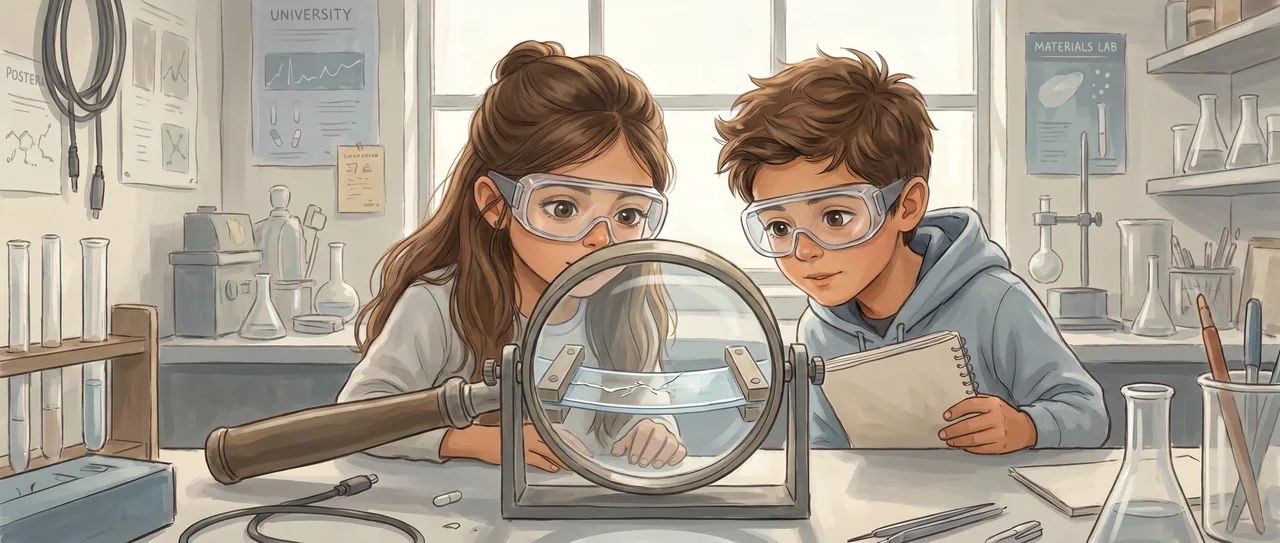
The Weak Things Inside
The self-healing strip would not heal.
Maya bent over the lab bench until her forehead almost touched the clear plastic. The strip lay under the magnifier with one neat scratch across it, silver-white and stubborn.
Soren checked the timer. “Six minutes.”
“It is getting worse at being impressive,” Maya said.
The lab manager hurried past with a coil of tubing over one shoulder and a wrench in her hand. She had safety glasses perched on her head and another pair on her face. “If strip seven is dead, use the video. Families love videos.”
“Videos do not heal,” Maya said.
“Neither does strip seven.” The lab manager pointed the wrench toward the far side of the room, where a vacuum pump was making a sound like an angry goose. “I have twenty minutes to make the moon-habitat dome stop leaking. Do not touch the pump. Do not touch the catalyst cabinet. Do not make smoke.”
Then she was gone, swallowed by metal shelves and hissing hoses.
Soren looked at the strip. He had written three columns in his paper notebook, scratch, time, change. The third column was empty except for the word none, which was not a satisfying word.
On the poster behind the bench, a cartoon crack ran through a gray material. Tiny round capsules burst open along the crack. A blue repair liquid flowed out and hardened, sealing the damage. Under it, large cheerful letters said: MATERIALS THAT MEND THEMSELVES.
Maya disliked the cartoon crack. It looked too polite.
She reached for the plastic scratching tool and made a second mark, harder this time.
“Same place?” Soren asked.
“Beside it.”
The scratch appeared clean and bright. Nothing seeped out. Nothing changed color. Nothing crept into the line.
Soren leaned closer. “Maybe the capsules dried out.”
“Maybe we are not hurting it correctly.”
He looked up. “That is a terrible sentence.”
“It’s a useful sentence.”
Between them sat the reject tray. It held bent coupons, cracked tiles, a glove with one melted fingertip, and a curved piece of transparent plastic from the mini moon dome. Maya had been watching it without meaning to, because one crack in the curved piece did not look like the others.
Most cracks were sharp white lightning. This one had a glossy line inside it, like someone had drawn over the break with wet glass.
Maya picked it up.
“Reject tray,” Soren said.
“Exactly.”
The curved piece flexed in her hands but did not split. A milky band ran through its middle, sandwiched between two clearer layers.
Soren held strip seven beside it. Strip seven also had a milky middle, but their scratches were only on the shiny top.
Neither of them spoke for a moment.
Maya lifted the plastic to the magnifier. “Look at the middle.”
Soren adjusted the focus. The world under the lens sharpened. The top layer was clear and smooth. The middle layer was crowded with tiny pale dots, hundreds of them, almost bubbles, almost eggs, packed through the plastic.
The scratch they had made stopped above them.
Soren made a small sound in his throat. He flipped to a new notebook page and drew a side view of the strip. Top layer. Capsule layer. Bottom layer. Then he drew their scratch, too shallow and very useless.
“We scratched the raincoat,” he said.
“The medicine is under the skin,” Maya said.
Soren looked at the reject piece again. The real crack went all the way through the milky layer. It had smashed the tiny capsules in its path. The repair liquid had not covered the whole strip. It had gone only where the crack went.
Maya put her finger beside the glossy line, not on it. “It fixes the place that breaks because breaking opens the fix.”
Soren tapped his pencil once. “So we need a crack, not a scratch.”
“A small crack.”
“A controlled crack.”
“A crack with manners.”
The lab had a bending frame bolted to the demonstration table. It looked like a tiny bridge press, with two supports and a slow handle that pushed down in the center. A sign on it said: STAFF USE ONLY DURING PUBLIC HOURS.
Public hours had not started.
Soren read the safety card twice. Maya checked the sample box. The self-healing strips were labeled for bending demonstration. Wear goggles. Keep fingers clear. Do not exceed the red mark.
“We can use it,” Soren said.
“We can use it correctly,” Maya said.
They put on goggles. Soren slid a fresh strip into the frame so the milky layer faced sideways, visible like a thin fog trapped inside ice. Maya lowered the handle one notch. Nothing happened.
“Again,” Soren said.
She lowered it another notch.
A faint white line flashed through the middle layer.
Maya froze with both hands on the handle.
Soren brought the magnifier over without touching the strip. The crack was not a cartoon lightning bolt. It was a valley, jagged and narrow, full of broken pale circles. Along the valley, a shine appeared.
It did not pour. It did not gush. It gathered in tiny beads, then pulled itself along the crack as if the crack were drinking.
“Capillary action,” Soren whispered.
Maya did not answer. Thirty seconds ago, plastic had been a thing. A hard, quiet thing. Now it was rooms inside rooms, pockets inside layers, a material carrying its own emergency workers in breakable shells. The weak parts were not mistakes. The weak parts were how the message got sent.
Soren pressed the two sides gently together with the clamp, just as the instruction card showed. The wet shine thinned into a clear thread. On the poster, the cartoon made it look instant. On the bench, it was slower and stranger, chemistry beginning because something had opened.
The lab manager returned, still carrying the wrench. “Please tell me the smoke alarm is quiet because there is no smoke.”
“There is no smoke,” Soren said.
Maya pointed to the strip. “The demo was wrong.”
The lab manager’s eyebrows rose.
“Not the material,” Maya said. “The way we were asking it.”
Soren held up his side-view drawing. “The scratch didn’t reach the capsule layer. The crack has to break the microcapsules. Then the liquid flows into the crack and hardens there.”
“And if we only scratch the top,” Maya said, “it looks like nothing works.”
The lab manager set the wrench down very carefully. For the first time all morning, she looked fully at the bench.
“I told two graduate students that batch was bad,” she said.
“Maybe apologize to the batch,” Maya said.
The lab manager laughed once, then caught herself. “Families arrive in nine minutes. Can you show that safely?”
Soren moved the safety card beside the bending frame. Maya moved the dead scratched strip to the left and labeled it too shallow. The cracked strip stayed clamped under the magnifier, its thin clear seam catching the light.
“Yes,” Soren said.
“Good,” the lab manager said. “I’ll bring the dome over when the pump stops honking.” She started away, then turned back. “Do not let anyone call it magic.”
“We won’t,” Maya said.
When the doors opened, the room filled with damp coats, squeaky shoes, and voices trying to be quiet. People crowded around solar cells, aerogel tiles, printed metal lattices, and a small display about alloys that might heal tiny damage when heated. At Maya and Soren’s station, the first visitors saw a scratched strip that had done nothing and a cracked strip with a seam bright as a hair.
Soren did not start with the poster. He held up the too-shallow strip.
“This one failed,” he said.
People leaned closer.
Maya held up the cracked one. “This one failed better.”
That made them lean closer still.
Together, they bent a fresh strip in the frame. The white line opened in the milky layer. Under the magnifier, tiny capsules broke along the path, and a clear glimmer moved through the damage. No one spoke for several seconds. Even the lab manager, passing behind them with the repaired moon dome, slowed down.
Soren pointed, but did not touch. “The repair agent was already inside.”
Maya watched the seam brighten. “It only comes out where the crack knows the way.”
in the bending frame. Maya lowered the handle one notch. In the lens, a white line opened, paused, and filled with a bright thread of liquid.
Read the interactive version, listen to the narration, and earn a gold star →
A science-verified short story for curious kids · Curiosity Land