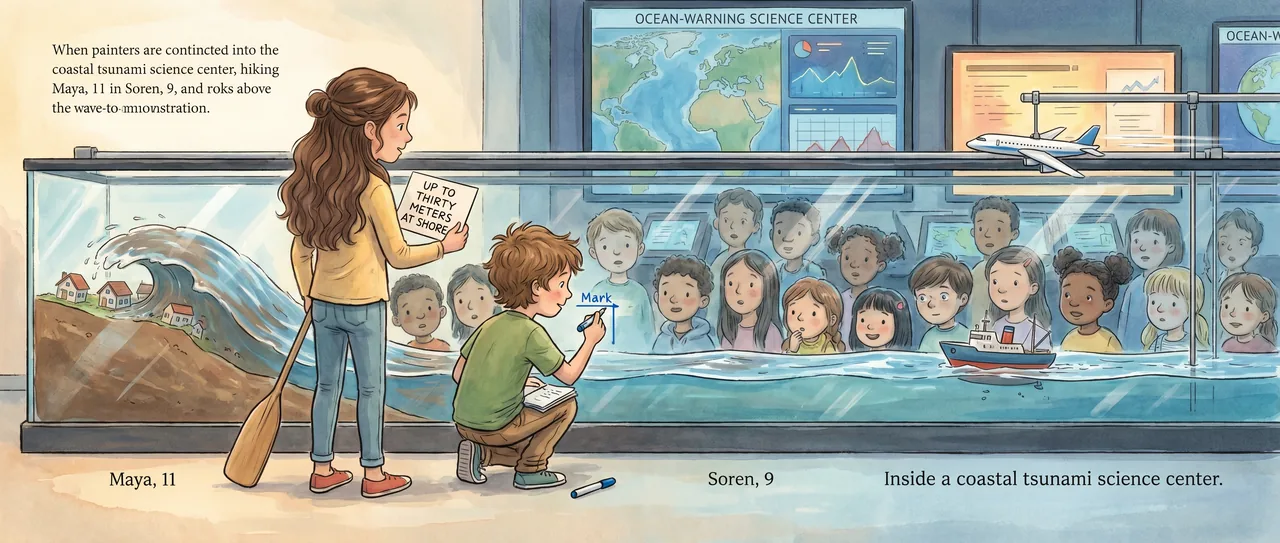
The Wave That Looked Like Nothing
The wave machine was failing perfectly.
That was the problem.
Dr. Pell slapped the side of the clear tank with the flat of her hand. A tiny ship rocked in the deep blue end. A line of fifth graders pressed their noses near the glass and groaned.
"That is not a tsunami," said a boy in a rain jacket. "That is bathtub water."
Dr. Pell closed her eyes for one whole second. She had three pens in her hair, two radios clipped to her belt, and a paper cup of coffee with a tide chart printed on it. The coffee had a skin on top.
"It is supposed to be dramatic," she said. "The mayor is coming in twenty minutes. The exhibit is called Wall of Water. People expect a wall."
Maya leaned closer to the tank.
The tank was longer than a dining table. One end was deep and dark. The bottom sloped upward toward a shallow plastic coastline with tiny houses glued to it. A paddle at the deep end shoved the water forward in one clean push.
The little ship barely moved.
Then, near shore, the water rose up and ran over the houses.
Maya said, "Don't fix it."
Dr. Pell looked at her as if Maya had suggested putting jam in the circuit board.
Soren had already crouched beside the tank. He had his paper notebook open on one knee, but he was not writing. He was watching the strip of floating cork dust Dr. Pell had sprinkled on the surface.
"Do it again," he said.
"I have done it nine times," Dr. Pell said.
"Ten is better," Soren said.
Maya grinned at him. "Ten is a real number."
Dr. Pell muttered something into one of her radios, then pulled the paddle back and released it.
In the deep part, the water line climbed less than the width of Maya's little fingernail. The toy ship gave one lazy nod, like it was bored. The cork dust slid forward in a smooth, almost invisible sheet.
Soren tapped the glass. "There."
"There what?" asked the boy in the rain jacket.
"You missed the fast part," Maya said.
The pulse hit the sloping bottom.
The whole shape changed.
The front of the water slowed, as if the tank had grabbed its ankles. The water behind kept coming. It bunched. It climbed. It stopped being a ripple and became a moving edge with a shadow under it. The little houses vanished under brown-blue water.
Nobody groaned that time.
Dr. Pell held the paddle handle without moving. "But the deep-ocean section looks too small."
"It should," Soren said.
Maya pointed at the toy ship. "The ship is the trick. People keep staring at it because ships are big. But the wave doesn't care if you notice."
On the wall above the tank, a poster showed a world map with curved lines crossing the Pacific. Beside it, in bright letters, someone had written: Tsunamis can travel across deep ocean at eight hundred kilometers per hour.
Soren looked from the poster to the tank. "That's airplane speed."
"Commercial jet," Dr. Pell said automatically. Then she winced, as if she had answered when she meant to keep fixing things.
Maya put her hand flat against the glass near the deep end. The pulse had looked like nothing there. A thing could run under a whole ocean at the speed of a jet and lift the surface less than a meter. A ship might pass over it and keep serving soup.
The room seemed to get wider without moving.
There were the maps. There were the exit signs. There were the blue evacuation-route arrows painted on the street outside. There were buoys somewhere far out past the gulls, listening to the weight of the sea.
Dr. Pell reached for a red knob under the tank. "Maybe if I increase the paddle force, we can make the deep-water wave visible."
"No," Maya and Soren said together.
Dr. Pell froze.
Soren stood up. "If it's big in the deep part, it's wrong."
"The mayor will not applaud a wave nobody sees," Dr. Pell said.
Maya had stopped listening halfway through. She was reading the labels in the tray under the tank. Scale markers. Depth tiles. Harbor models. A plastic airplane from some other exhibit.
She picked up the airplane.
"We don't make it bigger," she said. "We make missing it the point."
The mayor arrived early.
So did a woman from the newspaper, three parents with wet umbrellas, and a group of second graders who immediately began chanting, "Big wave, big wave, big wave."
Dr. Pell's left eye twitched.
"Welcome to Wall of Water," she said, in the voice of a person falling down stairs politely. "Today our young assistants will demonstrate, briefly, how a tsunami moves from deep ocean to shore."
"Not Wall of Water," Maya said.
Dr. Pell's mouth stayed open.
Soren lifted a card and clipped it over the old title. He had printed the new one in block letters from the label machine.
TRY TO MISS IT
The second graders stopped chanting.
Maya placed the tiny ship in the deep end. Soren placed the plastic airplane on a rail above the tank, the kind used for model satellites in the space room. He had found a wind-up motor and a string. It was not elegant. It clicked.
"This airplane is not flying," he said. "It's only for speed."
"Because the real wave can cross open ocean about this fast for something in water," Maya said. "Eight hundred kilometers per hour."
A parent laughed softly. "A wave?"
"Watch the ship," Maya said.
Dr. Pell pulled the paddle.
Soren released the airplane.
The airplane zipped along its rail. The cork dust slid. The tiny ship dipped so slightly that half the room leaned closer and the other half missed it.
"I didn't see it," said the boy in the rain jacket.
"Good," Maya said.
The pulse reached the slope.
Soren moved a blue marker along the side of the tank, following the front. "Slower here," he said.
The water thickened. It stood higher. It shoved into the harbor. The tiny houses disappeared again, not with a splashy movie crash, but with a steady push that kept coming.
Maya held up a second card.
LESS THAN A METER OUT THERE
Then she held up the third.
UP TO THIRTY METERS AT SHORE
The second graders were silent now.
Dr. Pell forgot to introduce the mayor.
The newspaper woman raised her camera, but she did not point it at the wave. She pointed it at the faces along the glass, all those children trying to see the part that looked like nothing.
Soren reset the airplane string. His fingers shook a little. Not because he was scared. The paper card in his other hand had gone soft where he gripped it.
"Again?" asked the boy in the rain jacket.
"You have to watch before it gets interesting," Soren said.
Maya looked at him.
That was exactly it.
All the times people had said wait for the big part, skip the small part, stop asking about the part that looked empty. Here was a wave that crossed an ocean by hiding in the part everyone skipped.
Dr. Pell bent to adjust the little houses back into place. Her radio crackled. She ignored it, then did not ignore it.
"This is not part of the show," she said, and listened.
On the wall screen behind her, the live Pacific map refreshed. Blue dots marked deep-ocean buoys. Green lines marked coastlines. Most of the ocean looked blank, which was what oceans did when they were very busy.
The room stayed quiet.
Dr. Pell lowered the radio. "Small undersea quake near the Aleutians. No warning issued. The buoys will log it if anything moves through."
The mayor whispered, "Should we continue?"
Dr. Pell looked at the children packed around the tank, at the card that said TRY TO MISS IT, at the toy ship waiting in deep water.
Maya reached for the paddle.
Soren reset the airplane.
The far wall screen gave a soft ping. On the Pacific map, south of a chain of small black islands, one blue buoy dot blinked twice.
Read the interactive version, listen to the narration, and earn a gold star →
A science-verified short story for curious kids · Curiosity Land