The Third Space
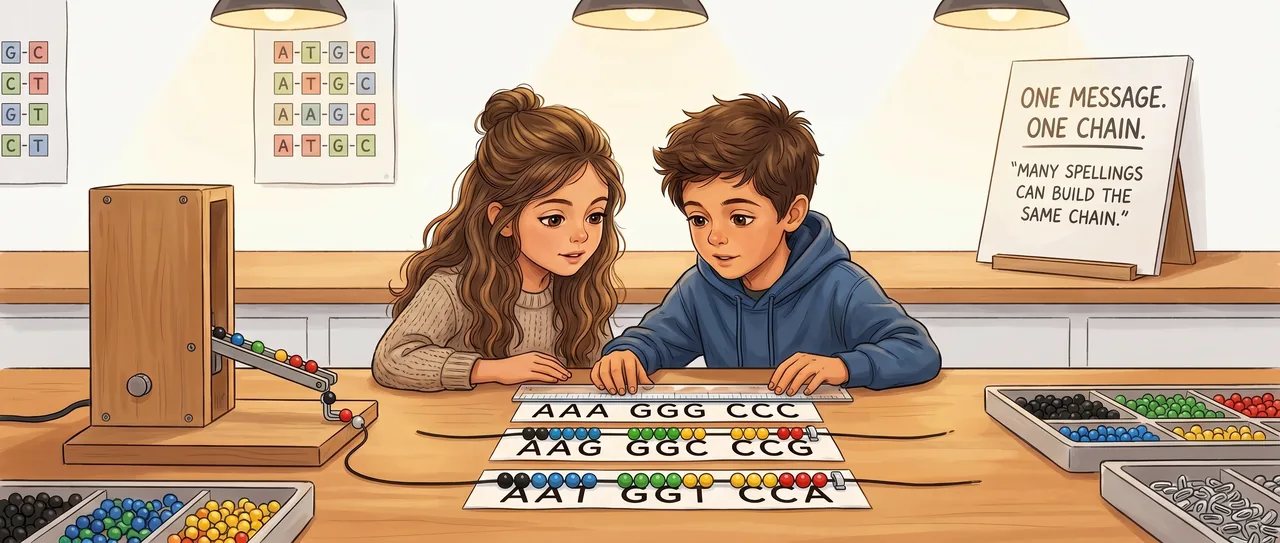
The machine made two identical bead chains, which was the kind of thing that made adults say the machine was broken.
Maya leaned so close to the clear plastic cover that her breath fogged it.
Soren stood beside her with his paper notebook open, one finger pressed under the letters he had written very carefully.
On the left strip, Maya had typed ATG GCT GGT TTA TCT TAA.
On the right strip, Soren had typed ATG GCC GGA CTG AGC TAG.
The strips did not match. Not mostly. Not nearly. They were different in almost every group after the first.
Inside the translator, the little arm clicked through Maya’s strip and dropped beads onto a cord. Black. Blue. Green. Yellow. Red. Then a silver clip.
It clicked through Soren’s strip.
Black. Blue. Green. Yellow. Red. Then a silver clip.
The lab technician looked up from a tray of empty sample tubes. He had safety glasses pushed onto his forehead and a label stuck to one sleeve.
“That scanner does this when crumbs get under the feed wheel,” he said. “Nobody eat near the machines.”
“There aren’t crumbs,” Maya said.
“There are always crumbs,” the technician said.
Soren did not argue. He lifted both strips by their clean corners and held them against the light. The letters glowed in two uneven ladders.
“They are different,” he said.
“Different different,” Maya said.
The technician opened the cover, blew into the feed slot, and reset the machine. “Try again, then use the template. The open house starts in twelve minutes, and the sign is supposed to say one DNA message makes one protein chain.”
Maya looked at the sign leaning against the wall.
ONE MESSAGE. ONE CHAIN.
She made a small sound in her throat.
Soren heard it. “What?”
“That sign is too smooth,” she said.
The technician sighed, but not unkindly. “Smooth is the point. Parents like smooth.”
Maya fed her strip again.
Black. Blue. Green. Yellow. Red. Silver.
Soren fed his.
Black. Blue. Green. Yellow. Red. Silver.
The technician stopped sighing.
Soren turned to the big poster above the worktable. It showed the four DNA letters, A, T, G, and C, arranged in tiny boxes of three. Each box had a bead color and a name beside it.
He ran his finger down the boxes beginning with GCT.
“Alanine,” he said.
Maya was already on GCC. “Also alanine.”
“GGA is glycine,” Soren said.
“GGT is glycine too,” Maya said.
They moved faster, not racing, just fitting their thoughts together before the thoughts could spill off the table.
“TTA is leucine,” Maya said.
“CTG is leucine,” Soren said.
“TCT is serine.”
“AGC is serine.”
Soren put both strips flat beside each other. He did not smile yet. He needed one more step.
“There are four letters,” he said.
Maya grabbed three blank tiles from the bin and set them in a row. “First spot has four choices.”
Soren put four fingers down. “Second spot has four.”
“Third spot has four.”
“Four times four times four,” Soren said. He wrote sixty-four in his notebook, then boxed it so hard the pencil nearly tore the paper.
Maya pointed at the bead trays. There were not sixty-four bead colors. There were twenty colors, plus the silver stop clips.
The table between them seemed to get deeper. Not bigger like a room. Bigger like a word that suddenly had a trapdoor under it.
Sixty-four boxes. Twenty kinds of pieces. Stops.
Maya touched GCT and GCC at the same time with two fingers. “The letters can disagree and still build the same thing.”
Soren checked the poster because he had to. GCA was alanine too. GCG was alanine too.
The technician came closer. “That is codon redundancy,” he said. “Degeneracy, technically. I should have remembered the demo would do that.”
Maya did not look away from the poster. “Degeneracy sounds like a broken word.”
“It is not broken,” Soren said.
He took a new blank strip.
The technician glanced at the clock. “If you want, I can print you a fresh template.”
“No,” Maya said.
Soren said, “We can make a third one.”
The technician paused with one hand still reaching for the printer controls.
Maya called out the chain from the beads. “Black, blue, green, yellow, red, stop.”
Soren found a new spelling for each color. “ATG.”
“GCA,” Maya said.
“GGC.”
“CTC.”
“TCC.”
Maya’s finger hovered over the three stop boxes. TAA. TAG. TGA. Three different full stops.
“TGA,” she said.
Soren typed the new strip. ATG GCA GGC CTC TCC TGA.
The technician folded his arms. He looked skeptical in the way people look skeptical when they are hoping to be wrong.
Maya fed the third strip.
The translator clicked.
Black. Blue. Green. Yellow. Red. Silver.
The technician laughed once, short and surprised. “All right. The sign is wrong.”
“Not wrong,” Soren said.
Maya picked up a marker. “Unfinished.”
They crossed out nothing. That seemed important. Instead, under ONE MESSAGE. ONE CHAIN, Maya wrote, MANY SPELLINGS CAN BUILD THE SAME CHAIN.
Soren added, IF YOU READ FROM THE RIGHT PLACE.
Maya tapped his sentence. “Show that part.”
Soren took his original strip and slid a clear ruler over the first A. The groups changed without any letters changing.
TGG CCG GAC TGA.
The silver clip box on the poster sat under TGA.
Maya fed the covered strip through by hand, one triplet at a time, not letting the machine pull it. The arm dropped a bead, another bead, another bead, and then stopped at silver far too soon.
The same strip lay under the cover. The same ink. The same order of letters. Only the starting place had moved.
Soren’s mouth opened a little, but no sound came out. He moved the ruler back to the beginning.
ATG GCC GGA CTG AGC TAG.
Full chain.
He shifted it forward again.
TGG CCG GAC TGA.
Stopped chain.
Maya whispered, “The spaces are not printed.”
The technician looked at the strip, then at the sign, then at the strip again. “Cells have ways to know where to begin,” he said, but his voice had gone quieter, as if the room had asked him not to flatten it.
The first families arrived at the glass door. A small child pressed both palms against it, looking past the technician at the bead machine.
The technician hurried to unlock the door. “Can you two run the table for five minutes?”
Maya and Soren were already setting out the strips.
For the first group, Soren showed the different letters. Maya ran the machine. The children watched three unmatched strips make the same necklace.
For the next group, Maya covered the first letter with the ruler. Soren moved the beads into a short, wrong-looking chain that ended in silver.
Nobody asked if the machine was broken.
They asked to try another spelling.
The tray of blank strips emptied. The bead cords piled up, same and not same, not same and same. Soren stopped writing everything down because his notebook could not hold the line of waiting hands.
At the edge of the poster, above the grid of triplets, small letters read Standard Genetic Code.
Maya lifted a blank strip. Soren set two letter tiles beside it, A and T.
The third space was empty.
Read the interactive version, listen to the narration, and earn a gold star →
A science-verified short story for curious kids · Curiosity Land