The Things the Alarm Kept
The first rule of the rover hatch was that nobody was allowed to write the code down.
Soren looked at his empty hands as if they had betrayed him.
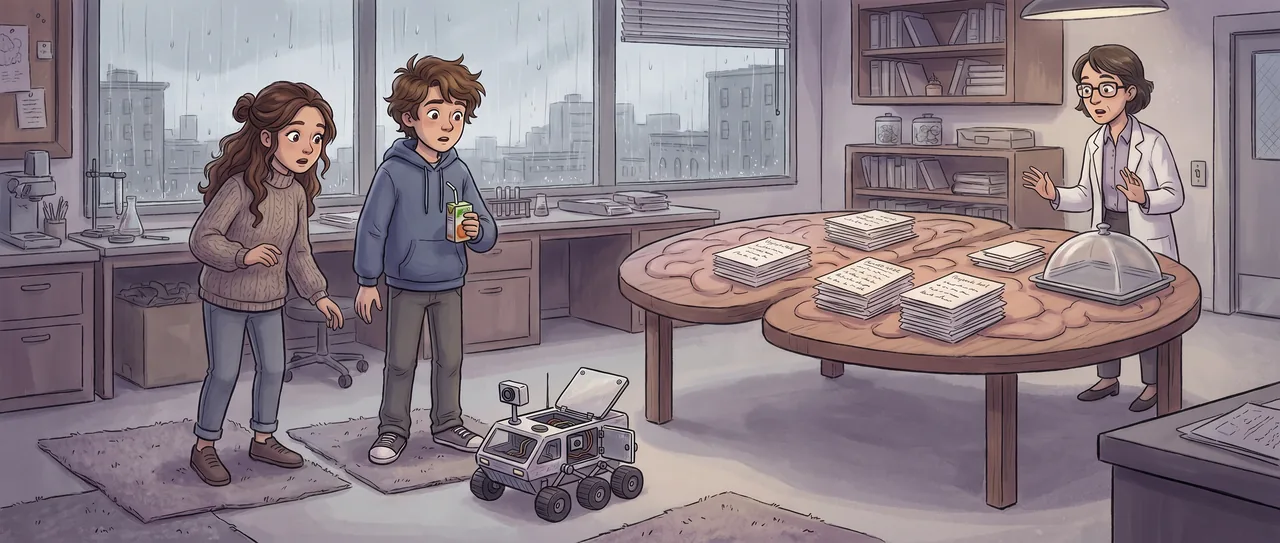
Maya grinned at him across the lab table. The table was shaped like a slice of brain, with the folds painted purple and silver. Behind it waited a small model rover, its hatch sealed by a keypad. On a tray under a clear cover sat six ordinary objects: a red button, a brass key, a sugar packet, a plastic beetle, a blue tile, and a curled orange peel.
The neuroscientist checked the time on her wrist screen and frowned at the room full of visitors. She had a voice like someone trying not to spill soup while running.
“Look for ten seconds,” she said. “Then I cover the tray. After that, you memorize four words. After a delay, you tell me the objects and unlock the rover. Also, if you agreed to saliva samples, chew the cotton swab now. We’ll send them later to measure cortisol, one of the hormones your body releases under stress.”
She held up a tube. “Please do not drop these. The grant people are upstairs.”
Maya was already looking.
Red button scratched on one side. Brass key with three teeth. Sugar packet folded wrong. Beetle missing one leg. Blue tile with a bubble in the glaze. Orange peel drying at the edge.
Soren looked too, but in rows, left to right, then right to left, then by color, then by usefulness. Button, key, sugar, beetle, tile, peel.
The neuroscientist snapped down the cover.
“Now the hatch code,” she said. “Copper. River. Seven. Pine.”
Soren said it silently once. Twice. He put the words in a square in his head. Copper above river. Seven beside pine.
Maya whispered, “Pine is wrong.”
“It’s a word,” Soren whispered back.
“No. It feels placed.”
Before Soren could ask what that meant, every light in the museum flashed white.
A siren opened its metal mouth.
The sound did not beep. It tore. It filled the lab tables, the rover wheels, the hollow places behind Soren’s eyes. The visitors froze for half a second, then the ceiling voice said, “Fire drill. Please proceed to the nearest exit.”
The neuroscientist stared upward.
“Oh no,” she said. “That was today.”
The grant people upstairs began coming down the glass stairs very quickly.
Outside, the sky was low and gray. Everyone stood on the wet sidewalk in clumps. The siren kept sounding inside the building, muffled now, like a giant insect trapped under a cup.
Soren pressed his fingertips together. Copper. River. Seven. Pine.
A little gust blew rain from the museum sign. A yellow leaf stuck to the neuroscientist’s shoe. A boy near the door cried without making noise. One of the grant people had shaving cream on one ear. The cotton swab tubes in the neuroscientist’s pocket clicked together whenever she moved.
Copper. River.
The siren stopped.
Soren had the feeling of a drawer sliding shut.
When they went back inside, the lab smelled like warm plastic and damp coats. The neuroscientist clapped once.
“All right,” she said too brightly. “We’ll reset. That trial is ruined.”
Maya’s head turned.
Soren knew the look. Something had failed in a way that made her want to touch it.
“Not ruined,” Maya said. “Sideways.”
The neuroscientist was already gathering tubes. “The delay was interrupted by an alarm. We can’t use the memory scores.”
“What was the code?” Maya asked Soren.
He opened his mouth.
Nothing came.
Not even a wrong word. The square in his head was blank paper.
Maya tapped the covered tray. “Button. Key. Sugar. Beetle. Tile. Peel.”
“Orange peel,” Soren said automatically.
“Right. Orange peel. What was the code?”
Soren shut his eyes. The siren came back first. Then the yellow leaf. Then the tubes clicking in the pocket.
“I can tell you the leaf had two black spots,” he said. “I can tell you the grant person had shaving cream on his left ear. I can’t get the words.”
Maya looked at the visitors, who were arguing softly about whether the alarm light had been white or red, whether the exit sign had flickered, whether the stairwell smelled like dust or lemons.
She said, “Ask them wrong.”
The neuroscientist stopped with six tubes in her hand. “Ask them what?”
“Not the tray first. Ask the alarm.”
“We are not studying the alarm.”
Soren reached for a stack of blank response cards. “Maybe we are now.”
The neuroscientist looked toward the glass stairs. Her mouth made a straight line. “Three minutes. Do not block the doorway. Do not touch the freezer. Do not lose my swabs.”
Maya took half the cards. Soren took the other half.
They did not ask, “What do you remember?” That was too big. Soren wrote two prompts in block letters.
Before the alarm, list the objects on the tray.
During the alarm, list anything you remember.
Maya added a third line.
No names.
They passed the cards to the visitors. People wrote standing up, leaning on walls, on the backs of their own sleeves. The lab grew quiet except for pencils, rain ticking the windows, and the neuroscientist muttering, “This is not controlled. This is extremely not controlled.”
When the cards came back, the tray side was thin.
Button. Key. Candy?
Bug thing. Blue square. Lemon?
Coin. Button. Packet. Something orange.
The alarm side was crowded.
The light made stripes on the floor.
The scientist said “oh no” before the ceiling voice.
The siren changed pitch near the end.
The cotton tubes clicked like teeth.
The exit sign buzzed on the second z.
The red button was on the tray, but during the alarm I thought it was part of the alarm and hated it.
One card had only one sentence, written very carefully.
I counted the screws in the door hinge because loud sounds make the rest of the room too large.
Soren read that card twice.
Maya did not say anything. She put it in the center of the table, not on top, not on bottom.
“These aren’t photographs,” Soren said. “Some people say the light was red. Some say white.”
“But they’re full,” Maya said. “The tray is empty-ish. The alarm is crowded.”
The neuroscientist forgot to look upstairs. She leaned closer.
“The cortisol samples won’t be analyzed until later,” she said. “And cortisol rises over minutes, not instantly. Adrenaline is faster. But stress can make old information harder to pull out while the brain stamps new important information more strongly.”
She stopped, as if she had accidentally given a lecture to a door.
Maya was already moving the cards into piles.
“Old things,” she said, pointing to the tray answers and the missing code. “New loud things.”
“Important things,” Soren said.
Maya looked at him.
“Not same as loud,” he said.
He picked up the hinge-screw card.
The neuroscientist’s expression changed. Not softer. Sharper.
“Again,” she said.
This time she gave them juice boxes and made everyone sit on the carpet squares for five quiet minutes. No siren. No grant people on the stairs. No one watching the keypad.
Soren held the straw between his fingers and did not try to remember the code. Trying felt like grabbing soap in bathwater.
He looked at the rover instead. Its little hatch had a painted handle. The handle had a black nick near the bottom. The nick looked like a river seen from very high up.
Copper.
He did not chase it.
The sugar packet on the tray had been folded like a tent.
River.
Maya was watching the ceiling, lips parted, not speaking.
Seven came next, plain as a knock.
Then the smell of cleaning fluid near the fake trees by the entrance.
Pine.
Soren stood up.
Maya stood up at the same time.
“Copper river seven pine,” they said together.
The neuroscientist stared.
Maya punched the words into the keypad.
The rover hatch clicked open, and inside was not a prize, only a hollow space with wires, a tiny camera, and a second sealed door farther in.
The visitors leaned forward.
The neuroscientist looked from the open hatch to the cards spread across the brain-shaped table. Her wrist screen chimed. Upstairs, someone called her name. She ignored both.
“I have another tray,” she said. “And blank cards.”
Read the interactive version, listen to the narration, and earn a gold star →
A science-verified short story for curious kids · Curiosity Land