The Shape That Holds
Steel won before the contest began.
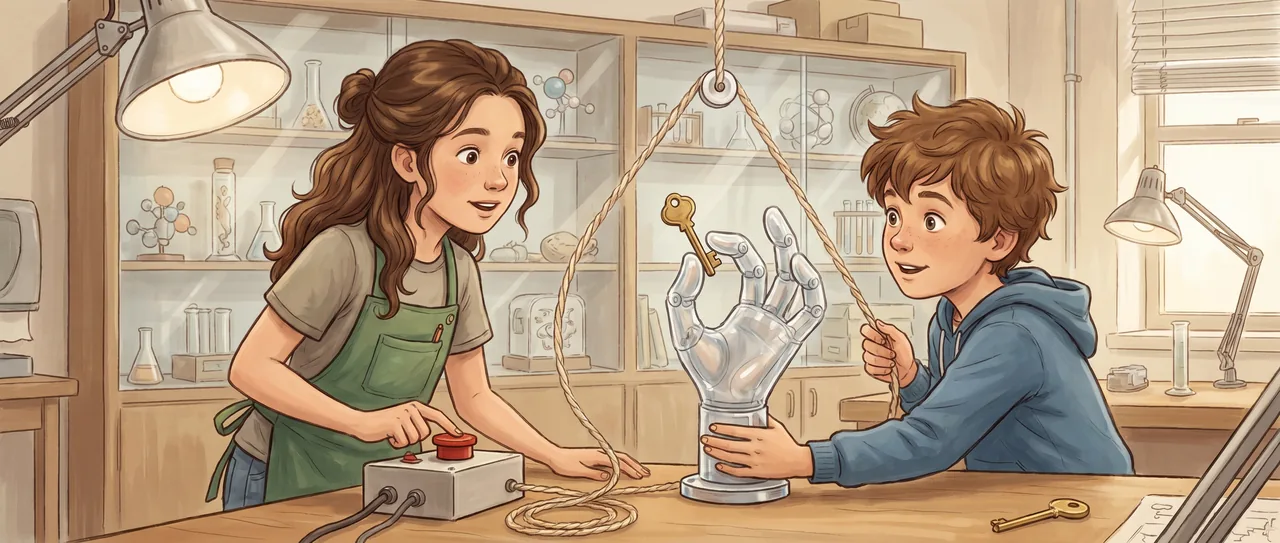
That was what the materials engineer kept saying at the workshop table. She had silver hair cut like a helmet and safety goggles pushed onto her forehead. In front of her lay spools of wire, fishing line, cotton thread, and a soft robot hand with clear plastic fingers.
“Strongest cable lifts the heaviest key,” she said. “You may choose anything from the table. Try not to snap my robot. It is my favorite hand.”
Maya picked up the steel wire first. It was thin and bright and very sure of itself.
Soren touched the robot finger where the cable was supposed to run. The path was not straight. It curved through tiny loops inside the finger, over a white pulley, and down into the palm.
“That bend is rude,” he said.
“It’s a finger,” Maya said. “Fingers are rude bends.”
The other kids took steel too. Steel looked like the answer. Steel made a tiny ringing sound when it tapped the table. Steel was the kind of material adults smiled at before anything happened.
Maya threaded it through the robot finger. Soren tied the end to the little motor spool and wrote one word in his notebook: kink.
“You haven’t tested it yet,” Maya said.
“It already wants to,” Soren said.
When the motor turned, the steel pulled. The clear finger curled halfway, then stopped. The wire had bent sharply at the pulley. On the second try it bent in the same place. On the third try it made a little permanent elbow and the finger twitched sideways, dropped the brass key, and knocked it off the table.
The engineer winced. “That wire is strong in a straight pull. Less charming around corners.”
She hurried away because another group had tied their robot hand to a chair leg.
Maya watched the fallen key spin flat on the floor. She did not pick it up right away.
“Straight strength is not finger strength,” she said.
Soren looked at his own hand. He opened and closed his fingers. Pale cords rose in his wrist and vanished again.
“Mine don’t kink,” he said.
“No,” Maya said. “Which is unfair.”
On the next table was a display nobody was using because it did not have a motor. It had a glass case with a piece of white tendon preserved in a clear block, a slice of bone polished like moonstone, and a model made of three colored cords wound around one another.
Soren leaned over the label. “Collagen,” he read. “Most abundant protein in the human body.”
“I know that one,” Maya said. “Skin stuff.”
“Skin, bone, tendons,” Soren said. “It forms a triple helix. Three protein strands wound together.”
Maya touched the glass above the model. The cords were not braided like hair. They spiraled around a shared middle, each one always beside the others, none of them becoming the center for long.
Soren read the last line twice. His eyebrows moved closer together.
“What?” Maya asked.
“Stronger than steel wire of the same diameter.”
Maya stared at the tendon in the block. It looked like old chewing gum. It did not ring when tapped. It did not shine. It did not seem as if it should win anything.
“That cannot be the whole sentence,” she said.
“It is the whole sentence.”
“Then steel is bragging.”
Soren took three pieces of cotton thread from the table. “Cotton is not collagen.”
“No,” Maya said. “But the robot doesn’t need collagen. It needs the part steel was bad at.”
“The bend.”
“The not-being-alone.”
Soren made a face, not because he disagreed, but because he was moving the words around to see if they had machinery inside them. He tied three threads to the motor spool without twisting them. The finger curled, but the threads slid unevenly. One went tight. One sagged. One caught under the pulley.
“Three is not enough,” he said.
“Three wrong,” Maya said.
She pinched the loose ends and began turning them. The threads twisted together, but when she let go they snarled into a little angry nest.
“Too much want,” Soren said.
Maya grinned. “Want is good. Hold both ends.”
Soren held the motor end. Maya held the free end and backed away until the threads were straight between them. She turned the free end again, slower this time. The three threads wound around each other in a clean spiral. When the twist tried to crawl into knots, Soren kept tension on it.
“It needs pulling while it becomes itself,” he said.
Maya stopped turning.
The cord between them was still only cotton. It was fuzzy. It was not a protein. It did not belong inside anyone. But it no longer behaved like three separate threads trying to escape three different ways.
They threaded it through the clear finger. Soren ran it around the pulley with his fingernail, once, twice, checking for snags. Maya tied the end to the little hook at the fingertip.
“Ready?” she asked.
“No,” Soren said. “Try it.”
Maya pressed the motor button.
The cord tightened. The finger curled smoothly, joint by joint, like it had remembered how. It lifted the brass key from the table and held it in the air.
Neither of them spoke.
The other kids turned. The engineer came back with a chair leg still tied to one wrist.
“You used cotton thread?” she asked.
“Three cotton threads,” Soren said.
“Twisted,” Maya said.
The engineer looked at the display, then at the robot hand, then at Maya’s fingers still on the button. Her mouth opened in the shape of a lecture and closed again in the shape of a laugh.
“Well,” she said. “The body has been doing materials science longer than we have.”
She moved on to untie the chair.
Soren did not let go of the robot hand. The key hung there, small and bright, held by something that looked too soft for the job.
Maya went back to the glass case. She looked at the tendon, then the bone, then the skin diagram behind them. Three strands. Three strands. Three strands, again and again, hidden in places that did not look alike.
She pressed one thumb into the inside of her wrist and opened her hand. A cord lifted under the skin. She curled her fingers and it slid away.
Soren came beside her. He put the brass key down very carefully.
“Bone too,” he said.
Maya tapped her shin with two knuckles.
“Skin too,” she said, pinching the back of her hand and letting it spring flat.
Around them, the workshop kept clattering. Motors hummed. Wire pinged. Someone cheered because a robot finger had flung a key into a recycling bin. The engineer called for more tape.
Maya looked at the model again. The three colored strands curved around a space no one strand owned.
Soren picked up a single piece of loose cotton thread and tugged it until it snapped.
Maya held out her hand.
He gave her three new threads.
They did not go back to the contest table. They sat on the floor between the glass case and the robot hand, knees nearly touching, and made another cord, then another. One twisted too loosely and sagged. One twisted too tightly and snarled. One held a knot so small Soren had to use his teeth to loosen it.
Maya did not mind the failed ones. She lined them up from messiest to cleanest. Soren tested each around his finger and wrote only the numbers of turns, not the answers, because the answers kept changing when the cord bent.
At last they made one as thin as a hair elastic and smooth enough to run over the pulley without shivering.
Soren held it beside the model in the glass case.
“It’s not the same,” he said.
“No,” Maya said. “It’s pointing.”
The robot hand kept holding the key.
Maya laid her wrist beside Soren’s on the metal table.
Together they curled their fingers.
Five thin ridges lifted under their skin.
Read the interactive version, listen to the narration, and earn a gold star →
A science-verified short story for curious kids · Curiosity Land