The Room With Too Many Directions
The first thing the quantum table did was tell them they were wrong.
Not gently.
A red line flashed across the glass. ERROR TOO LARGE.
Maya leaned closer until her breath made a cloud on the surface. Under the glass, a blue curve sat inside a long white rectangle. It was supposed to be a quantum state, according to the sign. A particle in a box. Not a marble. Not a planet. A particle, described by a wave.
Soren had both hands on the sliders. There were eight of them, each with a number at the top. One through eight. When he moved slider one, a smooth arch rose on the screen. Slider two added a wave with one hill and one valley. Slider three made three bumps. Each slider changed the whole shape.
The target curve was narrow and round, crowded near the left side of the box, as if the particle had politely chosen one small neighborhood and was waiting there.
Maya tapped the glass beside a tiny wiggle that should not have been there.
“That corner is wrong,” she said.
“I know,” Soren said. “But if I fix the corner, the middle gets worse.”
He moved slider six by the width of a fingernail. The wiggle shrank. A new wrinkle appeared on the right.
ERROR TOO LARGE.
Across the room, the other exhibits were easier. A pendulum swung. A robot arm stacked foam blocks. A screen invited visitors to measure their reaction time and printed cheerful stars when they improved.
This table printed nothing cheerful.
Maya pressed the button labeled CLEAR.
Soren looked at her.
“We were close.”
“Close is what it hates,” Maya said.
The eight sliders snapped back to zero. The blue target remained.
Soren took his notebook from his pocket and made eight small columns. He did not write the answer. He wrote what failed. First slider alone. Then second. Then both. The inside of his head got too crowded if he did not put some of it somewhere else.
Maya watched the curve, not the numbers. Slider one made a shape that belonged everywhere. Slider two belonged everywhere differently. None of the sliders lived only where the target lived.
“They are not positions,” she said.
Soren glanced up. “What?”
“The sliders. They look like pieces, but they are not pieces. They are directions.”
Soren read the small sign bolted to the edge of the table.
In this model, the numbered waves are basis directions. They are perpendicular in Hilbert space, even though they overlap on the screen.
He frowned in the good way, the way that meant the frown was a door.
“Perpendicular?” he said. “They are drawn on top of each other.”
Maya dragged slider one up and slider two up. The screen showed both waves crossing everywhere, tangling like jump ropes.
Soren pressed SHOW OVERLAP.
The two waves turned green where they agreed and purple where they disagreed. The green and purple regions balanced until a little meter at the bottom read ZERO.
“They cancel,” Soren said.
“Perpendicular without corners,” Maya said.
Soren added a ninth column to his notebook even though there was no ninth slider.
The table noticed.
A pale square appeared at the end of the slider row. MORE BASIS DIRECTIONS?
Maya pressed it.
Eight more sliders slid into view.
Soren did not smile yet. He rebuilt the shape, this time with sixteen waves. The target grew nearer. The wrong wiggles got smaller and sharper, as if the error had been squeezed into thin places.
The red line flashed again.
ERROR TOO LARGE.
Soren pressed MORE BASIS DIRECTIONS.
The table gave them sixteen more.
With thirty-two sliders, the target looked almost perfect. The curve rose where it should rise. It fell where it should fall. Maya had to put her cheek nearly against the glass to see the faint shiver near the edges.
“There,” she said.
Soren nodded. “Still wrong.”
“Good.”
He stared at her.
“If it can still be wrong after thirty-two,” Maya said, “then eight was not the problem.”
Soren pressed MORE BASIS DIRECTIONS again.
The table did not give them sliders this time. The glass darkened. Then the whole room changed.
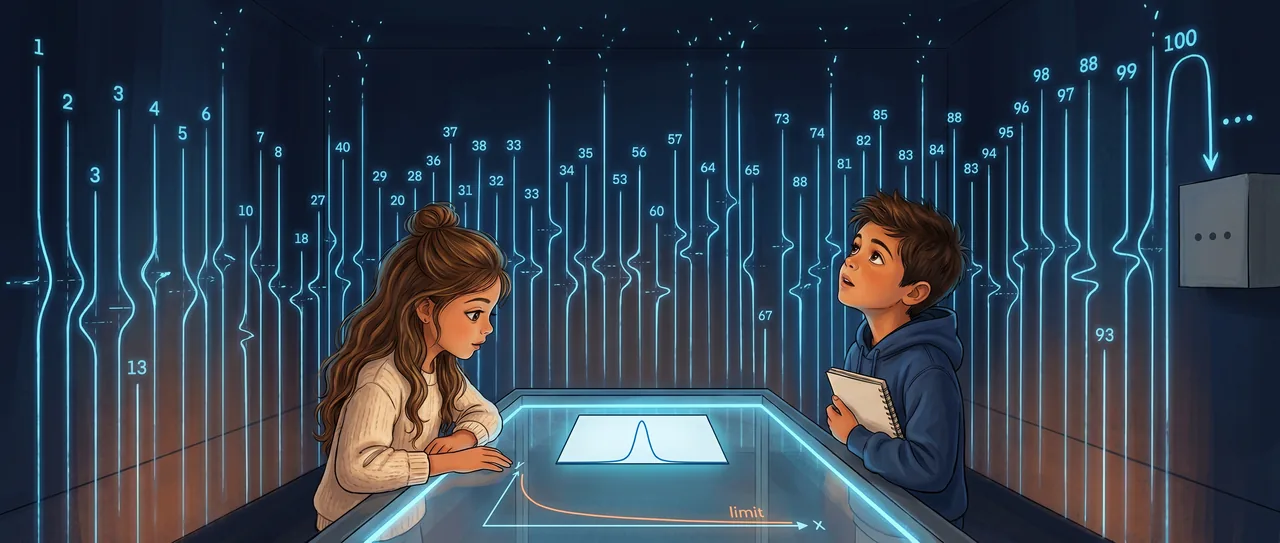
Lines of light appeared on the floor, one after another, each labeled with a number. One. Two. Three. Four. They did not point north or east or up. Each line carried a tiny moving wave inside it, like a secret animal. By the time the lines reached twenty, they were packed too tightly for Maya to stand between them. By forty, they climbed the wall as labels. By one hundred, they were only sparks along the ceiling.
Then the ceiling ran out.
The numbers kept going on the table.
One hundred one.
One hundred two.
One hundred three.
After that came a gray box with three dots.
Soren stopped writing.
Maya felt the room become too small for the thing it was showing. Not too small like a closet. Too small like a cup trying to hold weather.
On the glass, a sentence appeared.
A Hilbert space can have infinitely many independent directions. In quantum mechanics, a state is a vector in a Hilbert space.
Soren touched the word infinitely with one finger.
“Not lots,” he said.
“No last one,” Maya said.
The target curve waited inside its white box.
Soren looked at his columns. Eight had failed. Sixteen had failed. Thirty-two had failed better.
He tapped the gray box with the three dots.
The table changed modes.
Instead of sliders, it showed a rule:
Take each basis wave. Measure how much of it is in the state. Use that as its coordinate. Continue without stopping.
Under the rule, the red error line became a thin orange line. Then thinner. Then thinner. It did not vanish. It approached vanishing.
The table no longer said ERROR.
It said LIMIT.
Maya did not move. Soren did not move. Around them, the pendulum kept swinging and the robot arm kept stacking foam blocks, but those things belonged to a smaller room now.
Soren said, very quietly, “A vector with no last coordinate.”
Maya said, “That is why it would not fit.”
The table brightened as if it had been waiting for that sentence.
A new row of keys appeared below the state. POSITION. MOMENTUM. ENERGY.
Soren pressed ENERGY.
Nothing exploded. Nothing beeped. The blue curve did not turn into a planet or a cat or a bolt of lightning.
Instead, the coordinates lifted from the screen like tiny bars. Above each bar, a number appeared. The first bar received a small number. The second received a larger one. The third larger still. Farther along the endless row, the numbers grew fast.
The sign changed.
An operator acts on a state vector.
Maya ran her finger above the bars without touching them.
“So the question is a machine,” she said.
Soren considered this. “Or the machine is how the question works.”
The ENERGY key glowed. The coordinate bars shifted, each according to its own number, and the result assembled itself into a new blue shape.
Soren turned slowly in the forest of numbered light. Some labels were on the floor. Some were on the walls. Some had already escaped the room and continued only as the promise of the gray box with three dots.
At school, when Soren asked whether a fraction could have two different endless decimals, people stared. When Maya interrupted a lesson because the shadow on the window had moved the wrong direction, people sighed. Here, the table had refused to be eight sliders wide. It had refused politely, exactly, again and again, until there was room for the kind of question that did not end in the usual places.
The orange error line thinned until it was finer than a hair.
Maya looked at the keys still waiting.
POSITION.
MOMENTUM.
ENERGY.
Soren put his notebook away without closing it.
Maya pressed the key marked MOMENTUM, and another row of numbered boxes slid into view, ending at the edge of the wall.
Read the interactive version, listen to the narration, and earn a gold star →
A science-verified short story for curious kids · Curiosity Land