The River With Teeth
The willows were supposed to be taller than Maya by spring.
By Tuesday morning, most of them were shorter than her boot.
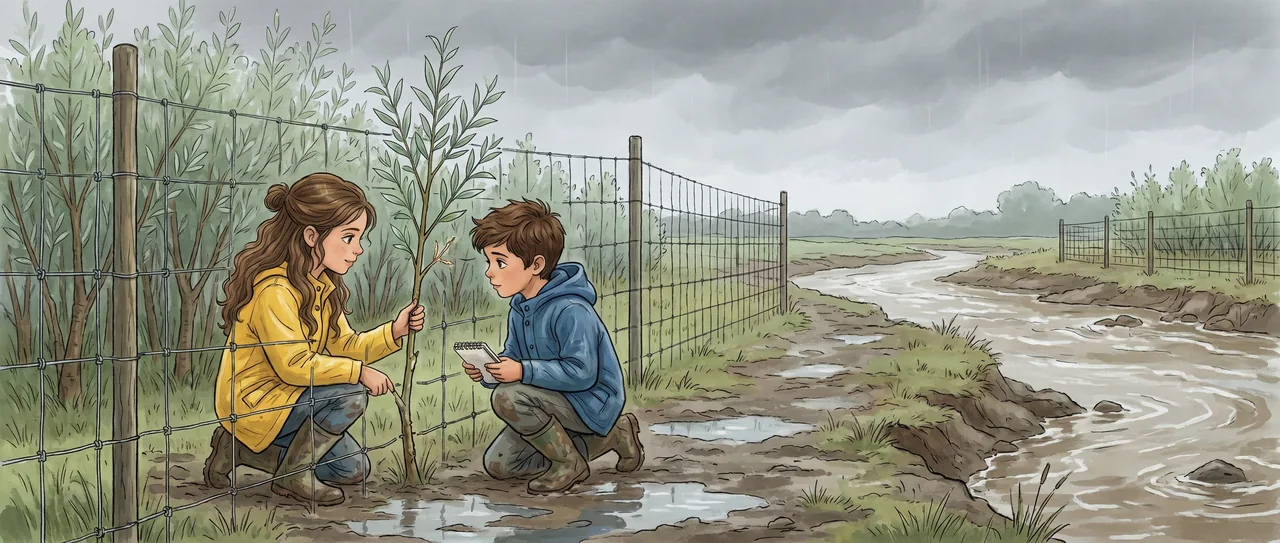
Maya stood in the mud beside the North Fork River and stared at the chewed sticks poking from the bank. The reserve had planted them in straight rows last autumn, hundreds of willow cuttings pushed into wet soil like green promises. Today they looked like sharpened pencils after a very angry art class.
Soren crouched beside one and opened his paper notebook on his knee. The pages curled in the damp air.
"Don't write sad things yet," Maya said.
"I'm measuring sad things," Soren said.
He held his pencil against a cut stem. The bite was ragged and slanted.
Maya looked upriver. The fenced test patch, only a few steps away, was bursting with leaves. Inside the wire cage, willow shoots crowded each other, silver-green and wet with rain. Outside the cage, the same mud, the same river, the same sky, almost nothing.
"That is rude," Maya said.
Dr. Lian hurried down the path with a bucket of orange flags bumping her leg. She was the reserve ecologist, but today she looked more like a person being chased by a calendar.
"Please tell me some of them survived," she said.
Soren pointed at the cage.
Dr. Lian looked, then looked away too quickly. "Good. We'll bring the visitors there first. The board wants photographs with leaves. We can explain the rest later. Maybe drought stress. Maybe flood damage. Maybe planting depth. Restoration is complicated."
Maya touched one of the chewed stems. It wobbled.
"Drought doesn't have front teeth," she said.
Dr. Lian closed her eyes for half a second. "I know. Deer. I know. But today is Willow Day, not Deer Ate Everything Day. The donors arrive in forty minutes, and the pump on the stream table is clogged, and someone put the beaver skull in the lunch fridge. Please, both of you, put flags by anything still alive."
She hurried away.
Soren watched her go. "She knows it isn't drought."
"She doesn't want to say the thing before the thing," Maya said.
"Which thing?"
Maya pointed at the bitten willow, then at a deer print pressed deep in the mud, then at the open hills beyond the cottonwoods.
Soren waited.
"I don't know yet," she said. "But the cage is shouting."
They flagged the living willows first. It did not take long. The orange flags clustered inside the fence like a tiny festival. Outside, the flags stood far apart.
Soren measured the bite heights. Most were between his knee and his hip. He found clipped willow tips scattered on the mud. He found pellet droppings near the trail. He found hoofprints where the bank had slumped.
Maya walked along the fence line. Every willow inside had leaves. Every willow outside had been bitten back, except one skinny stem growing through the wire from the inside to the outside. The part inside the fence had leaves. The part outside ended in a chewed nub.
"Soren," she said.
He came over.
She did not explain. She held the stem still with one finger.
Soren looked at the leafy side. He looked at the bitten side. He looked at the fence between them.
"Same plant," he said.
"Same roots. Same rain. Same mud."
"Different mouths."
The reserve's visitor center had a stream table under the porch roof, a long tray of sand with a little pump that sent water curving through it like a river. It was supposed to show how willow roots held banks together. Today the pump made a tired humming noise and spat bubbles.
Maya found the clog first. A willow leaf had been sucked into the tube.
Soren fixed the tube while Maya searched the supply boxes for something better than flags. She found laminated animal cards from an old school program. Elk. Deer. Beaver. Willow. Songbird. Coyote. Wolf.
The wolf card was at the bottom, its corners bent.
Maya held it up.
Soren said, "There aren't wolves here."
"That's why it's heavy."
He took the card and turned it over. On the back, in faded marker, someone had written: Last confirmed breeding pack in this valley, nineteen forties.
Maya looked toward the ridge. It was only a ridge, brown grass and dark firs under a rain-heavy sky. Thirty seconds before, it had been background. Now it had a missing shape on it.
The chewed sticks, the deer prints, the empty beaver pond downstream, the caged willows, the bare bank, the old wolf card in her hand, none of them sat still anymore. They pulled on one another.
Soren laid the cards on the porch floor.
"Wolf affects deer," he said.
"Deer affect willow," Maya said.
"Willow affects beaver."
"Beaver affects water."
They both looked at the river, brown and fast, biting at its own bank.
Dr. Lian appeared carrying a coil of extension cord over one shoulder. "Why is the wolf card out?"
"Because the willows are gone," Maya said.
"Predators are a public meeting, not a children's activity."
"The deer made it a willow activity," Soren said.
Dr. Lian looked at him.
He did not look away. "We can show the fence plant. Same plant, different side. We can show the stream table with banks. We can show the cards. We don't have to say wolves fix everything. We can say when top animals disappear, other things change all the way down."
"And sideways," Maya said. "And wetly."
The first visitors arrived in raincoats, shaking water from their sleeves. There were board members with clean boots, neighbors with muddy ones, and a photographer who kept asking where the greenest place was.
Dr. Lian started with her usual welcome. She thanked the nursery, the volunteers, the river district, and the people who had brought muffins. Then she looked at the neat speech card in her hand.
Maya could see the exact moment Dr. Lian decided not to read it.
"Our willows had a difficult winter," Dr. Lian said. "Two of our junior volunteers have a better demonstration than my speech."
Maya and Soren did not stand behind the table. They led everyone into the mud.
Soren showed the bitten stems and the measurements. He showed the hoofprints. Maya showed the one willow growing through the fence, leafy on one side, chewed on the other. The photographer stopped asking for the greenest place.
Then they brought the group to the stream table.
Maya pressed willow roots, gathered from already fallen cuttings, into one sandbank. Soren left the other bank bare. He started the pump. Water curled through the channel. The bare side slumped first, a soft brown collapse. The rooted side held longer, not forever, but longer.
"Willows aren't decorations," Soren said.
Maya set the deer card above the willow card. She set the beaver below it. She set the river below that.
A board member with silver buttons on her coat said, "We already budgeted for more fencing."
"Fencing helps this patch," Maya said.
Soren placed the wolf card above the deer.
Nobody spoke for a moment.
Rain ticked on the porch roof. In the stream table, the little river kept working at the sand.
Dr. Lian said, "Large predators used to live in this valley. Without them, deer can feed longer and more often in places like this. In some ecosystems, when predators return, browsing changes, young trees recover, and other animals come back too. It is not magic. It is not simple. But it is real."
Maya liked that. Not simple did not mean no. It meant the question had roots.
The board member looked from the wolf card to the river. "We are here to fund willows."
"Then fund what lets willows grow," Soren said.
His voice shook a little on the last word, but it stayed there.
After that, people walked the river differently. They bent over the bitten stems. They put their fingers through the fence and touched the leaves inside. Someone asked about deer numbers. Someone asked about wildlife corridors. Someone asked how a valley begins to make room for an animal that is not there.
Dr. Lian did not answer quickly. She looked almost relieved not to.
The rain thinned to mist. The visitors drifted back toward the muffins and maps. The stream table pump hummed softly, sending its small river around the bend again and again.
Maya picked up the laminated cards. The deer card was muddy. The willow card had a bent corner. The wolf card was still in Soren's hand.
"You didn't put it away," she said.
"It isn't done being useful," he said.
On the magnetic map, the North Fork River was a blue thread. Maya put one finger on the bare reach. Soren held the gray wolf over the ridge. Together they let it click into place.
Read the interactive version, listen to the narration, and earn a gold star →
A science-verified short story for curious kids · Curiosity Land