The Ones That Asked Again
The first rule of the quiet wall was that it had to stay quiet.
That was what the observatory director said when she gave Maya and Soren the console nobody else wanted.
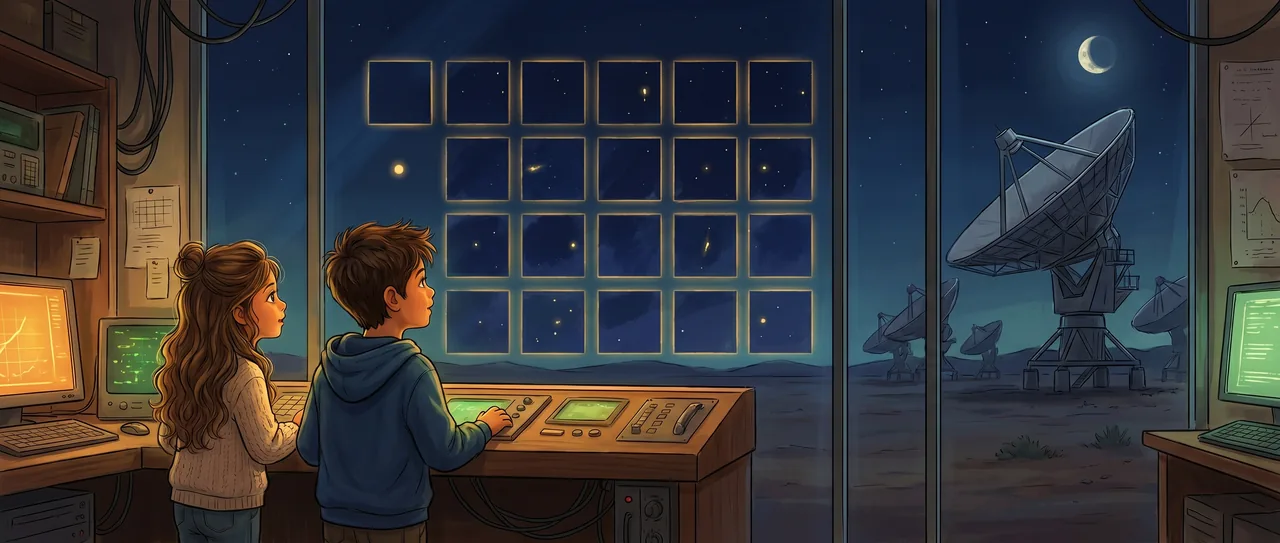
The quiet wall was a sheet of glass taller than a classroom. It showed the radio sky as it arrived, cleaned and sorted by the observatory’s companion system. Satellites were gray. Pulsars were blue. Known fast radio bursts were gold, little pinpricks that appeared and vanished faster than a blink.
“Visitors like the gold ones,” the director said, balancing a cup of coffee, a headset, and three expressions at once. “But not too many. If everything flashes, nobody knows where to look. Your job is to keep the duplicate filter on and the explanations short.”
Maya was already looking past her shoulder.
Soren said, “What counts as duplicate?”
“The same patch of sky, same kind of event, too close together,” the director said. Her headset chirped. “The companion handles it. If something repeats, it is usually already cataloged, or it is junk. Keep the wall calm.”
She walked away before Soren could ask what usually meant.
The observatory sat in a high desert bowl where the air was dry enough to crack lips. Beyond the glass, dishes tilted in rows, white and patient, each one listening to a piece of sky no eye could see. Inside, the visitors gathered around meteorite cases and moon-grown lettuce. The quiet wall glimmered politely.
Gold dot.
Gone.
Gold dot.
Gone.
Each one had been a flash of radio energy lasting a few milliseconds, stretched by its trip through space so the high radio frequencies arrived just before the low ones. Soren liked that part. It was as if the universe had combed each burst with invisible fingers on the way here.
The all-sky counter in the corner kept climbing. The number was not how many the observatory caught. It was an estimate of how many fast radio bursts were going off across the whole sky every day, most of them where nobody happened to be listening.
Maya tapped the glass under the counter.
“It’s too neat,” she said.
“It’s supposed to be neat,” Soren said. “Quiet wall.”
“No. Neat like swept.”
Soren looked at the console. The companion had a column labeled suppressed. The number in it was larger than the number on the wall.
He opened the log.
A red warning popped up.
Duplicate stream hidden for public display.
Maya leaned in. “Show them.”
“That is the opposite of our job.”
“Show one second.”
Soren made a copy of the display in the private pane, not the wall. He turned the duplicate filter off for the copied stream only.
The private pane flowered.
Gold appeared, vanished, appeared again. Not everywhere. In little places. A patch near the constellation Cygnus flickered twice. A patch near the southern edge of the survey flickered three times. Some were marked cataloged repeater. Some were marked probable interference. But three of them had no name beside them at all.
Maya pointed before Soren had finished reading.
“That one is wrong.”
“Which kind of wrong?”
“Wrong wrong. It came back, but the label did not.”
Soren opened the event bundle. The companion unfolded the data into thin colored curves. Each burst had the same sweep, high frequencies first, low frequencies later. The delay was too large for anything near Earth. The signal had arrived at separated dishes in the pattern expected from the same place in the sky.
Soren checked the catalog. Nothing.
He checked satellites. Nothing.
He checked local equipment notices. Two coolant pumps, one door alarm, no radio test.
“Maybe it is a side lobe,” he said.
Maya shook her head. “Side lobes wobble when the dish moves. This is pinned.”
Soren did not ask how she could tell so fast. He zoomed into the position measurements. They overlapped like three beads on the same string.
On the big wall, the visitors saw one neat gold dot and an explanation: Fast radio bursts are brief flashes from far beyond our galaxy.
In the private pane, the same unknown place asked again.
The director hurried past with two donors wearing silver name badges.
“Everything good?” she asked without stopping.
“No,” Maya said.
The director stopped.
Soren said, “The duplicate filter is hiding uncataloged repeats.”
“That is what filters do,” the director said. “They hide clutter.”
“It has the same dispersion sweep,” Soren said. “Same sky position. Not in the repeater catalog.”
The director looked at the private pane. Her mouth tightened, not angry, exactly, but scheduled.
“Put it in the morning review queue,” she said. “Tonight is public night. We cannot chase every hiccup.”
Maya said, “It hiccuped three times.”
“Lots of things hiccup,” the director said. Her headset chirped again. “If it is real, it will still be interesting tomorrow.”
She moved away with the donors.
Soren stared at the three beads.
“Will it?” Maya asked.
“I don’t know.”
That was why his notebook existed, usually. But the console did not need a notebook. It had the last twelve hours of sky buffered in stacked slices, more radio than any person could watch. The companion could search it if it was asked the right way.
Soren did not type find more. That was too soft.
He typed: Search buffered survey for uncataloged sources with two or more fast radio burst candidates sharing position within localization error and consistent dispersion measure. Exclude cataloged repeaters and known interference.
The companion answered with a spinning circle.
Maya was still watching the private pane.
“They taught it to throw away the answer,” she said.
“They taught it to throw away repeated things.”
Maya’s face changed in the reflection of the glass. Not a smile. Not surprise. Something sharper.
“Same thing.”
The spinning circle stopped.
Eighteen results.
For a moment neither of them touched the console.
The private pane arranged the sky into eighteen small squares. In each square, a place with no catalog name had flashed, gone dark, and flashed again. Some twice. One five times. Each flash had crossed space for so long that the space between galaxies had left its fingerprints on the radio waves.
The quiet wall behind them looked suddenly fake, like a tidy picture hung over a window.
Soren opened the five-time source. The times were uneven. Not a clock. Not a beacon. Not anything that made a simple pattern he could hold.
Maya whispered, “Across the universe, things keep doing it.”
Soren said, “And we kept deleting the second sentence.”
A group of visitors laughed at the moon lettuce. Someone dropped a spoon in the café. Outside, one of the dishes adjusted by a few degrees, smooth as a bird turning its head.
The companion posted a question in the corner of the private pane.
Candidate cluster exceeds youth access threshold. Submit real-time follow-up request?
Below it were boxes. Source. Evidence. Reason.
The source box filled itself.
The evidence box listed the positions, the sweeps, the repeated flashes, the missing catalog names.
The reason box stayed empty.
Soren put his fingers on the keys, then stopped. “It wants a reason.”
Maya said, “Give it the real one.”
Soren typed: They repeat, and no one has asked why yet.
The companion did not accept it.
Reason requires observable objective.
Maya made an impatient sound. “Fine.”
She took the keyboard and typed: Capture next burst from same position to refine localization and compare burst structure.
Soren added: Preserve repeated candidates. Do not suppress as duplicates.
The request turned amber.
The director appeared beside them so suddenly that Soren’s shoulders jumped.
“What did you submit?” she asked.
“A follow-up,” said Maya.
“You do not have authority to interrupt the main schedule.”
“It is youth access time,” Soren said. “The threshold says we can request if the evidence is in the buffer.”
The director looked at the amber request. Then at the eighteen squares. Then back at them.
For once, her headset chirped and she ignored it.
“Eighteen?” she said.
Soren nodded.
“Uncataloged?”
Maya pointed to the empty name fields.
The amber request changed to green.
Follow-up granted. Waiting for source window.
The director slowly set her coffee on the console and missed the coaster.
On the public wall, the quiet explanation vanished. The eighteen squares appeared instead, not neat, not quiet, each one holding a patch of sky where something far away had repeated itself and been mistaken for clutter.
Nobody in the visitor gallery laughed now.
The countdown began at ten seconds.
Maya and Soren stood shoulder to shoulder at the console.
Outside the glass, the nearest dish tilted away from the Moon and began to listen.
Read the interactive version, listen to the narration, and earn a gold star →
A science-verified short story for curious kids · Curiosity Land