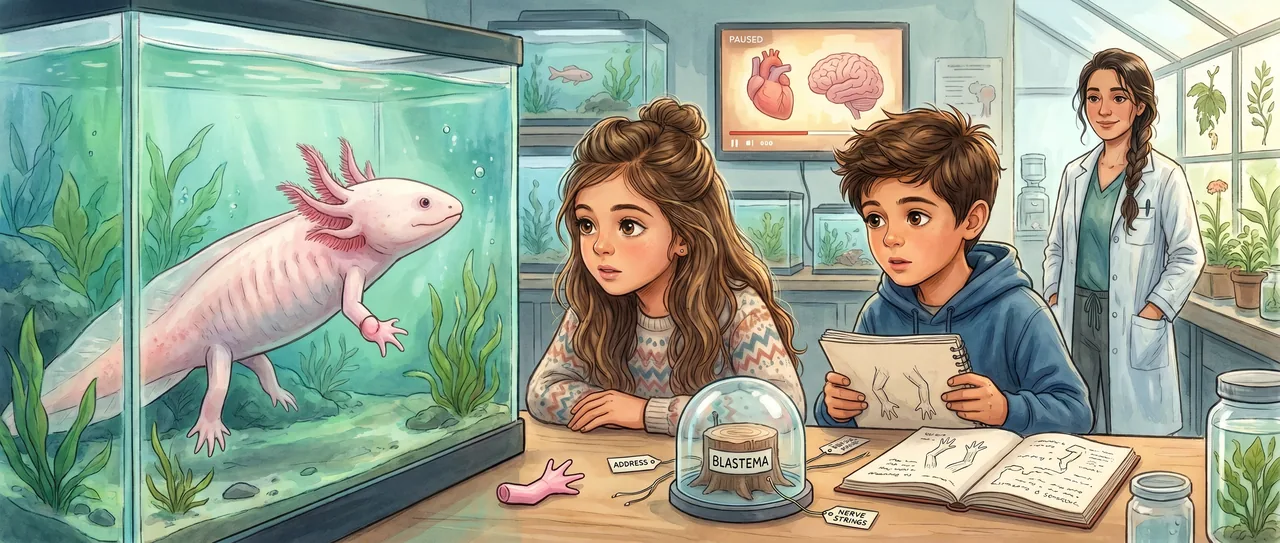
The Foot That Remembered
The first thing Maya saw was that the plastic foot was wrong.
It sat on the lab table beside the axolotl tank, pink and shiny, with four tiny toes. A sign behind it said: AXOLOTLS CAN REGROW LOST LIMBS.
Maya leaned closer.
'Wrong,' she said.
Soren had his paper notebook open already, because the lab smelled like pond water and clean glass and something important. He looked from the model to the pale axolotl floating behind the tank wall. Feathery gills waved from the animal's head like red seaweed.
'Which part?' he asked.
'All of it,' Maya said. 'It looks clipped on.'
Dr. Ibarra, who ran the Saturday tour, came in carrying a crate of wet filters against her hip. Her hair had escaped its braid in three directions.
'Please tell me the display is not on fire,' she said.
'It lies,' Maya said.
Dr. Ibarra shut her eyes for one second. 'A small lie or a grant-funding lie?'
Soren touched the plastic foot. It came off with a click. Under it was a smooth round stump, also plastic.
'It says they regrow limbs,' Soren said. 'But this makes it seem like the limb appears ready-made.'
'Children like things that click,' Dr. Ibarra said. 'Visitors arrive in forty minutes. If you can make it truer before then, do it. If not, please do not dismantle my only table display into a philosophical puddle.'
She hurried away toward the water pumps.
Maya was already pulling the foot off and putting it back on. Click. Click. Click.
'No,' she said. 'That is a toy lizard tail trick. This is different.'
The axolotl in the tank drifted forward. One front leg was shorter than the other. At the end, where a foot should have been, there was a pale nub, smooth as a rice grain. The sign on the tank said the animal had arrived injured from a canal filter six weeks before.
Soren wrote six weeks, then stopped. He turned the page sideways and drew the axolotl's two front legs.
'It is not doing nothing,' he said.
Maya tapped the glass gently, not to call the animal, just once, as if checking whether glass and water and creature all belonged to the same world.
At the nub, the skin was not wrinkled. It was rounded, soft-looking, busy without moving.
On the lab bench beside the model were pieces Dr. Ibarra had not used. Colored beads. Thin rubber strings. Small magnets. Labels that said skin, bone, nerve, muscle.
Soren picked up a magnet. 'Maybe we build it in layers.'
'From the inside out?' Maya asked.
'Or outside in.'
Maya put a clear plastic dome over the stump. Then she stuck beads inside it until it looked like a cupcake with sprinkles.
Soren frowned. 'That says the beads know what to become because we put them there.'
'They do know,' Maya said.
'How?'
Maya opened her mouth, then closed it.
That was the problem with her head. It often arrived somewhere before the path had finished building itself.
Soren flipped through the printed pages on the bench. There were photographs from different days. The injured leg, then a bump, then a paddle shape, then tiny rays where toes would separate. Under one image was the word blastema.
'Here,' he said.
Maya came around to his side.
The first photo after the injury did not show a foot. It showed a wound covered over. Then a little mound of cells. Not a scar. Not a scab. A beginning.
Soren read quietly, moving his finger beneath the line. 'Cells near the injury gather and form a blastema. Nerves are important. The cells keep information about position.'
'Position,' Maya said.
She grabbed the plastic foot and held it backward against the stump. The toes pointed toward the axolotl's elbow.
'Bad foot,' she said.
Soren almost smiled. 'So the display needs addresses.'
'Not names. Addresses.'
They emptied the model. Soren sorted the beads into shallow trays. Maya cut tiny paper tags from an old brochure. She wrote near body on some and far from body on others. Soren wrote top, bottom, front, back, because he did not trust a limb that had only two directions.
Maya watched the injured axolotl again. Its short leg moved when the animal paddled. The nub did not drag uselessly. It rode at the end of the limb like a promise the body had not finished saying.
On a screen across the room, a paused video glowed. Soren noticed because the file name said heart_regrowth, and that seemed too large a phrase to leave alone.
He touched the trackpad.
A tiny transparent axolotl heart pulsed on the screen. A dark mark showed where tissue had been damaged in an old research video. The next images stepped through days. The gap changed. Cells moved and multiplied. The heart kept beating.
Maya came very still.
'It does hearts too,' Soren said, though the words felt too small for the screen.
Maya reached past him and clicked the next file.
Brain_section_regeneration.
For a moment neither of them spoke.
The images were not like movie brains, not glowing with thoughts. They were slices stained in colors, branching and speckled. The caption said axolotls could replace lost neurons in parts of the brain after injury, and the new tissue could connect and function.
Maya stepped back from the table.
The room had not changed. Tanks bubbled. Filters hummed. Dr. Ibarra argued with a hose somewhere behind the greenhouse door. But the axolotl's pale body was no longer small in the water. It was a country with roads that could be rebuilt, rooms that could be reopened, maps folded inside maps.
Soren looked at his own hand. He bent his fingers. Tendons shifted under skin.
'We scar,' he said.
'Mostly,' Maya said.
'They rebuild.'
'Not like replacing a part,' Maya said. 'Like the place remembers what belongs there.'
Soren looked at the scattered tags. Near body. Far from body. Top. Bottom. Front. Back.
At school, his notebook made people ask why he did not just record everything on a wrist screen. At lunch, Maya stopped halfway through conversations because a pattern on the ceiling tiles had broken. Here, the difference between almost right and true was not decoration. It was the whole limb.
Soren picked up the wrong plastic foot. 'We should make visitors build it incorrectly first.'
Maya's eyes brightened. 'Yes.'
They made the display into a failure.
First, a visitor could click on the finished foot. It looked easy. It looked false. Then the foot fell off, because Maya had loosened the magnet.
Under it, Soren placed the clear dome. Inside were blank beads with no labels.
A card said: A scar would close the place. An axolotl does something stranger.
Maya crossed out stranger and wrote more careful than that.
Soren did not argue.
They added strings for nerves, leading into the mound. They did not make the nerves glow or command anything. They just had to reach the mound, because without nerve signals a limb blastema does not develop normally.
They put address tags around the stump. Not in a neat row. Bodies were not rulers. Bodies were neighborhoods.
By the time the visitors came in, Dr. Ibarra had wet sleeves and a skeptical face.
'What happened to my click foot?' she asked.
'It still clicks,' Maya said.
'But now it embarrasses itself first,' Soren said.
Dr. Ibarra looked at the table. She looked at the tank. She looked back at the table, and her face changed in the smallest possible way.
'Proceed,' she said.
with her hands in her damp lab coat pockets.
'I was attached to the click foot,' she said.
'It was very clicky,' Soren said.
'It was wrong,' Maya said.
'Yes,' Dr. Ibarra said. 'It was.'
She took the crossed-out card and read it aloud. 'More careful than that.'
Maya watched the axolotl through the glass. 'Can people learn it?'
Dr. Ibarra did not answer quickly. That was better than answering easily.
'We are learning pieces,' she said. 'How wounds heal without scarring. How cells talk. How nerves matter. How some animals keep abilities we mostly do not. The honest answer is that there is a great deal we do not know yet.'
Soren closed the heart video. The last image stayed on the screen for a second, a small bright chamber caught mid-beat.
Maya picked up the plastic foot and set it beside the tank, not attached to anything.
In the water, the pale axolotl lifted its new foot and pressed all four tiny toes against the glass.
Read the interactive version, listen to the narration, and earn a gold star →
A science-verified short story for curious kids · Curiosity Land