The Empty Features Box
The first time their sorter grabbed a seashell and dropped it into the plastic bin, Maya said, "No."
The second time, when it pinched a white pebble, lifted it proudly, and clattered it into the same bin, Soren made a mark in his notebook.
The third time, the tiny robot arm picked up nothing at all. It closed its claw on a shadow.
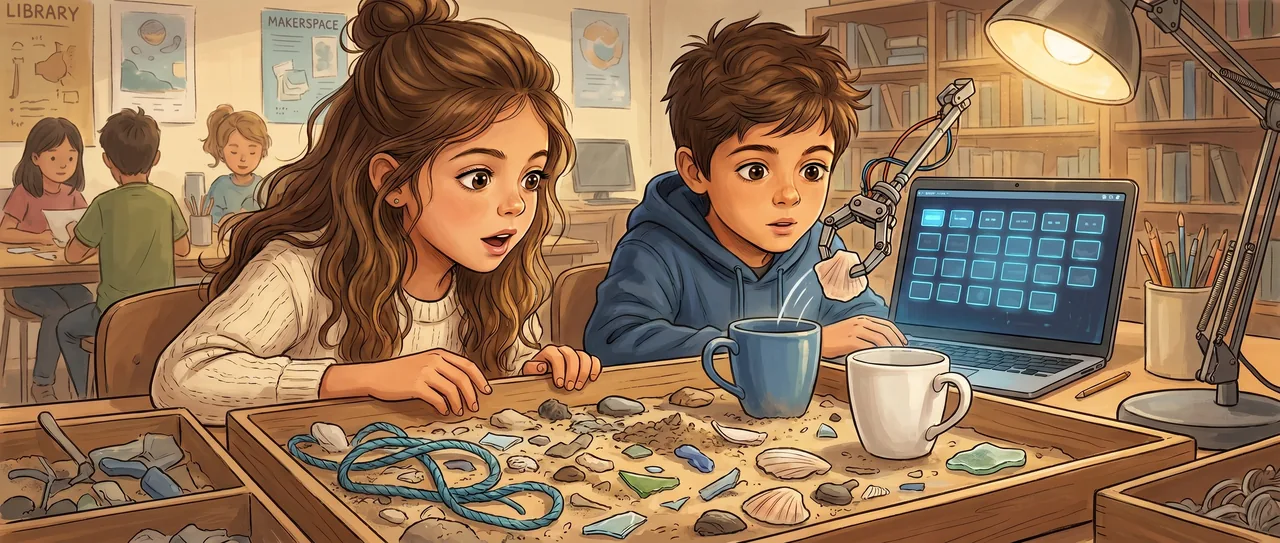
Maya leaned close to the tray of beach things. There were bottle caps, bits of blue rope, clear plastic pellets, shells, brown glass, gray stones, and sand that had escaped from everything. The camera above the tray stared straight down. On the laptop screen, their rule list looked very clever.
If round, maybe plastic.
If bright, maybe shell.
If transparent, maybe glass.
If blue, definitely human-made.
The librarian stood behind them with a mug that said Ask Me About Circuits. She had built the makerspace sorting table herself and loved anything with labels. Every drawer in the room had a printed label. Some drawers had labels for the labels.
"Feature rules are tidy," she said. "A machine should use reasons people can read. That is civilized."
Maya poked the clear pellet with one finger. It rolled exactly like a seed.
"The ocean is not civilized," she said.
Soren wrote: shadow counted as object.
The workshop challenge was simple. Sort twenty beach samples. Plastic into the blue cup. Everything else into the white cup. The camera saw the tray. The program decided. The arm obeyed.
They had chosen Feature Builder because it sounded like making a creature with bones. You gave it parts to look for. Edges. Color. Roundness. Shine. Size. The librarian had shown them the sliders, then rushed away to fix a printer that was making a sound like an angry goose.
Maya and Soren had spent the morning adding rules.
Now the rules were betraying them one by one.
"Glass is transparent," Soren said.
"So is that," Maya said, pointing to a plastic pellet.
"Shells are curved."
"So are bottle caps if they are smashed."
"Pebbles are gray."
Maya held up a gray bottle cap.
Soren crossed out three lines. His notebook page looked like a tiny battlefield.
On the laptop, beside Feature Builder, there was another button they had ignored. Learner. It had almost no controls. Upload examples. Mark answer. Train.
"That one is too empty," the librarian had said earlier. "It will want lots of data. Feature rules are smarter."
Maya clicked it.
The screen changed to a blank grid.
Soren looked at the robot arm, then at the tray, then at the clock. "We have forty minutes."
"We have twenty wrong answers," Maya said.
She dragged the saved camera images from the failed runs into the grid. Shell in plastic bin. Pebble in plastic bin. Shadow with a claw around it. Each mistake appeared as a square.
"Those are bad examples," Soren said.
Maya shook her head. "They are exact examples."
Soren did not answer right away. He took the clear pellet, the white shell, and the brown glass and placed them under the camera one at a time. He clicked plastic, not plastic, not plastic. Then he turned each object and did it again.
Maya added a bottle cap half buried in sand. Plastic. Blue rope in shadow. Plastic. Wet shell under a lamp. Not plastic. Pebble beside a plastic pellet. One click, then the other. She did not make the tray neat. She made it worse.
"More ugly ones," she said.
Soren moved the lamp left and right. The same shell became bright, then dull, then striped with shadow. He photographed every version.
The librarian came back carrying a printer gear in one hand. "You switched to the hungry one."
"We are feeding it," Soren said.
"With chaos," the librarian said.
Maya looked at the tray, where plastic and not-plastic touched and overlapped and hid parts of each other. "With beach."
The librarian opened her mouth, closed it, and went to find a screwdriver.
They made examples until Soren’s hand cramped from clicking. The grid filled with small squares. Plastic. Not plastic. Plastic. Not plastic. Nothing in the program asked for roundness. Nothing asked for shine. It only showed mistakes decreasing as it trained.
The first test was not perfect.
The robot arm picked up a shell fragment and hovered over the blue cup. Maya made a sound through her teeth.
The arm paused, swung back, and dropped the shell into white.
"It changed its mind," Soren said.
"It checked again," Maya said.
"No," Soren said, leaning closer to the screen. "The camera took a new image. The numbers changed."
There were no words on the decision display, only a field of tiny boxes lighting and dimming as the image moved through the learner. No box was named shell curve or bottle-cap blue. No one had told it that beach glass could be brown or that plastic pellets could look like fish eggs. It was not using their list. It was using the pile.
Maya’s fingers went still on the edge of the table.
Across the makerspace, the angry printer gave one last honk and fell silent.
Soren fed in the worst image again, the shadow that had fooled their rules. The learner ignored the shadow and found the blue rope crossing through it.
"Again," Maya said.
He rotated the tray. The rope moved to a corner. The learner found it.
He sprinkled sand over half the cap. The learner found the cap.
Maya put a white plastic spoon beside a white shell. The old rules would have cried. The learner lifted the spoon.
The librarian had come back without them noticing. She stood with the screwdriver in her apron pocket and watched the arm drop the spoon into blue.
"Huh," she said, which sounded like a drawer label peeling off.
For the final run, the librarian chose the twenty objects. She tried to be fair, but she also tried to be tricky. She used clear pellets, broken shells, a green glass chip, two gray stones, a black bottle cap, a knotted thread of fishing line, and one piece of plastic so scratched and pale it looked like bone.
Maya and Soren stood on opposite sides of the laptop. Maya watched the tray. Soren watched the errors.
The arm moved.
Plastic. White cup. White cup. Plastic. Plastic. White cup. It missed one fishing-line knot, then caught the second piece when Soren added three more examples and trained again. Not magic. Not guessing. Work, then change.
When the last object dropped, the blue cup held only plastic.
The librarian picked up their old Feature Builder printout. It had arrows and circles and careful words. She held it beside the messy grid of examples.
"There is an old lesson in machine intelligence," she said. "People kept building clever knowledge into programs. Chess patterns. Speech rules. Vision tricks. Again and again, the plain learners with enough computation and enough data came along and beat the clever parts. Researchers called it bitter because the clever parts were theirs."
Maya took the printout from her. She did not crumple it. The rules had not been stupid. They had just been small.
Soren looked at the filled grid. Hundreds of little failures and near failures stared back at him. The images nobody would have chosen for a poster. The shadow. The buried cap. The shell pretending to be plastic. The plastic pretending to be shell.
"It needed the weird ones," he said.
"Yes," the librarian said. Then she smiled in a crooked way. "That part is not bitter."
On the laptop, a folder blinked open. City Beach Archive. Unlabeled survey images.
"Those came from last month’s cleanup drones," the librarian said. "No one has sorted them yet. Too many. Too messy. Too many almost-things."
Maya reached for the tray. Soren slid his notebook aside.
The librarian set a fresh blue cup beside a fresh white cup and stepped back.
Maya lifted a clear pellet with the tweezers. Soren placed an empty tray beneath the camera. On the screen, the button read: Add first example.
Read the interactive version, listen to the narration, and earn a gold star →
A science-verified short story for curious kids · Curiosity Land