The Cost of a Blue Square
Soren was sure the most important message would cost the most.
That seemed fair. If a message mattered, it ought to be heavy. It ought to take up space. He wrote in his paper notebook, IMPORTANT EQUALS BIG, then put a question mark after it because Maya was already making the face she made when something did not fit.
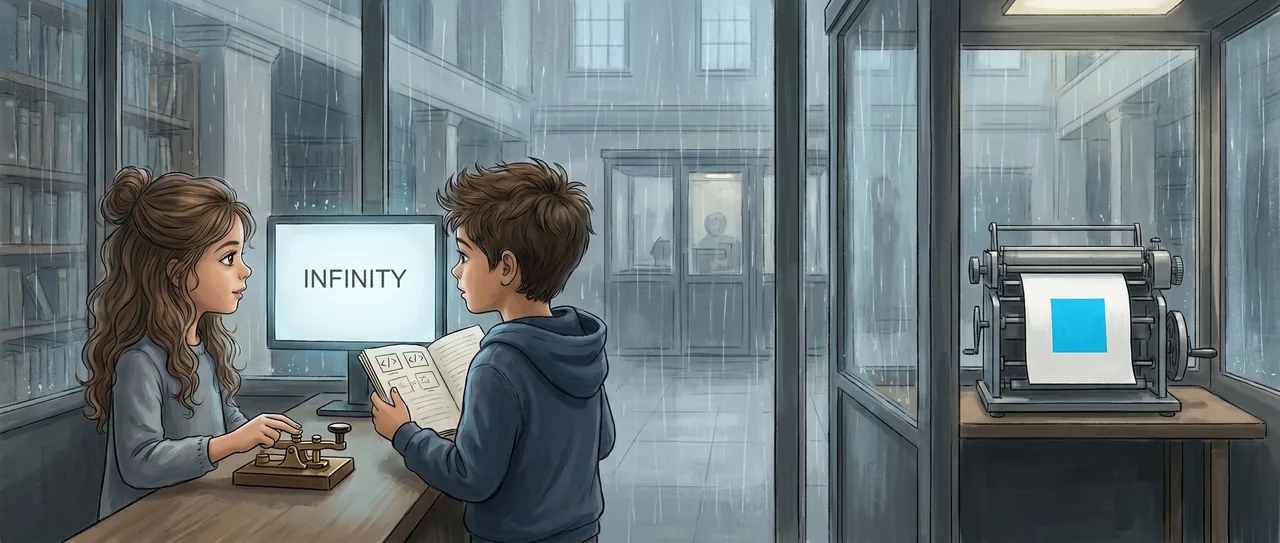
The Whisper Room had no chairs. It had two glass booths facing each other across the library courtyard. In this booth, there was a brass key, a screen, and a slot for picture cards. In the other booth, far away behind the rain-streaked glass, there was a printer with a roll of white paper.
Between them was the thinnest possible connection the library would allow for a game. One wire. One pulse at a time. Yes or no. Click or silence.
The screen said, SEND THE PICTURE. SPEND AS FEW SURPRISES AS POSSIBLE.
“That is not a unit,” Soren said.
Maya tapped the brass key. It clicked. “It is here.”
A little counter woke on the screen. It did not say letters. It said bits.
The first card slid from the slot. It showed a white square.
“That is easy,” Maya said.
She reached for the key.
Soren caught her wrist, not to stop her, only to slow the world down. “Wait. The other side needs to know what to print.”
The screen changed before Maya could argue.
THE RECEIVER EXPECTS A WHITE SQUARE.
The far printer across the courtyard clicked once. A perfect white square slid out.
The counter did not move.
Zero bits.
Soren stared at the counter. “We did not send anything.”
Maya smiled. “Exactly.”
“That cannot count.”
The screen answered as if it had been waiting for him.
IF THE MESSAGE WAS CERTAIN, IT CARRIED NO SURPRISE.
Maya leaned close to the glass. “It already knew.”
Soren crossed out IMPORTANT EQUALS BIG. He did not write the replacement yet.
The next card slid out. It showed two squares, one black and one white.
The screen said, THE RECEIVER EXPECTS EITHER BLACK OR WHITE. EACH IS EQUALLY LIKELY.
Maya pressed the key once for black.
Across the courtyard, the printer made a black square.
The counter jumped.
One bit.
Soren’s fingers moved without the notebook. “One yes-or-no question.”
The third card was mostly white. In the lower left corner, one tiny black square sat by itself, looking like a crumb on a plate.
The screen said, THE RECEIVER EXPECTS A WHITE FIELD WITH ONE BLACK SQUARE SOMEWHERE.
“How many places?” Maya asked.
Soren counted the grid printed faintly on the card. “Sixteen across. Sixteen down.”
“That is too many.”
“Not if we do halves.”
He drew the square in his notebook, then drew a line down the middle. “Left half or right half.”
“Left,” Maya said.
He clicked once.
“Top or bottom?”
“Bottom.”
Click.
“Left half of that?”
“Left.”
Click.
They kept cutting the picture smaller with questions. The dot stayed in the chosen piece each time, stubborn and exact. Eight clicks later, the far printer printed a white field with one black square in the lower left.
The counter said eight bits.
Soren looked from the card to the printed copy. “We did not send the white part.”
Maya said, “The white part was boring.”
“It was expected.”
“Same thing, for this room.”
Soren wrote, COSTS THE PLACE WHERE THE GUESS BREAKS.
The room hummed softly. It was not a thinking hum, because machines did not need to hum when they thought, but libraries liked to make machines friendly.
The shrinking box swallowed a row of one hundred white squares and made almost nothing. Then it swallowed a row that went black, white, black, white, black, white, and made a tiny pattern. Then it swallowed a row of speckles with no pattern Soren could see, and the counter spun so fast it blurred.
“It cannot shrink what it cannot guess,” he said.
Maya was at the predictor. It showed a white square, then another, then another. Its guess bar climbed higher with each one, certain and smug.
The next square on its own little test card was black.
The predictor’s bar dropped as if someone had cut a string.
Maya laughed once, not because it was funny, but because the room had flinched.
“There,” she said. “That one woke it up.”
Soren felt the words before he had a place to put them. The black square had not been bigger than the white ones. It had not been louder. It had simply arrived where the room had left no space for it.
A chime sounded. The final card slid from the slot.
It was a white field with one blue square near the center.
Maya went very still.
Soren checked the printer across the courtyard. Its little cartridges were visible through the glass. White paper. Black ink. Blue ink. The machine could print blue.
The screen said, THE RECEIVER’S MODEL ALLOWS WHITE OR BLACK.
Maya touched the blue square with one finger. “It can print it.”
“But it does not expect it.”
“It expected the black dot, barely.”
“This says blue is not allowed.”
They waited.
The counter changed by itself.
INFINITY.
Not a huge number. Not a spinning blur. The word sat there clean and impossible.
Maya whispered, “That is not a cost. That is a wall.”
Soren’s mouth had gone dry. “Under the model.”
“What?”
“If the model says blue can never happen, then no number of ordinary clicks means blue. The message does not fit through the old alphabet.”
Maya turned toward the brass key. “Then we do not send blue first.”
Soren looked at her.
“We send a new alphabet.”
The screen did not help. It only showed the blue square, the narrow wire, and the waiting printer.
Soren flipped to a clean page. He drew three tiny boxes.
“White is zero zero,” he said. “Black is zero one. Blue is one zero.”
Maya shook her head. “The other side does not know that yet.”
“So the first message says, stop using the old code.”
“There is no code for that either.”
They stood in the humming room. Rain moved down the glass between the two booths. Across the courtyard, the printer waited with its blue cartridge shining like a trapped piece of sky.
Maya walked to the shrinking box. She ran the old tests again, white row, striped row, speckled row. Then she went to the predictor and let it guess white until it became certain. She pressed the black test square and watched the bar fall.
Soren watched her watching.
“What made it recover?” he asked.
Maya pointed. After the black square, the predictor did not break. It widened its next guess. White was still likely, but black had a little room now.
“It learned a crack,” she said.
Soren stared at his three boxes. “We need a crack that is already legal.”
Maya came back fast. “Black is legal.”
“The card has one blue square.”
“Before the picture, send a black square where no picture starts. A warning mark.”
Soren looked at the instructions. The receiver expected the picture to begin only after a start pulse. Anything before the start pulse was training. Not picture. Not counted as the card.
The room had not hidden it. It had written the rule at the bottom in small plain letters, where a person in a hurry would treat it like dust.
Soren wrote the training line carefully. First, a legal black square. Then a pattern saying, when the next two clicks are one zero, use blue. Then the start pulse. Then the location of the square.
Maya tested each part aloud.
“Warning.”
Click.
“New color table.”
Click click. Click. Click click.
“Start.”
Click.
“Now the place.”
They halved the card again, left or right, top or bottom, smaller and smaller, until the blue square had nowhere else to hide.
The far printer clicked. Paper moved. For a moment there was only white.
Then, across the courtyard, the printer laid a blue square in the center of the page.
Read the interactive version, listen to the narration, and earn a gold star →
A science-verified short story for curious kids · Curiosity Land