The Bone in the Middle
Maya was sure they had put her in the wrong room.
The sign on the door said Fracture Follow-Up, but the nurse handed her a cup of purple drink and said, “All of it, please.”
Maya held the cup away from her face. It smelled like melted grape candy and dentist gloves.
“My wrist is broken,” she said.
“I know,” the nurse said. She stuck a label on a tiny tube. “That is why you are here.”
Maya looked at her cast. It was white, stiff, and already gray at the edges from being dragged across desks, doorways, and the underside of her bed while she tried to find the thing that had rolled away. Her wrist had been cracked for three weeks. It had not once asked for juice.
“I think this is for blood sugar people,” Maya said.
“It is,” said the nurse.
Maya drank the purple drink.
After that came a finger prick, which was annoying but quick, and then a memory test, which was more annoying because the doctor read a list of words in a voice that made every word sound like furniture.
“Candle,” he said. “River. Button. Peach. Ladder. Window.”
Maya repeated them. “Candle, river, button, peach, ladder, window.”
The doctor smiled without looking up from his tablet. He had a pen behind one ear, another pen clipped to his coat, and a third pen in his hand that did not write. He clicked it three times, frowned at it, and put it in his pocket with the others.
“Excellent,” he said. “We are measuring several things today.”
“Several wrong things,” Maya said.
That made him look up.
“My bone broke,” she said. “My pancreas did not. My memory did not.”
The doctor opened his mouth, then his tablet chimed. He looked at the screen, then through the glass wall into the hallway.
“Oh no,” he said. “They are early.”
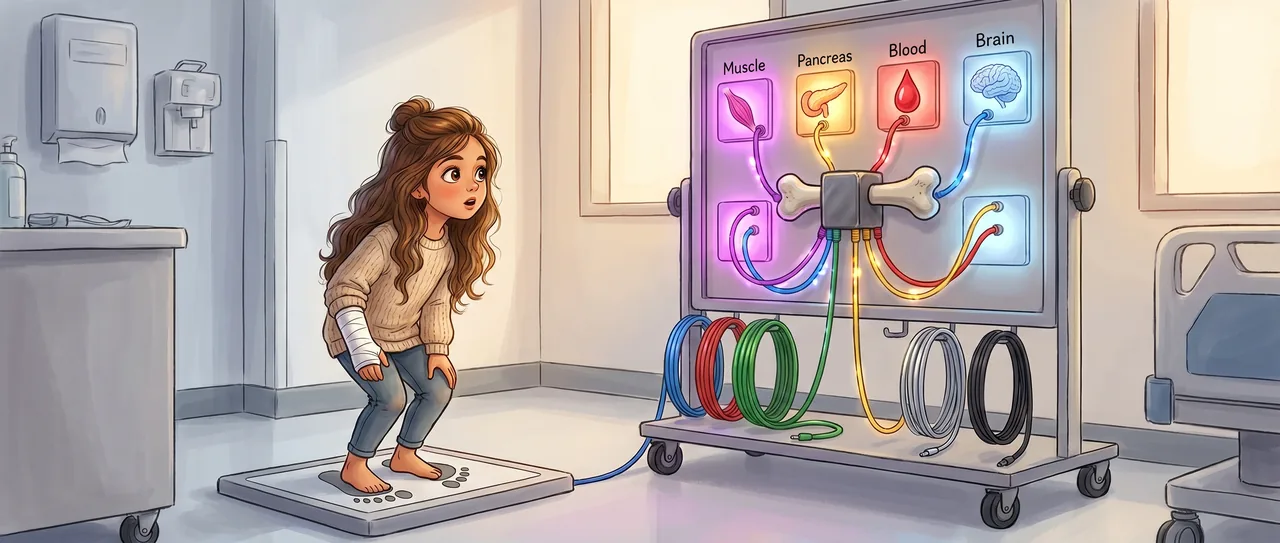
A rolling cart stood outside. On it was a tall board shaped like a person without skin. Bright magnets were stuck all over it. Brain. Heart. Liver. Muscle. Pancreas. Fat. Bone. There were blue cords, red cords, and yellow cords in a nest at the bottom.
The doctor hurried to the cart and waved at the nurse. “If anyone from the school group asks, the body map is almost ready.”
“It has said almost ready since breakfast,” the nurse said.
“It is a software issue,” the doctor said.
Maya slipped off the paper-covered exam table. The purple drink was moving through her like a secret storm. Her cast bumped the doorframe as she followed.
The body map’s screen flashed: MAKE THE BODY KEEP BLOOD SUGAR STEADY AND REMEMBER THE DOOR CODE.
Under that, smaller letters blinked: CONVERSATION INCOMPLETE.
The doctor attached a red cord from Pancreas to Blood.
The board buzzed.
He attached a yellow cord from Brain to Memory.
The board buzzed again, louder.
“Software,” he said, but not to anyone in particular.
Maya looked at the magnets. The pancreas magnet was polished from being handled. The brain magnet had a tiny cartoon lightning bolt. The bone magnet had been pushed to the side, half under a stack of labels that said SUPPORT, SHAPE, PROTECTION.
The doctor tried Pancreas to Liver. Liver to Blood. Muscle to Blood. The board buzzed each time.
“It is not pipes,” he muttered.
Maya liked that sentence. She liked it so much she put it in the part of her head where she kept unfinished things.
The nurse called from the exam room. “Your next patient is waiting.”
The doctor looked at Maya. “Do not drink any more grape liquid,” he said, as if she had planned to steal it. Then he hurried away, one shoe untied, tablet under his arm.
Maya stood alone with the body that would not talk correctly.
She tried the obvious things first because wrong answers were faster if you did not make them fancy. Pancreas to Blood. Brain to Memory. Muscle to Sugar. Buzz, buzz, buzz.
She took the bone magnet out from under SUPPORT.
It was heavier than the others. On the back, in small print, someone had written: BONE CELLS SENSE STRAIN. BONE RELEASES OSTEOCLACIN.
Maya squinted.
Not osteoclacin.
Osteocalcin.
She said it under her breath. “Os-tee-oh-cal-sin.”
The word sounded like a dinosaur wearing a lab coat.
There was a card clipped behind the magnet. She pulled it free.
Bone is living tissue. Some bone cells sense bending and load. Bone-building cells release osteocalcin into the blood. Osteocalcin helps the pancreas release insulin, helps the body handle sugar, and reaches the brain, where it is involved with memory and mood.
Maya read it twice. The first time, the words lined up. The second time, the room changed.
Her cast was not a chalky shell around a mistake. Under it, cells were sealing a crack with minerals, blood vessels, messages, and time. Her skeleton was not the coat rack for the important parts. It was one of the important parts. It was listening when she jumped. It was answering breakfast. It had a word for the brain.
The board blinked again: CONVERSATION INCOMPLETE.
Maya put Bone in the center of the body map.
The magnet clicked into place.
Nothing buzzed.
That was better than a sound.
She picked up a blue cord and connected Muscle to Bone.
The board gave a soft ping.
Maya looked down. There was a square pad on the floor in front of the cart, with footprints printed on it. Nobody had stood there because the cart was in the way.
She pulled the cart back with her good hand, stepped onto the footprints, and bent her knees once.
Inside the board, a line of tiny lights traveled from the legs to the bone magnet.
“Oh,” Maya said.
Not loud. There was no room in the word for loud.
She connected Bone to Pancreas.
Ping.
Pancreas to Blood.
Ping.
Bone to Brain.
Ping.
Brain to Memory.
Ping.
The body map glowed from ankles to skull, not all at once, but in little answering flashes. Muscle tugged. Bone lit. Pancreas lit. Blood lit. Brain lit. The cords did not look like pipes now. They looked like messages going places they were allowed to go because the hard white piece in the middle had stopped being furniture.
The doctor came back with a paper cup of coffee and stopped so quickly that some coffee climbed out.
“You fixed it,” he said.
Maya did not look away from the board. “You put bone in the quiet pile.”
The doctor looked at the SUPPORT labels on the floor.
“I did,” he said.
“It is not quiet.”
“No,” he said. His voice had changed. “It is not.”
The screen flashed: DOOR CODE READY.
Six words appeared.
CANDLE. RIVER. BUTTON. PEACH. LADDER. WINDOW.
Maya laughed once.
The doctor stared. “Those were from your test.”
“I know.”
He set his coffee down, missed the edge of the cart, caught it with two fingers, and did not spill the rest. “We were going to add kidney and gut later,” he said. “Immune cells too. Bone talks to more systems than people used to think. Almost everything has a reply.”
Maya looked at the pile of unused cords. There were more than she had noticed before. Thin green ones. Silver ones. A black one coiled under the cart like a sleeping question.
The doctor picked up the SUPPORT label, turned it over, and wrote on the blank side. He held it out to her.
“What should the new pile be called?” he asked.
Maya took the label but did not write on it.
On the screen, a new question blinked: WHAT ELSE IS BONE SAYING?
Maya lifted the cast until the rough white curve touched her ear and tapped one fingertip against the plaster.
Read the interactive version, listen to the narration, and earn a gold star →
A science-verified short story for curious kids · Curiosity Land