No Ticks to Vega
Maya’s job was to be a photon from Vega.
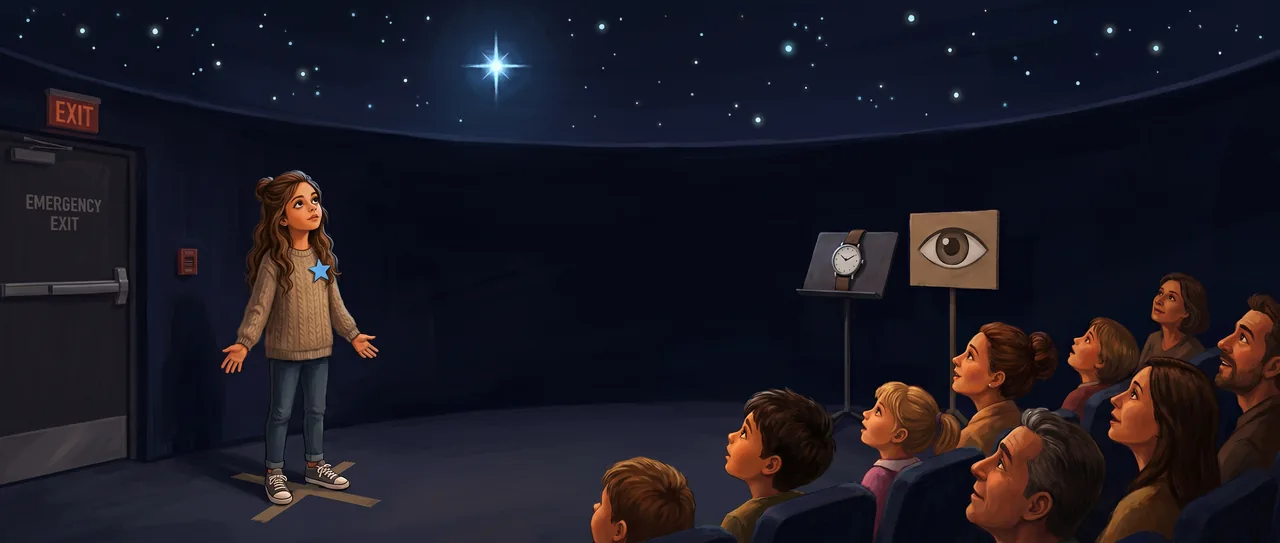
She wore a blue paper star on her shirt and stood on a taped X near the emergency exit, which was Vega because the real Vega would not fit in the planetarium. Across the dark round room, beside the first row of seats, a cardboard eye waited on a music stand.
The script said, "I left Vega twenty-five years ago. I have crossed space for twenty-five years to reach you tonight."
Maya could cross the room. Maya could wear the star. Maya could even say Vega in a way that made the word sound cold and blue and far away.
She could not say the line.
The planetarium director was under the console with a screwdriver in her mouth. Only her boots showed. The projector had started making a clicking sound whenever it turned toward the summer triangle, and the show opened in forty minutes.
"Again," the director said from under the console.
Maya looked at the cardboard eye.
"I left Vega," she said. "Twenty-five years ago."
She stopped.
The boots shifted.
"Maya."
"It sounds wrong."
"It is not wrong. Vega is about twenty-five light-years away. That means light takes about twenty-five years to get here."
"For us," Maya said.
The director slid out halfway. Her hair was full of dust. "For everyone sitting in those seats, yes."
Maya touched the blue star on her shirt. "But I’m supposed to be the light."
The director took the screwdriver out of her mouth. "Physicists do not really say light has a point of view. There is no little chair on a photon. You cannot ride one."
"I know."
"Then say the line in the ordinary way. The audience is not coming for a relativity argument."
Maya looked up at the blank dome. It was waiting to become sky.
The director sighed, but not unkindly. "If you can make it shorter and truer before I fix this clicking, make it shorter and truer. If not, we keep the line."
Then she disappeared under the console again.
Maya took the script and walked from Vega to the cardboard eye. It took fourteen steps if she walked normally, eleven if she made the diagonal sharper and nearly stepped on a seat.
Fourteen steps was not twenty-five years.
Eleven steps was not no time.
She tried running it. Her sneakers squeaked on the polished floor. The blue star bounced against her chest. She arrived at the cardboard eye breathing hard, which was completely wrong. Light did not arrive tired.
She tried standing at Vega and snapping her fingers, then running to the eye before the sound finished echoing. Still wrong. Sound was slow. The echo made everything worse.
She tried wearing her watch on the outside of her sleeve. She pressed the button at Vega, sprinted, pressed it again at the eye.
Three seconds.
The watch had ticked.
Maya stared at the numbers. The problem was not that the watch was too cheap. The problem was that the watch was allowed to be a watch. It sat on her wrist and moved through one second, then another, then another. Anything that could sit still enough to have a wrist was already not light.
Under the console, the projector clicked and stopped.
"Ha," the director said. "Progress."
Maya put the watch on the cardboard eye instead.
That was better. Not solved. Better.
She dragged a stool to Vega and placed the script on it. Then she went to the eye and looked back. From here, Vega was a paper star by an exit door. Twenty-five light-years had become a row of seats, two cup holders, and a crushed popcorn kernel.
The planetarium lights dimmed by accident or because the director had bumped something. The dome bloomed suddenly with stars.
Maya held still.
Vega appeared above her paper Vega, bright and blue-white. The projector made it only a dot, but the name in Maya’s head stretched until the room could not hold it. Light now entering someone’s eye from that star had left before Maya was born. Before the museum repainted the lobby. Before the little tree outside the entrance had grown taller than the parking meter.
For the room, twenty-five years.
For the light, no tick to put between leaving and arriving.
Not a short trip. Not a fast trip. A trip with no place to put a clock.
Maya walked back to the stool. She turned the script over and used the blank side. She did not write much. The show opened in thirty-two minutes, and her letters were too large when she was hurrying.
The director came out from under the console and pressed a button. The stars vanished. The ordinary room returned, with its carpet stains and taped X and cardboard eye.
"Well?" the director asked.
"I need the audience to do the twenty-five years," Maya said.
"The audience has paid to sit down."
"They can sit down and do it."
The director looked at the clock, then at Maya, then at the screwdriver. "One minute."
"Fifteen seconds."
"Better."
When the doors opened, people filled the planetarium with coat rustles and whispers. Small children kicked the seat backs. Someone dropped a water bottle, and it rolled all the way to the cardboard eye.
Maya stood on Vega. The blue paper star felt too bright on her shirt.
The director welcomed everyone. She talked about summer stars, ancient names, and distances so large people had invented light-years because miles became ridiculous. Then she looked at Maya.
The dome turned black. Vega shone above the emergency exit.
Maya held up her watch.
"This is an Earth clock," she said.
A few people leaned forward.
She carried the watch to the cardboard eye and set it on the music stand.
"It stays with you."
She returned to Vega with empty hands.
The director, from the console, said carefully, "The light from Vega takes about twenty-five years to reach Earth."
Maya pointed to the watch beside the cardboard eye.
"So you count," she said.
The audience laughed a little, the way people laugh when they are not sure if they are allowed.
Maya did not laugh.
The director began. "One."
The audience joined her. "Two. Three. Four."
Their voices filled the dome. Maya stood at Vega and did not move. She kept her hands open at her sides. No watch. No script. No pretending she could carry seconds across space.
"Eleven. Twelve. Thirteen."
A little kid in the front row counted louder than everyone else.
"Eighteen. Nineteen. Twenty."
The blue-white star stayed above Maya. The cardboard eye waited in the dark.
"Twenty-three. Twenty-four. Twenty-five."
On twenty-five, Maya crossed the room in one clean step to the cardboard eye. Not because light would step. Because the step was not the trip. The counting had been the trip. Her part was the contact.
She touched the cardboard eye with one finger.
"For your clock," Maya said, "twenty-five years."
She lifted her empty wrist.
"For light, no ticks. There is no clock riding with it. Emitted there. Absorbed here."
No one coughed.
The dome changed. Vega became one star among thousands.
The director did not rush to the next line.
Maya stayed beside the cardboard eye while the show moved on without her. The audience learned Deneb was farther, Altair was closer, and some light in the sky had crossed distances so enormous that the counting game would have lasted longer than the building, longer than the city, longer than all the names people had given the stars.
Each time the director said, "The light traveled," Maya’s empty wrist seemed louder than the words.
After the applause, the director stacked programs by the exit. She did not say Maya had been right. She did not say she had been difficult. She only handed Maya the cardboard eye.
"Keep it," the director said. "It has better timing than my projector."
Outside, the museum steps were cold. The little tree by the parking meter rattled its leaves in the night wind. Above the roof, Vega burned blue-white in the dark.
Maya raised the cardboard eye to her face and opened the little round hole.
Read the interactive version, listen to the narration, and earn a gold star →
A science-verified short story for curious kids · Curiosity Land