Forty Minutes Before
The wristband told Maya about the migraine before Maya did.
It was a soft band, pale gray, with two green lights pressed against the inside of her wrist. A flat patch behind her ear measured skin temperature. A tiny ring watched her pulse. The phone on the lab table chimed once.
The companion said, “Migraine likely in forty minutes. Confidence high.”
Maya looked up from the maze puzzle she had been pretending not to finish. “No.”
Soren looked at the clock. “You feel it?”
“No.”
He wrote the time on a sticky label, not in his notebook, because the research doctor had said paper notebooks made the lab look like a cave with better lighting.
The doctor hurried over with a cup of coffee in one hand and three sensor straps looped over the other. She had a badge clipped upside down to her sweater. She always seemed to be arriving at the middle of her own sentence.
“Excellent,” she said. “Not excellent that you may get a migraine. Excellent that the system caught a forecast during your visit.”
Maya touched the patch behind her ear. “It caught something I can’t feel.”
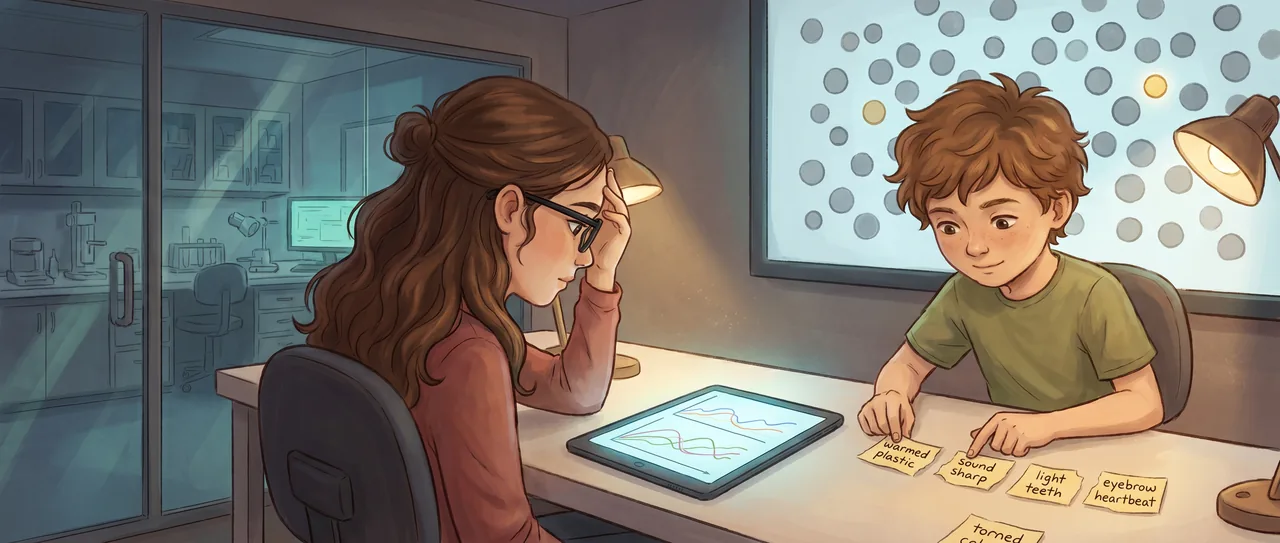
“That’s the point.” The doctor tapped the tablet. Lines ran across the screen, green and blue and orange, each one too smooth to look like a person. “Heart rhythm patterns, movement, skin temperature, sleep history, maybe skin conductance from the band. The model has learned from thousands of hours of data.”
“Which one changed?” Soren asked.
The doctor made the face adults made when the answer was going to be less solid than the question deserved.
“The system does not explain it that way,” she said. “It is not one signal. It is not even the same combination every time. The neural network finds patterns we cannot read directly.”
“So it knows,” Maya said, “but it can’t say how it knows.”
“It predicts,” the doctor said. “Knowing is a word people argue about at conferences.”
The phone chimed again, softer this time, as if embarrassed to repeat itself.
“Migraine likely in thirty-nine minutes.”
The doctor smiled too brightly. “The useful thing is the warning. Forty minutes is enough to take medicine if your family plan allows it, lower the lights, get water, avoid noise. That can change a whole school day.”
Soren stared at the lines. “But if no one knows what combination predicts it, then the warning is the beginning, not the end.”
The doctor’s coffee trembled in its cup. Somewhere behind her, a printer began making a sound like a small animal chewing foil.
“I agree in principle,” she said. “In practice, the grant visitors arrive in eleven minutes, and the printer believes paper is a myth.”
She set the tablet on the table. “Do not unplug anything. Do not change the trial record.”
Then she went to argue with the printer.
Maya swung her feet under the chair. The lab lights were white squares in the ceiling. They had always been white squares. Now she looked at them as if they might be waiting.
“I don’t like that it knows first,” she said.
Soren moved the tablet closer without touching the wires. “Maybe it doesn’t know first. Maybe part of you knows, but not the talking part.”
Maya considered this. “That is worse.”
“Maybe,” Soren said. “Maybe better.”
The tablet showed a button marked sensor view. Soren did not press it. He looked toward the doctor, who was feeding one sheet of paper into the printer with both hands and muttering, “Gently, you expensive toaster.”
Maya pressed the button.
Rows of dots appeared. Pulse interval. Skin temperature. Movement. Sleep. Electrodermal signal. Sensor quality. Prediction strength.
Maya leaned in. “They all look boring.”
“Boring might be the pattern.”
“That sounds like something a boring pattern would say.”
Soren pointed, not touching the screen. “There’s a sandbox copy. See? It says practice data.”
This time he pressed the button.
A copy of Maya’s last two hours appeared, separated from the trial record by a red line that said not used for medical decisions. Under it were small switches. Hide movement. Hide temperature. Hide pulse intervals. Hide skin conductance.
Maya grinned. “A machine with curtains.”
Soren hid movement.
The prediction stayed high.
He unhid movement and hid skin temperature.
The prediction dipped, but stayed gold.
He hid pulse intervals.
It dipped again.
He hid skin temperature and pulse intervals together.
The gold circle turned pale.
Maya sat very still.
“It’s not the pulse,” Soren said.
“Not the temperature.”
“Both.”
“Not both like two blocks stacked,” Maya said. She held up her hands, one higher than the other. “Both like timing. Like one moves and the other answers.”
Soren looked at the screen again. “Maybe. We can’t say that from this.”
“I know.” Maya’s eyes stayed on the pale circle. “But it’s not a magic wristband.”
“No,” Soren said. “It’s a net.”
The phone said, “Migraine likely in thirty-two minutes.”
The doctor returned carrying three warm pages from the printer as if she had defeated a dragon and felt sorry for it.
“What did you do?” she asked.
“Sandbox,” Soren said quickly. “We didn’t touch the record.”
Maya said, “Your trial asks when the pain starts.”
“Yes.”
“What if that’s too late?”
The doctor opened her mouth, then closed it.
Maya pointed at the gold circle. “It says migraine before pain. But your button says pain started. So the interesting part gets called nothing.”
The doctor lowered the printed pages.
Soren pulled the sticky labels toward him. “We can mark the forty minutes. Not as symptoms if there aren’t symptoms. Just checks. Light, sound, smell, neck, stomach, yawning, mood, words, whatever. Every five minutes.”
“Mood?” Maya asked.
“Migraine prodrome can include mood changes,” Soren said. “I read the consent form.”
“You read the whole consent form?”
“It was there.”
The doctor’s bright grant-visitor smile was gone. She looked younger without it, and much more awake.
“We did not design the visit that way,” she said.
“You designed it for after,” Maya said.
The doctor looked at the clock. Then at Maya. “Do you want to do that?”
“I want to know what the empty part is made of.”
So they made a row of labels on the table.
Thirty minutes. Maya reported nothing, but she chose the dimmer chair away from the window.
Twenty-five minutes. The doctor asked nothing. Soren held up the label. Maya said the air smelled like warmed plastic. The doctor sniffed and said she smelled coffee and printer defeat. Soren wrote warmed plastic.
Twenty minutes. Maya yawned three times and got annoyed when the tablet made its polite little click. Soren wrote yawn, sound sharp.
Fifteen minutes. The white ceiling squares were no longer just squares. Their edges had teeth. Maya put on dark glasses from the migraine kit, the ones she usually refused because they made her look like a secret agent who had lost her agency.
Ten minutes. The doctor’s visitors arrived outside the glass wall. Adults in jackets. Adults with lanyards. Adults ready to hear about accuracy and school days saved and costs reduced.
The doctor did not wave them in.
She stood behind Maya and Soren, watching the labels gather beside the smooth lines.
Five minutes. Maya said, “My left eyebrow has a heartbeat.”
Soren wrote it down exactly.
At zero, Maya pressed the pain button herself.
The tablet accepted it with a small blue dot.
Then Soren placed the labels underneath the graph, lining them up by time. The first half of the graph still looked almost boring. Smooth colored threads. Tiny rises. Tiny falls. Nothing a person would point to and say, there, that is where the storm begins.
But under the lines sat Maya’s words.
Warmed plastic.
Sound sharp.
Light teeth.
Eyebrow heartbeat.
The doctor touched the edge of one label, not moving it. “We predict attacks,” she said quietly. “You are asking what an attack is before pain.”
Soren looked through the glass wall at the waiting adults. “Is that a worse question for your meeting?”
The doctor gave a short laugh. “It is a much harder one.”
Maya rested her forehead against her palm. The medicine plan was already done. The lights over their table were low. The room had become soft at the edges.
On the wall screen, anonymized circles showed other people in the study. Most were gray. A few were blue, marking recorded migraines from days before. One circle near the bottom glowed gold.
The companion spoke from the tablet.
“Participant seventeen. Migraine likely in forty minutes. Confidence high.”
No one moved for a second.
Then Soren tore a fresh strip of sticky labels into equal pieces.
Maya put on the dark glasses. On the wall screen, another small circle changed from gray to gold.
Read the interactive version, listen to the narration, and earn a gold star →
A science-verified short story for curious kids · Curiosity Land