The Yellow Button
Soren failed at being calm in forty-three seconds.
The mock scanner was not even a real scanner. It was a white plastic tunnel with a padded table and a speaker that made a soft thumping sound, so visitors could practice lying still before seeing the real MRI room through the glass. The real room had a round machine with a warning sign on the door that said no metal, in letters large enough to stop a bicycle.
Soren had no metal. He had a paper notebook, a pencil, and a paper clip he had already surrendered to the lab director, who put it in a dish labeled bad ideas.
“Excellent,” the lab director said, looking at three screens and holding a roll of tape between her teeth. “One minute of quiet breathing. Don’t chase thoughts. Don’t move. We want the graph to look peaceful.”
Soren lay with his hands at his sides. A blue circle pulsed on the tiny screen above his face.
Breathe in.
Breathe out.
His sock had a seam near the little toe.
Breathe in.
The scanner thump sounded like a giant walking under the floor.
Breathe out.
If the real magnet was strong enough to pull a chair, could it pull iron dust out of cereal?
The blue circle flashed red.
“Try not to think,” the lab director called.
“I’m trying,” Soren said.
“That may be part of the problem.” She said it kindly, but also while pulling tape with her teeth and not looking at him.
The minute ended with a cheerful ding. On the screen beside the scanner bed, a line jagged up and down like a mountain range that had been frightened.
The lab director winced. “Maybe we won’t use children for the meditation demo.”
Soren sat up. “What did I do wrong?”
“You wandered.”
“I noticed.”
“Yes, but for the exhibit we need calm. People understand calm.” She peeled a crooked label off a display board. The label said BUILD A BETTER BRAIN in silver letters. “Tomorrow we have families coming through, donors at noon, and a camera crew that once called the hippocampus the hippo campus. I need simple.”
Soren slid off the scanner bed and went to the display board.
There were pictures of brains in rows. Some were gray, some were colored with blue and orange overlays. Beneath them were cards.
Experienced meditators. Thousands of hours of practice.
Greater cortical thickness in regions linked with attention.
Eight-week mindfulness-based stress reduction study. Changes in gray matter measurements. Amygdala decrease correlated with lower reported stress.
Soren read the cards twice. The words were careful words. Linked with. Correlated with. Measurements. They did not say magic. They did not say forever. They did not say everyone.
The lab director pressed a strip of tape down with her elbow. “The pretty part is this.”
She pointed to a transparent image of the cortex, the wrinkled outer layer of the brain. A few regions were outlined, not glowing, just marked. Attention did not look like a lightning bolt. It looked like folded tissue with edges.
Then she pointed to a small almond-shaped shape deep inside another brain picture.
“Amygdala,” she said. “Helps process threat and strong emotion. Some meditation studies show it changing with practice. Isn’t that marvelous? Invisible habits, visible structure.”
She hurried away to stop a projector from displaying the menu upside down.
Soren stayed by the scans.
Thirty seconds earlier, the pictures had been gray walnuts with labels. Now the room seemed to have another room inside it, one no one could walk into. A person could sit on a cushion, breathing. Nothing would move except ribs, air, maybe fingers. Years later, a scanner could find different thickness in the folded rind of the brain, different measurements in a tiny almond of alarm.
Not a feeling. Not a gold star. Tissue.
Soren opened his notebook to the page from inside the mock scanner.
one
two
sock seam
one
thump giant
one
cereal iron?
He had written the failures because the inside of his head had felt too crowded to hold them. He tapped the pencil on the word sock seam.
The exhibit’s test screen still showed his jagged line. Under it, a score blinked: CALMNESS, TWELVE PERCENT.
Soren looked at the button pad. There was one blue button for when a tone sounded. If a visitor missed a tone, the calmness score went down.
He pressed the blue button. The screen made a sad beep.
He waited for the next tone. While waiting, he counted breaths.
One.
Two.
Three.
The screen had nowhere to put that.
The lab director passed carrying a foam brain under one arm and a coffee under the other.
“Where do I put noticing I wandered?” Soren asked.
She stopped. “In life, ideally.”
“In the test.”
“The test measures attention.”
“It measures tones.”
“It measures whether attention is stable enough to catch the tones.”
Soren pointed at the card on the meditation display. “That card says when attention wanders, notice, then return.”
“Yes.”
“The test only counts if I never wander.”
The lab director opened her mouth. Then she shut it. The coffee tilted, and she corrected it just before it spilled onto the foam brain.
“We don’t have time to rebuild the program,” she said.
“Can I add a button?”
“To the code? No.”
“To the table.”
She looked at the screens, the crooked labels, the upside-down projector, and Soren’s notebook. “You may use tape. You may not use scissors near the scanner curtain. You may not rename the amygdala.”
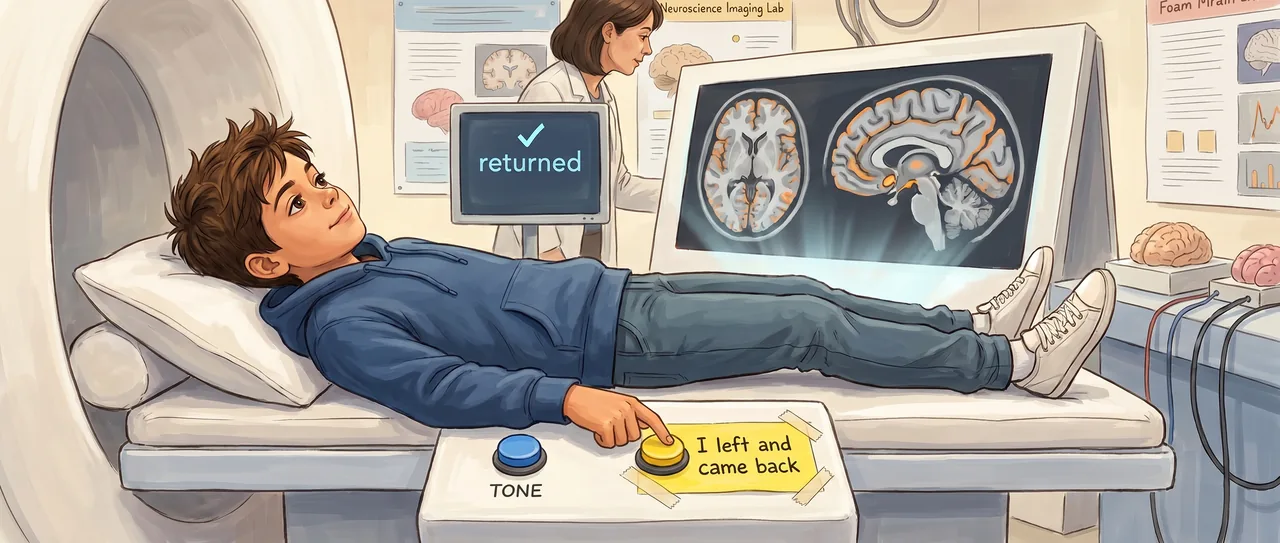
Soren took a yellow visitor button from a basket of spare parts. It was not connected to anything. He taped it beside the blue one and made a paper label.
Yellow: I left and came back.
Blue: I heard the tone.
Then he made a new instruction card.
Count breaths from one to ten. When your mind goes somewhere else and you catch it, press yellow and begin again at one. When you hear a tone, press blue.
The lab director leaned over his shoulder. “That will make everyone look messy.”
Soren looked at the brain images on the board. The outlined cortex. The almond shape. The cards full of careful words.
“Maybe messy is the data,” he said.
The lab director gave a small laugh, then did not laugh. She set down the foam brain.
“Run it,” she said.
Soren lay back in the mock scanner. This time the lab director did not tell him to empty his mind. She only started the timer.
He counted.
One.
Two.
The speaker thumped.
Three.
His toe seam bothered him. Yellow.
One.
Two.
A tone chimed. Blue.
One.
Would a person with thousands of hours still press yellow? Yellow.
One.
Two.
Three.
Four.
The minute ended.
The screen still showed the old jagged calmness line, because Soren had not changed the program. But below it, the lab director had opened a blank slide. She typed while standing, fast and inaccurate, then fixed the spelling.
ATTENTION IS NOT NEVER LEAVING.
She paused with her fingers over the keys.
Soren handed her his instruction card.
She typed again.
ATTENTION IS COMING BACK.
By noon the next day, the silver BUILD A BETTER BRAIN letters were still crooked. The foam brain had a coffee ring on the bottom. The public exhibit had real scan images, cautious study cards, the blue tone button, and Soren’s yellow button taped beside it.
The lab director stood at the entrance telling visitors that no, the MRI would not read their thoughts, and yes, braces were safe outside the magnet room, and no, the amygdala was not pronounced like a pasta.
Soren waited until the first group gathered around the mock scanner. The lab director looked at him and raised both eyebrows.
He climbed onto the padded table.
“When I hear the tone, I press blue,” Soren said. “When I leave and come back, I press yellow.”
The fan in the mock scanner hummed against Soren’s socks. His thumb pressed the yellow button. On the screen above his knees, a small mark appeared beside the word returned.
Read the interactive version, listen to the narration, and earn a gold star →
A science-verified short story for curious kids · Curiosity Land