The Water That Would Not Drink
The ocean bottle was supposed to turn yellow before the mayor arrived.
It did not.
It sat on the folding table at Pier Nine, blue as a summer sky, while volunteers taped paper kelp to the railings and Aunt Leena argued with a microphone stand. The label in front of the bottle said, THE OCEAN HELPS BY ABSORBING ABOUT ONE QUARTER OF THE CARBON DIOXIDE PEOPLE RELEASE. Under that, in smaller print, it said, THE OCEAN CONTAINS ABOUT FIFTY TIMES MORE CARBON DIOXIDE THAN THE ATMOSPHERE.
Maya read the label twice and then looked at the bottle.
“No,” she said.
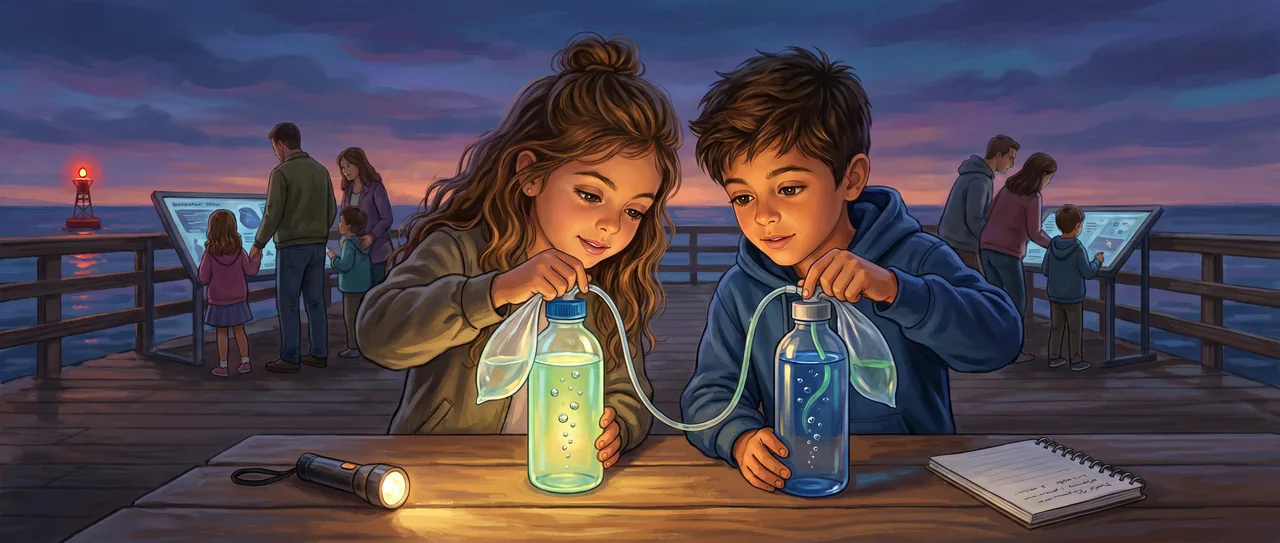
Soren had his notebook open, but he was not writing. He was watching the tiny airline tube that dipped into the bottle. A plastic bag, puffed full of breath, sagged at the other end. They had squeezed the bag exactly the way Aunt Leena showed them. Air had bubbled through the seawater. The blue indicator was supposed to change as carbon dioxide entered the water.
It had changed for the practice bottle that morning.
This one stayed blue.
Aunt Leena hurried past with a roll of tape in her teeth and a tablet under one arm. She was a carbon chemist, which meant she could explain seawater while untangling electrical cords with her shoe.
“Don’t worry if it’s slow,” she said around the tape. “Tell people the ocean is big. Big things take time.”
“It’s not slow,” Maya said. “It’s refusing.”
Aunt Leena pulled the tape from her mouth. “Maya, please do not make the demonstration dramatic. The city council is coming, and the last time a child called my exhibit haunted, the newspaper used that word in the caption.”
Then the microphone screeched, and Aunt Leena ran toward it.
Soren tapped the bottle with one finger. “It feels warm.”
“It was by the window,” Maya said.
“All afternoon?”
Maya looked toward the lab door, then at the sun sliding low and orange beyond the harbor cranes. “The ocean bottle got sunburned.”
Soren wrote two words, warm bottle, then shut the notebook before anyone could tell him paper was old-fashioned. “We need another bottle.”
They found the cooler behind the touch tank, under a towel and three abandoned name tags. Inside were sealed sample bottles of seawater collected that morning from below the pier. The cold packs had melted, but the water was still cool enough to fog the plastic.
Maya held up one bottle. “This one wants to drink.”
“That is not a measurement,” Soren said.
“Yet.”
They carried the bottle to the table and set it beside the warm one. Both bottles held seawater. Both had the same drops of blue indicator. Both tubes had fresh bags filled with breath. Soren pinched each bag flat first, then filled them again, counting so the breaths matched.
“One,” he said.
“Two,” Maya said.
They squeezed.
Bubbles climbed through both bottles, silver and quick. In the cool bottle, the blue softened to green, then leaned toward yellow. In the warm bottle, blue held on stubbornly, with only a thin green cloud near the tube.
Maya did not say anything.
Soren put his palm around the warm bottle, then around the cool one. He looked at the label again. One quarter. Fifty times. Big numbers, sitting politely on card stock.
The cool bottle kept changing.
The warm one did not.
A little boy in a shark hoodie stopped chewing his pretzel. “Why is that one being difficult?”
Maya pointed at the bottles. “Same water. Same breath. Different temperature.”
Soren said, “Cold water holds more dissolved gas than warm water.”
The boy looked at his pretzel, then at the harbor. “Like soda getting gross when it’s warm?”
“Yes,” Soren said, before anyone adult could improve the answer. “Like soda.”
The boy ran to tell someone.
Maya stared past the table. Out beyond the pier, the harbor shifted in long black folds. Ferries had crossed it all day. Fishing boats. Kayaks. A research buoy blinked red, then dark, then red again.
“So if the ocean warms,” she said, “it doesn’t drink as much.”
Soren lined the two bottles so their colors sat side by side. “And if it drinks less, more carbon dioxide stays in the air.”
“Which can warm things more.”
“Which makes it drink less.”
They both looked at the bottles.
The microphone squealed again. Aunt Leena’s voice boomed across the pier. “Welcome to Ocean Night, where we celebrate the sea’s amazing capacity to help regulate our planet’s climate.”
Maya picked up the exhibit label. It suddenly looked too smooth.
Soren said, “We can’t leave it like that.”
“No.”
They did not ask permission. Permission moved too slowly.
Maya flipped the label over. Soren found a marker whose cap was chewed flat. Together they made a new sign. Maya wrote the first line in large letters.
THE OCEAN IS HELPING.
Soren added the next line, smaller and neater.
But warm water cannot hold as much carbon dioxide as cold water.
Maya took the marker back.
SO WE HAVE TO MEASURE THE BREATHING.
Soren paused. “Measure the breathing?”
Maya pointed to the research buoy. “It blinks. It knows things.”
“It measures temperature and salinity,” Soren said. He had read the placard while everyone else was eating mini muffins. “Maybe pH too. Maybe carbon dioxide if it has the right sensor.”
“Can we see?”
The buoy was not reachable from the pier, but the display screen beside the lab door showed its live numbers. Most visitors passed it because it looked like homework. Temperature. Salinity. Oxygen. pH. Time stamps. A line graph crawled across the bottom like a small green worm.
Soren bent close. “The pH changes.”
Maya stood on her toes. “Up and down?”
“Tiny amounts.” He traced the graph in the air without touching the screen. “Day and night. Photosynthesis and respiration. Tides mixing different water. Not just one number.”
Maya’s face sharpened. “The harbor is not a bottle.”
“No,” Soren said. “It’s thousands of bottles. Moving.”
The pier noise thinned around them. The microphone, the gulls, the slap of water against pilings, all of it seemed to step back.
On the screen, the green line dipped and rose, dipped and rose. The harbor was taking in and giving back, holding and changing, never once being only blue or only yellow. Not a hero. Not a machine. A huge shifting thing doing chemistry in the dark.
Aunt Leena appeared beside them, breathless, one earring missing. “There you are. The mayor wants the carbon table. Why is my sign upside down?”
Maya handed her the two bottles.
Aunt Leena opened her mouth, ready to be busy and correct.
Then she saw the colors.
The cool bottle glowed yellow-green in her left hand. The warm bottle stayed mostly blue in her right.
“Oh,” Aunt Leena said.
Soren waited for the lecture. None came.
Aunt Leena looked at the old label, then at the new one. “The council came for a comforting sentence,” she said.
Maya said, “They can have a better question.”
Aunt Leena laughed once, not because it was funny, but because something had given way. She taped their new sign to the front of the table. Crookedly.
People gathered. The mayor came with a paper cup of lemonade. Aunt Leena began with the big numbers, the fifty times and the one quarter, but she did not stop there. She held up the two bottles.
Maya squeezed the cool bag. Soren squeezed the warm one.
The crowd watched the colors separate.
A woman in a raincoat whispered, “I thought the ocean just absorbed it.”
Maya heard because she was close enough to the table, close enough to the bottles, close enough to the place where the simple sentence had cracked.
After the demonstration, Soren went back to the live buoy screen. The green line had made another small dip.
“They update every ten minutes,” he said.
Maya looked at the dark water below the pier. “That is too slow.”
“For you, maybe.”
“For the harbor.”
Soren opened his notebook, then closed it again. “We could ask if students can help place more sensors. Not tonight. Eventually.”
Maya was already walking to the rail. “We can start with tonight.”
Aunt Leena had left a handheld temperature probe beside the table, the kind visitors used for touching tide pool water without touching the animals. It had a cord, a metal tip, and a button that made a tiny beep.
Soren picked it up. “This only measures temperature.”
Maya leaned over the railing. Beneath her, the harbor slapped the pilings, black and silver and breathing against the wood.
“Good,” she said. “First question.”
Soren lowered the probe by its cord, and Maya held the flashlight steady on the water.
Read the interactive version, listen to the narration, and earn a gold star →
A science-verified short story for curious kids · Curiosity Land