The Valley That Wasn't Lowest
The first molecule died in Soren's hands.
It had looked perfectly reasonable. Six bright carbon beads, a neat necklace of hydrogen beads, all clicked together on the glass surface of the chemistry table. The table hummed under his palms like a purring cat.
Then the necklace folded, flashed red, and flew apart into fragments.
A label appeared above it.
Lifetime: three microseconds.
Maya leaned over the rail. Her visitor badge had flipped backward, and she had not noticed.
“It had enough bonds,” she said.
Soren checked the paper card beside the table. The card showed happy molecules drawn as balls and sticks. Build bonds. Make chemistry.
“It had the right number,” he said. “Unless the card is lying.”
Across the lab, Dr. Kline was trying to convince a coffee machine to stop making only foam. He was the sort of adult who spoke to machines as if they had made personal choices.
“Don’t build the weird ones yet,” he called without turning around. “Open house starts in ten minutes. The simple mode is for families. Strong bonds, stable molecules. Nice and clean.”
The dead fragments faded from the table.
Maya tapped the place where they had been. “It didn’t break like weak sticks.”
“How did it break?” Soren asked.
“Like it found a slide.”
Soren liked that answer and did not like it. It sounded right, but it had no edges yet.
He rebuilt the necklace, slower. Same atoms. Same connections. This time he watched the shadows under the beads, faint gray patches the table drew and erased too quickly.
The molecule folded again. The shadows joined. Red flash. Gone.
Lifetime: three microseconds.
“Again,” Maya said.
“The visitors are coming,” Soren said.
“Exactly.”
Dr. Kline hurried over with a paper towel and a cup of foam. “Please tell me it works.”
“It works,” Maya said. “Your card doesn’t.”
Dr. Kline looked at the shattered red glow still fading from the glass. “The card is simplified.”
“It says strong bonds make stable molecules,” Soren said.
“For an open house, that is close enough.”
Maya shook her head. “Not for this table.”
The lab doors clattered. Voices filled the hallway outside. Dr. Kline glanced toward them, then at the table, then at the coffee foam as if it might have advice.
“You have five minutes,” he said. “Make it not embarrassing.”
Then he ran to rescue a tray of safety goggles from falling off a cart.
Maya was already searching the edge of the table. “There’s another mode.”
“There are no labels,” Soren said.
“There are always labels. They’re just hiding from the people who don’t need them.”
She pressed two fingers into a blank corner. Nothing happened. She pressed harder. A menu rose in pale blue letters.
Stick View.
Charge View.
Landscape View.
Soren read the last words twice.
Maya pressed them.
The table changed.
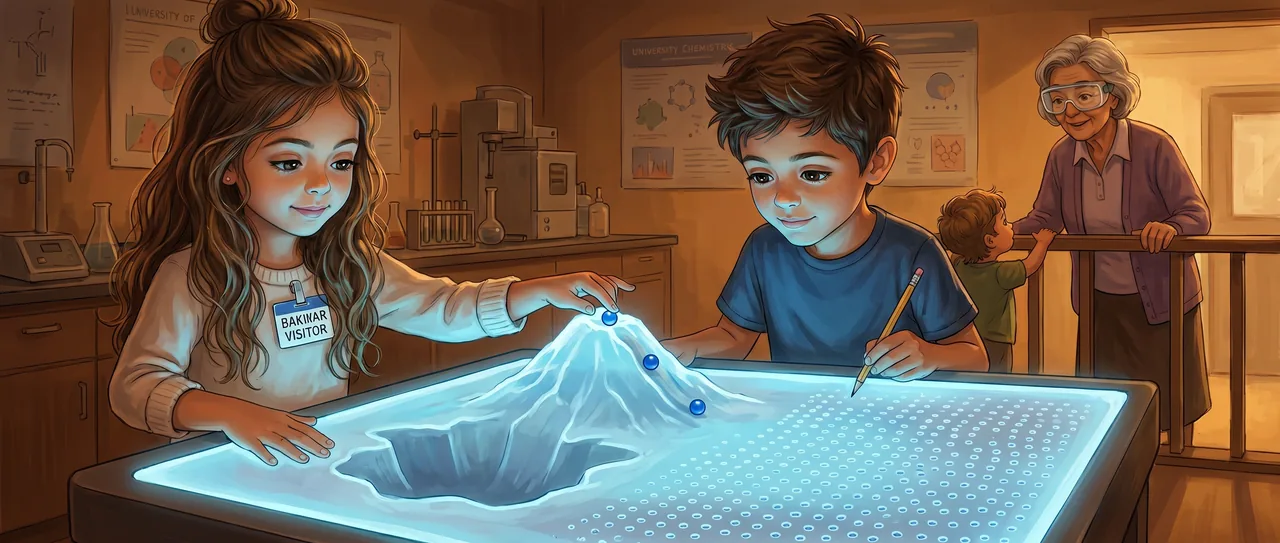
The glass was no longer flat. It pushed up under their hands, soft but firm, rising into ridges and sinking into hollows. The dead molecule reappeared as a blue bead sitting on a slope. Around it, the surface curved downward in three directions.
The bead trembled. It rolled.
Not fast. Not slow. Inevitably.
It dropped into another hollow, split into fragments, and the red flash bloomed again.
Soren put both palms on the table. The ridges were not pictures. He could feel them. A molecule was not only sticks between atoms. It was a place a thing could sit, or fail to sit.
Maya’s face had gone very still.
“Do nitrogen,” she said.
Soren selected two nitrogen atoms. The table snapped them together with three bright bands between them. A valley opened under the pair, narrow and deep, with steep sides all around. The blue bead settled at the bottom and stayed.
He pushed gently at the bead. It climbed a little, then rolled back.
“Hard to leave,” Soren said.
“Not just low,” Maya said. “Walled.”
Soren tried a bigger push. The table resisted his finger, not like a lock, more like a hill that did not care how much he wanted to be on the other side.
On the far wall of the lab, a display case held a slice of meteorite under glass. Its label said that some organic molecules inside meteorites had survived since before Earth had forests, before bones, before anything on land had eyes.
Maya looked from the meteorite to the tiny blue nitrogen bead.
“How many hills,” she said quietly, “between then and now?”
The hallway doors opened. The first visitors came in, a family with two little kids and a grandmother who was already putting on goggles over her regular glasses.
Dr. Kline skidded back. “Ready?”
“No,” Soren said. “Better.”
Maya pulled up the molecule list. “Show us cubane.”
Dr. Kline blinked. “Cubane is not simple.”
“It’s a cube made of carbon,” Maya said. “That is the simplest impossible thing.”
“It is not impossible,” Dr. Kline said automatically, which proved he wanted to say more and did not have time.
The table built it.
Eight carbon atoms snapped into the corners of a cube, each with hydrogens sticking out. It looked like something a younger child would make with sticks before being told atoms did not like square corners.
The landscape rose around it.
Soren expected a peak. The cube looked strained, crowded, wrong.
Instead, the bead sat in a small high hollow. Not deep like nitrogen. Not comfortable looking. But every way out climbed sharply before dropping away.
Maya laughed once, not because it was funny.
“It’s sitting on a mountain in a cup,” she said.
Soren pressed the bead. The table pushed back harder than he expected.
Dr. Kline leaned closer despite himself. “Kinetically stable,” he murmured.
Maya glanced at him.
He raised both hands. “Sorry. Continue.”
The grandmother at the rail said, “Is that molecule allowed?”
Soren looked at the carbon cube, perched where it should not have been and yet was.
“The electrons allow it,” he said. “Not because it looks normal. Because the ways out are too hard.”
One of the little kids reached up. “Can I push it?”
Maya moved aside. “Try.”
The child pushed. The bead climbed the wall of its hollow, stopped, and rolled back into the strange little cup.
The child pushed harder. Same thing.
“It stays,” the child said.
“For a while,” Soren said.
“How long?” asked the grandmother.
Dr. Kline opened his mouth.
Maya got there first. “That depends on the hills. Heat can help it climb. Light can. Other molecules can. But if nothing gives it the right shove, it can stay even if there’s a lower place somewhere else.”
Soren looked at the menu again. At the bottom, below Landscape View, was a line so faint he had missed it.
Unvisited Minima.
He read it aloud.
Dr. Kline’s eyebrows jumped. “That database is experimental.”
“So it shows mistakes?” Maya asked.
“It shows calculated local valleys for formulas nobody has made yet. Some are probably wrong. Some may be real. It is not for the public demo.”
The visitors leaned closer.
Maya’s finger hovered over the words.
Dr. Kline looked at the open doors, the goggles, the meteorite, the carbon cube still refusing to fall apart. His coffee foam had collapsed into a small, defeated puddle at the bottom of the cup.
“Oh, go on,” he said.
Maya pressed the menu.
The table went dark except for a field of tiny blue hollows. Dozens. Hundreds. They spread across the glass like thumbprints in invisible clay. Some were shallow dimples. Some were wells with walls like cliffs. Some were twisted, lopsided pockets no ball-and-stick card would ever have drawn.
Soren did not write anything down. His pencil stayed in his hand, point hovering above the paper, because there were too many places to put the first word.
Maya touched one hollow near the edge.
A blue bead appeared under her fingertip, rolled down the slope, and settled into a valley with no name.
Read the interactive version, listen to the narration, and earn a gold star →
A science-verified short story for curious kids · Curiosity Land