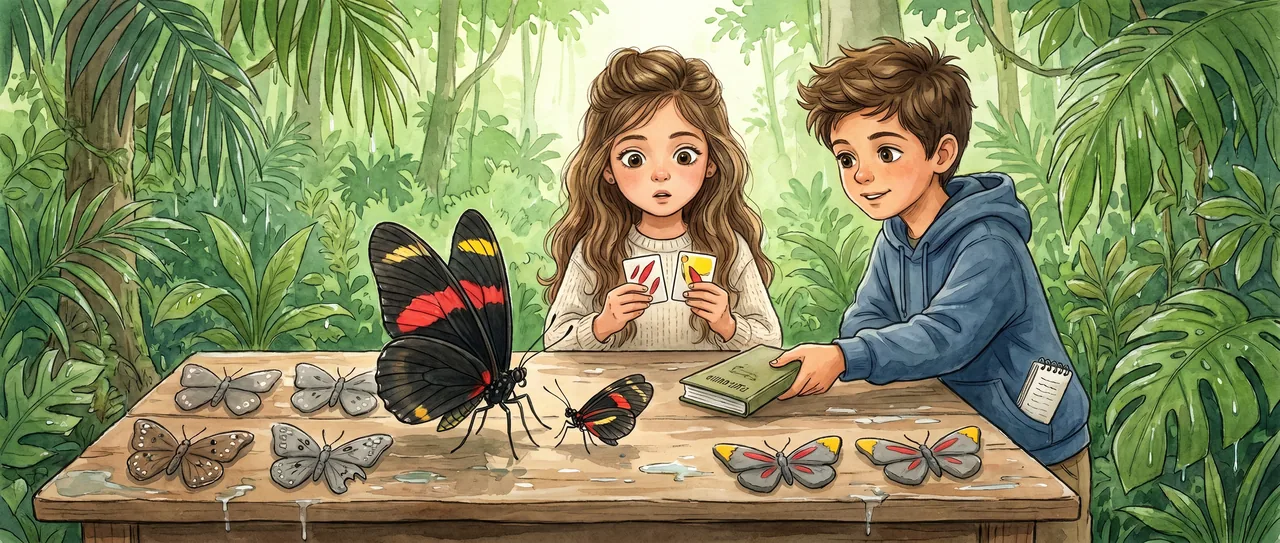
The Same Warning
The butterfly game was wrong before anyone played it.
Maya knew because the cards did not make her eyes settle.
On the long table outside the rainforest station, laminated butterfly cards waited in neat piles. Each card had a picture, a species name, and an empty box for visitors to match. The station coordinator had set out red stickers, yellow stickers, black markers, and a tray of clay butterfly bodies with paper wings.
“Simple,” the coordinator said, tying a bootlace with one hand and checking a weather screen with the other. “Match the pattern to the species. We have donors arriving in twenty minutes, and they love activities.”
Soren leaned over the cards. “These two have the same pattern.”
“Almost,” the coordinator said. “Different species. Different Latin names. Try to keep them separate.”
Then she hurried toward the radio shed, where someone was calling about rain.
Maya picked up the two cards.
One butterfly was black with a red slash across each forewing and a yellow mark near the tip. The other was also black with a red slash and a yellow mark near the tip. Not sort of. Not close enough for a small child. The same, in the way a stop sign was the same even if one was scratched and one was new.
“They can’t both be the answer to the same card,” Soren said.
“They are,” Maya said.
“That is not how matching games work.”
“That is the problem.”
Soren took out his paper notebook. The corners had gone soft from humidity. Everyone at the station used wrist screens, except Soren, who said batteries made bad memory. He copied the two names from the cards, slowly, because the names had too many pieces.
Heliconius erato.
Heliconius melpomene.
Maya had already moved on. She laid the two cards side by side, then added a third, a fourth, a fifth. Some had red bands. Some had yellow bands. Some looked like sparks on velvet. The piles did not want to be species piles. They wanted to become pattern piles.
The coordinator came back carrying a roll of orange flagging tape between her teeth.
Maya held up the cards. “If visitors match by pattern, they’ll put different species together.”
“Yes,” the coordinator said, taking the tape from her mouth. “They do that. Then we correct them.”
“Why?” Soren asked.
“Because identification matters.”
“Does the bird identify them?” Maya asked.
The coordinator paused. Her boot was half on a root. She looked at Maya as if Maya had made the path tilt.
“The bird learns warning patterns,” she said. “Not Latin names.”
Then the radio called again, and she ran.
Soren looked at the clay bodies. “Then the game is backwards.”
The clay butterflies were soft gray ovals with folded paper wings pinned into them. They were for the morning’s predator marks. Birds sometimes pecked the clay and left little beak dents. The real butterflies were not used. The models told the story without asking a butterfly to pay for it.
The instructions said: Paint each model to match one species card. Place models along the trail. Collect after lunch. Count attacks.
Maya read it once and shook her head. “No.”
Soren waited. He had learned that when Maya said no like that, she was not refusing. She was turning around inside a question.
“If the bird reads pattern,” she said, “we should make the trail read pattern.”
Soren drew two columns in his notebook, then crossed them out. “Not species. Ring.”
“Ring?”
He tapped a small paragraph on the back of the station sign. “Mimicry ring. It says different unpalatable species share warning colors. Predators learn faster if the warning looks the same.”
Maya grinned. “A group project with no meeting.”
They remade the game.
The first row of models wore the red slash and yellow tip. The cards beneath them carried three different species names. The second row wore yellow bars. The third wore red rays. Under every row Soren wrote, Same warning, different butterflies.
Maya made a fourth row with brown paper wings and pale spots, copied from a harmless-looking moth on the wall. “For comparison,” she said.
“You don’t know if that moth is tasty.”
“I know it isn’t wearing a sign.”
“That is different from tasty.”
“Write that down.”
“I am not writing that down.”
He wrote: no obvious warning pattern.
They carried the models onto the trail, stepping over roots slick as sleeping snakes.
Above them, real butterflies moved in slices of color.
A black butterfly with a red slash passed so close to Maya’s face that she felt the air it pushed.
“Erato?” Soren asked.
“Melpomene?” Maya asked.
The butterfly vanished between leaves.
They pinned the clay models to branches with bits of wire. Soren made sure each group had the same number of models and the same height from the ground. Maya kept shifting them when the sun hit wrong.
“The birds don’t read our labels,” she said.
“They also don’t read our spacing,” Soren said, but he moved one higher.
At the last station, he held the red-and-yellow model for a moment before pinning it. “If two species are both bad to eat, and both wear the same warning, then when a bird tries one…”
“It may leave the other alone,” Maya said.
“And if there are more species in the ring, the lesson gets bigger.”
“Cheaper,” Maya said. “For each one.”
Soren stared at the paper wings in his hand. The red slash looked suddenly less like decoration and more like a word that had been said by many mouths until the forest remembered it.
A call rattled from high above them. Something small moved in the leaves. Neither of them saw what it was.
When they returned after lunch, the coordinator was in front of the donors, talking too fast. She had mud on one knee and a leaf in her hair.
“And these children have prepared our matching activity,” she said, with the bright panic of an adult who had not checked what the children had done.
Maya and Soren stopped at the edge of the table.
The collected models lay in their rows.
The brown and pale-spotted models were dented all over. Little paired marks pressed into the clay, sharp at the ends. One had a whole wing torn sideways.
The red-slash models had a few marks, but not many. The yellow-bar models had fewer. The red-ray models had almost none.
The donors bent closer.
One of them pointed. “Are these all the same species?”
“No,” Soren said.
The coordinator opened her mouth, probably to make it simpler.
Maya was faster. She picked up two cards with the same red slash and held them beside the models. “Different bodies. Same warning.”
Soren put the dented brown model next to them. “The clay shows where birds tested. They don’t have to know the names. They learn the signal.”
A donor frowned at the cards. “So they are copying each other?”
“Not like homework,” Maya said.
Soren said, “Nobody decided. Over many generations, the ones with warning patterns predators recognized were more likely to be left alone. If two bad-tasting species looked alike, the same lesson helped both.”
The coordinator shut her mouth. Then she smiled, but only a little, as if smiling too much might scare the idea away.
The donors looked again, but differently this time. Not at the prettiest card. At the rows. At the repeated red, yellow, black. At the dents that were missing.
Maya saw Soren’s notebook sticking damply from his pocket and the crossed-out columns inside it. Species. Pattern. Both wrong alone. Both useful together.
A real butterfly landed on the edge of the table.
It was black with a red slash and yellow near the tips.
Everyone leaned in.
“Which one is it?” a donor whispered.
The coordinator reached for a field guide.
Maya did not. Soren did not.
From beneath the table, a second insect climbed into the light. It was smaller than the butterfly, with narrow wings and a body like a black thread. Its wings opened flat.
Red slash. Yellow tips.
Soren slid the field guide back toward the center of the table without opening it.
The small moth stood beside the larger butterfly, both of them holding the same colors in the wet green air.
Read the interactive version, listen to the narration, and earn a gold star →
A science-verified short story for curious kids · Curiosity Land