The Roots That Knew
The dune tray failed on Tuesday.
It was not supposed to fail on Tuesday. Tuesday was loading day. Wednesday was beach day. On Wednesday, forty volunteers would arrive wearing matching blue shirts and carry American sea rocket seedlings out to the broken dune, where winter storms had bitten a gap between the beach grass and the road.
The sea rockets were small and round-leaved and looked tougher than they were. Their roots held the sand. Their flowers fed insects. Their seeds could float in seawater and still grow later, which Soren thought was the sort of fact that should make people quieter when they heard it.
The tray failed when he tried to lift the first plug.
Instead of coming out as a neat cube of soil and roots, it brought six neighbors with it. Fine white roots stretched between them like wet hair. One snapped. Then another.
Soren stopped pulling.
Dr. Vale was at the far table, arguing with a printer that kept eating the labels for the volunteer buckets.
“They’re stuck,” Soren said.
“Wiggle them,” Dr. Vale said.
“I did.”
“Wiggle them less dramatically.”
Soren looked at the torn root. The end was bright white. It had been alive five seconds ago.
He did not wiggle anything.
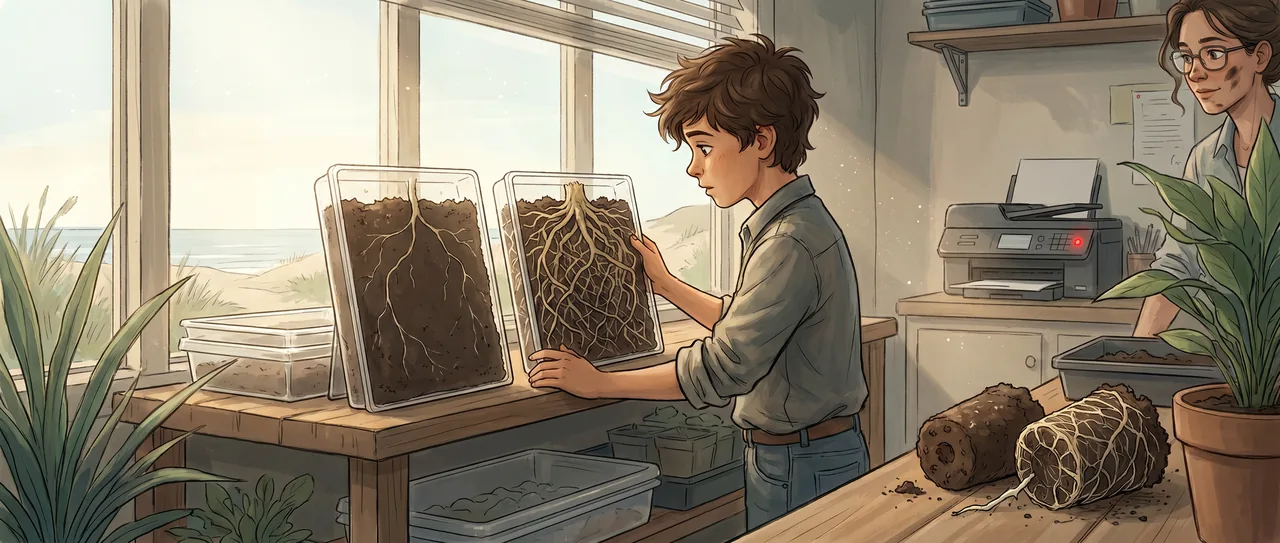
The greenhouse smelled like salt, damp soil, and warm plastic. On the left benches were the mixed trays, the ones Soren had helped make. Seeds from different mother plants had been scattered so every seedling would grow beside strangers. Dr. Vale had called it a good mix. Soren had liked that. Fair, he had written in his notebook two weeks ago, because every plant gets everyone.
On the right benches sat the mistake trays.
A college helper had planted whole families together by accident, Mother Plant One with Mother Plant One, Mother Plant Two with Mother Plant Two. Dr. Vale had muttered about wasted space but kept them because throwing living things away bothered her, even when she pretended it did not.
Soren crossed to the mistake trays and pressed up one plug from below.
It slid out whole.
He tried another. Whole.
Another. Whole.
The roots touched the soil cube edges but did not knit into the neighbors the same way. They curved back, or down, or stopped at the border as if the next cube already had enough roots in it.
Soren carried one mixed plug and one family plug to the potting table.
Dr. Vale slapped the printer lid. “Please do not make a museum while I am being defeated by office equipment.”
“I think our good trays are the bad trays,” Soren said.
Dr. Vale looked over her glasses. She had a smear of potting soil on her cheek that had been there since breakfast. “They’re all sea rocket.”
“Not all the same sea rocket.”
“That is why we mixed them. Genetic diversity. Strong dune.”
Soren set the plugs side by side. The mixed one had roots wrapped around its outside in a pale net. The family one was calmer. That was not a scientific word, so he did not say it.
Dr. Vale glanced at them. “Different watering, maybe. Different corner of the bench.”
Soren had expected that. He liked Dr. Vale, but when she was busy, her brain put everything into boxes labeled Later.
He went to the shelf under the west window. The old root-window exhibit was there, because no one had decided where to store it. Two clear plastic panels, each covered by a black sleeve to keep out light. Visitors were allowed to slide the sleeves up and see roots pressed against the glass.
Soren had read the card the first day and then read it again because it sounded impossible without being magic.
Some plants grow fewer competing roots beside kin than beside unrelated plants.
He had known the sentence. Knowing it had not helped when all the seedlings were just green circles in black trays.
Now he slid up the first sleeve.
Behind the glass, roots from two sibling sea rocket seedlings made thin white paths through the soil. There were not many. They did not crowd the middle.
He slid up the second sleeve.
The stranger pair had filled the meeting place with roots. So many roots. Fine ones, branching ones, roots laid over roots, all pressing into the same narrow dark as if each plant had reached for the same cup before the other could drink.
Dr. Vale had gone quiet behind him.
Soren did not turn around. He counted the root crossings at the center line because counting gave his eyes handles. On the sibling panel he counted nine. On the stranger panel he counted thirty-one before the roots became too tangled to separate.
He pulled the black sleeves down again.
“Those were grown for the exhibit,” Dr. Vale said.
“With sea rocket.”
“Yes.”
“From this greenhouse.”
“Yes.”
“With the same sand mix.”
Dr. Vale took off her glasses and rubbed the bridge of her nose. “I hate it when the display case wins an argument.”
Soren did not smile yet. The torn root on the table was still there.
He went back to the benches. The mixed trays were not failing because the plants were weak. They were doing something. They had met strangers underground and made more roots. More roots meant more grabbing. More grabbing meant the plugs could not be lifted without ripping.
The family trays were the mistake only if the job was to make every seedling touch strangers before it ever reached the dune.
Soren picked up the stack of colored mother-plant cards from the shelf. All month, volunteers had tried to throw them away after watering.
“Why keep those?” one had asked.
Soren had said, “Because they say where the seeds came from.”
The volunteer had said, “They’re plants.”
Now the cards made little bright families in his hands. Red for Mother Plant One. Yellow for Mother Plant Two. Blue for Mother Plant Three. Not names exactly. Not faces. Still not nothing.
Dr. Vale leaned on the bench. “We still need diversity on the dune.”
“We can plant families in patches,” Soren said. “Not one big family. Little groups. Red group, then yellow group, then blue group. The dune gets all the families. Each seedling starts next to kin.”
“That is not the plan.”
“The plan rips their roots before they reach the sand.”
Dr. Vale looked at the mixed plug. Then at the family plug. Then at the printer, which had begun blinking red for a new reason.
“One test strip,” she said. “Ten meters. You make the map. If anyone asks, I will say you made a persuasive mess on my table.”
Soren made the map on a sheet of bucket paper, not in his notebook, because the bucket paper would go outside. He drew the dune line, then circles of color in repeating clusters. Red, red, red. Yellow, yellow, yellow. Blue, blue, blue. Then red again, but farther down, because a dune did not need one kind of anything.
The next morning, the volunteers arrived in blue shirts and loud voices. They carried shovels, water jugs, and the family trays Soren had loaded himself. The mixed trays stayed in the greenhouse, watered and alive, waiting for bigger pots where their roots would not have to be torn apart.
At the beach, the wind pushed sand against Soren’s socks. Dr. Vale explained the main planting to the volunteers, waving her clipboard like a flag. When she reached the test strip, she pointed at Soren.
“He has the color map,” she said. “Follow him for this section.”
The volunteers looked surprised for half a second. Then they looked at the trays, because plants needed holes more than people needed explanations.
Soren knelt at the first marked spot. Three red-tagged seedlings waited in their tray, leaves trembling in the wind. He pressed two fingers under the first plug, lifted it whole, and set it into the sand beside its siblings.
A tiny white root showed at the edge of the soil cube, pointing sideways into the dark.
Read the interactive version, listen to the narration, and earn a gold star →
A science-verified short story for curious kids · Curiosity Land