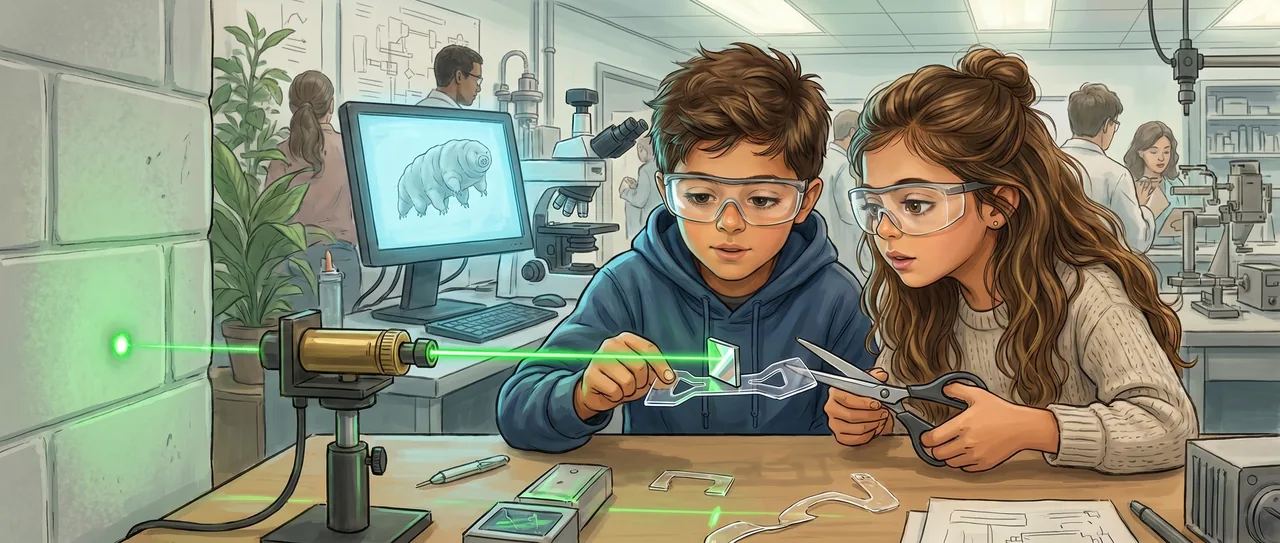
The Part That Bent
The microscope failed at the exact moment the water bear opened its claws.
On the screen, the tiny creature had been walking through a drop of moss water like it owned the place. Eight stumpy legs. A nose like a vacuum cleaner. Claws finer than eyelashes. Then Soren turned the focusing knob, the slide jumped, and the water bear vanished into gray blur.
Maya made a sound through her teeth.
Soren took his hand off the knob. The knob wobbled back.
“That,” Maya said, “is not focusing.”
“It is focusing badly,” Soren said.
“It’s fleeing.”
Around them, the microengineering lab buzzed for the open house. College students taped signs to tables. A small robot sorted colored beads into cups. Someone had written WELCOME, FUTURE INVENTORS on the glass wall in blue marker.
Dr. Nadir hurried past with a box of safety glasses under one arm and a half-eaten apple in the other hand. She had silver hair pinned with a red pencil and the expression of a person being followed by thirty unfinished tasks.
“The demo stage is loose,” Soren said.
Dr. Nadir stopped without stopping all the way. “Which one?”
“The microscope with the water bears,” Maya said. “It lurches.”
“It needs a hinge pin,” Dr. Nadir said. “Drawer seven. Brass pins. Tiny washers. If the tour gets here before it is fixed, show them the bead robot.”
“The bead robot is sorting orange into red,” Maya said.
Dr. Nadir closed her eyes for one second. “Then do not show them the bead robot.” She pointed with the apple. “Drawer seven.”
Drawer seven had brass pins, tiny washers, three springs, two mystery screws, and a label that said DO NOT MIX WITH DRAWER EIGHT, which made Maya immediately want to see Drawer Eight.
Soren did not open Drawer Eight. He lined the pins on a paper towel from shortest to longest. The microscope stage sat between them, a little platform that held the slide above the light. Its hinge was smaller than a fingernail. When he lifted the platform, it clicked. When he let it go, it sagged.
“There’s space around the pin,” he said. “The pin turns before the platform moves.”
“Dead wiggle,” Maya said.
“Backlash,” Soren said.
Maya pressed the platform down. It jumped twice, tiny and mean.
Soren tried a wider pin. Too wide. He tried a thinner washer. Better, then worse. He wrapped a pin with a strip of tape. The hinge stuck, then released all at once, and the water bear became a foggy ghost on the screen.
Maya watched the ghost drift. “The hinge is the problem.”
“Yes,” Soren said. “That is why we are fixing the hinge.”
“No. The hinge is the problem because it is a hinge.”
Soren looked at her. He did not say that made no sense. He had learned that when Maya said something crooked, it often pointed straight at the thing they had not found yet.
“What made you think that?” he asked.
Maya picked up the plastic container that had held Dr. Nadir’s grapes. The lid was still attached to the bottom by a thin strip of cloudy plastic. She opened and shut it. No pin. No screw. No click. The strip curved, uncurved, curved again.
“This moves,” Maya said. “Nothing turns.”
Soren took it and bent the lid slowly. The cloudy strip whitened a little where it folded sharp.
“Too far and it gets damaged,” he said.
“Then don’t go too far.”
“That is not usually considered a complete engineering plan.”
Maya smiled. “It is the start of one.”
The tour voices were coming closer. Dr. Nadir’s voice floated through the lab, bright and fast. “Precision means knowing where something is, not just hoping loudly.”
Soren put the grape container flat on the bench. “We need the slide to move a tiny amount without the dead wiggle.”
Maya was already holding safety scissors.
“Not that hinge,” Soren said.
“I know.”
She cut a rectangle from the flat part of the lid. The plastic made a soft crackling sound. Soren drew two long slits down the middle, not touching the ends. Maya cut along his lines. What remained was a center tongue held by two narrow bridges.
Soren pressed the tongue. The bridges bowed. The tongue shifted down and sprang back.
“No separate parts,” he said.
“No tiny washers,” Maya said.
“No place for wiggle to hide.”
They taped one end of the plastic rectangle to the microscope base and the slide holder to the center tongue. It looked ridiculous. It looked like trash trying to be a machine.
Maya nudged the tongue.
On the screen, gray became pebbled green. Pebbled green became moss stems. Moss stems became a clear bubble of water. In the bubble, the water bear returned, huge and impossible, dragging one clawed foot over a strand of algae.
Soren held his breath and pressed more gently.
The creature sharpened. Not with a click. Not with a jump. It arrived the way the moon arrives from behind a cloud.
Maya did not speak.
Soren did not either.
In school, bent meant ruined. Bent rulers. Bent paper clips. Bent explanations that did not fit the worksheet boxes. Here the thinnest, bendiest strips on the bench were the only parts steady enough to hold a creature smaller than a speck in place.
The first visitors reached the table. A little boy in a green sweatshirt stood on tiptoe. His mother leaned over his shoulder.
“Is that alive?” the boy whispered.
“Yes,” Maya said.
“It looks like a space cow.”
“Yes,” Maya said again.
Dr. Nadir arrived behind the visitors and saw the grape-lid microscope stage. Her mouth opened. She looked at the trash plastic, the tape, the slide, the screen, and Soren’s hand pressing the center tongue by less than the width of a crumb.
“You made a flexure,” she said.
Maya kept watching the water bear. “We made a not-hinge.”
“A very old, very useful not-hinge,” Dr. Nadir said. She sounded both delighted and annoyed that she had not thought of it first. “Compliant mechanism. The motion comes from the material bending. No rubbing joint. No backlash.”
Soren looked at the plastic bridges. “So precision instruments use trash lids?”
“Not usually trash lids,” Dr. Nadir said. “Sometimes spring steel. Sometimes titanium. Sometimes silicon. The stage in our interferometer moves on flexures cut from one solid piece. Some surgical tools use them too. Fewer little joints, fewer places to trap things you do not want trapped.”
Maya finally turned from the screen.
Across the room, past the bead robot and the blue welcome letters, a glass case held a silver tool no longer than a pencil. Its tip was split into jaws, but there was no hinge pin where jaws should have been. Only thin shining curves.
Dr. Nadir followed Maya’s look. “That one opens because the metal bends in the right places.”
The boy in the green sweatshirt pressed closer to the microscope. “Can it eat?”
“If we find its mouth,” Maya said.
Soren adjusted the plastic tongue. The water bear’s round head sharpened. Its mouth appeared as a dark tiny ring, there and not there.
Dr. Nadir put down the safety glasses box. “When the tour moves on, I want to see exactly what you cut.”
“You said Drawer Seven,” Soren said.
“I was wrong in a useful direction,” Dr. Nadir said.
Maya had already picked up the leftover plastic. She bent one corner, watched it spring back, then bent another part less far. Soren took a small mirror tile from the optics tray and set it on the center tongue of their scrap flexure. He aimed the green alignment laser at the mirror. The reflected dot landed on the far wall, trembling on the painted cinder block.
“Tiny bend,” Soren said.
“Big wall,” Maya said.
He pressed the plastic until the bridges curved.
The green dot slid three feet across the wall.
Dr. Nadir stopped talking to the visitors.
Maya set the scissors open around the next narrow bridge.
Soren held the laser steady.
The green dot waited on the wall.
Read the interactive version, listen to the narration, and earn a gold star →
A science-verified short story for curious kids · Curiosity Land