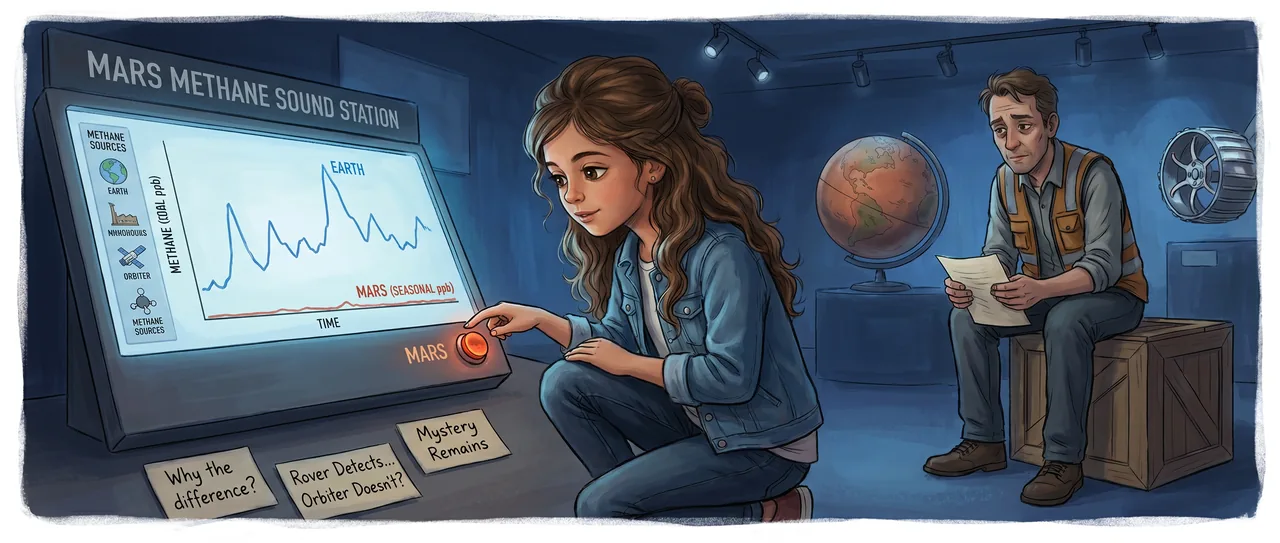
The Note That Came Back
The first time Mars breathed through the speaker, Maya tried to make it stop.
It was supposed to be a soft exhibit. A red globe. A rover wheel you could touch. A screen where visitors pressed buttons and heard numbers become notes. Low notes for low methane. Higher notes for more methane. The exhibit director wanted it ready by morning.
Maya had been given the easy job because she was eleven and because the adults were busy with drills, labels, and a Mars globe that refused to hang straight.
"Just test the sound loop," the exhibit director said, with a roll of tape hanging from one wrist. "If anything crackles, call me. If anything is confusing, make it less confusing. Families like clean stories."
Maya pressed play.
The speaker made a row of low wooden sounds, like someone tapping a table in another room. Then, in the same part of the loop, a higher note rose and vanished.
Tap. Tap. Tap. Ting.
Maya pressed stop.
The director was on a ladder, arguing with the crooked globe.
Maya played it again.
Tap. Tap. Tap. Ting.
"Bad speaker," Maya said.
She swapped the speaker with the one from the moonquake display. The moonquake speaker worked perfectly until it became the Mars speaker.
Tap. Tap. Tap. Ting.
She changed the cable. She changed the port. She played the file from the backup tablet. She lowered the volume. She raised the volume. The high note stayed exactly where it was, waiting for her.
The exhibit director climbed down from the ladder and looked at the time.
"Glitch?" the director asked.
"Not the speaker," Maya said.
"Then smooth it. The public does not need every wiggle."
Maya stared at the screen. The line was not a mountain. It was barely a wrinkle. The numbers were tiny, parts per billion, smaller than a whisper in a stadium. The label said the measurements came from Curiosity, the rover in Gale Crater, using an instrument that could sniff gases in the Martian air.
Most of the numbers sat low. Some were almost nothing. Then, when the Martian year turned to the same season, the line lifted.
Not much.
Enough.
The high note was not loud because Mars had a lot of methane. The high note was loud because the exhibit had stretched the small difference so human ears could catch it.
Maya opened the smoothing tool. It offered a neat curve, a polite Mars, a Mars that did not make embarrassing sounds in front of visitors.
She clicked it.
Tap. Tap. Tap. Almost nothing.
The exhibit became easier.
Maya disliked it immediately.
She undid the smoothing.
Tap. Tap. Tap. Ting.
The director was taping a caption to the wall. It said, Methane can be made by geology or biology.
Maya read it twice.
"That's slippery," she said.
"It is accurate," the director said. "On Earth, living things make most methane. Wetlands, microbes, animals. But some methane can form without life, when water and certain rocks react. We are not saying Mars has life. Absolutely not."
"The caption sounds like we know the choices," Maya said.
"We know possible choices."
"Do we know why it goes up there?"
The director pressed the tape flat too hard, wrinkling one corner. "No accepted explanation yet. But we cannot build an exhibit around yet."
Maya turned back to the screen.
Yet was a small word. It behaved like a locked door pretending to be punctuation.
She opened the data table instead of the sound file. Rows and rows appeared. Sol numbers. Dates on Mars. Methane values. Uncertainties. Notes from a rover sitting in a crater on another world, sniffing air thinner than the air on the highest mountains on Earth.
Some rows had less-than signs. Some had larger error bars. Some were marked background. Some were from special measurements. Scientists had argued with these numbers carefully. They had not thrown the strange ones away just because they were inconvenient.
Maya leaned closer.
The museum's smooth line had been trying to act like the odd rows were noise. The rover archive had made room for them.
She pulled up the comparison panel. Earth appeared in blue. Methane on Earth rose out of marshes, rice fields, cow stomachs, termites, landfills, and microbes living where sunlight never reached. Not all of it, but almost all. Life, life, life, and a thin thread of rock chemistry beside it.
Mars appeared in red.
No marshes. No cows. No rice fields. No known termites. No accepted answer.
Maya clicked the next panel, the one the director had hidden because it made the story messy. It showed another spacecraft, an orbiter circling Mars, searching from above and finding almost no methane at all in many observations.
Rover on the ground, tiny seasonal lift.
Orbiter above, mostly nothing.
The list in Maya's head changed shape. It was no longer, Why is the speaker making that sound? It was, Why is Mars allowed to whisper in one ear and not the other?
Behind her, the director said, "Please do not break the methane exhibit."
"It was already broken," Maya said.
"Maya."
"In the good way."
The director came over, carrying the wrinkled caption. "We open in nine hours. I cannot give visitors a mystery with no ending."
"Why not?"
"Because they will ask what it means."
"Good."
"Because parents will ask what we are claiming."
"Then don't claim."
The director looked tired in the blue light from the screen. "Clean stories are easier to trust."
Maya played the smoothed version again.
Tap. Tap. Tap. Tap.
Then she played the real version.
Tap. Tap. Tap. Ting.
Maya did not say any of that in a speech. She pulled three blank caption cards from the supply drawer and set them on the floor.
On the first card she wrote, Curiosity has measured small amounts of methane in Gale Crater.
On the second she wrote, The amount has changed with the Martian season.
On the third card she paused so long the director sat down on an unopened crate.
"Do not write aliens," the director said.
Maya made a face. "I wasn't going to write aliens."
On the third card she wrote, No accepted explanation fits all the observations.
The director read the cards.
"That is not an ending," the director said.
"It's a handle," Maya said.
She dragged the audio buttons into a new order. First, visitors would hear the smoothed line. Then the real rover measurements. Then the orbiter's quiet search from above. She added one more button and recorded silence for it. Not empty silence. Listening silence. The kind after a question lands.
The director watched her work, frowning at the crooked Mars globe, the wrinkled caption, the three cards on the floor.
"Children may not understand why no answer is exciting," the director said.
Maya kept her eyes on the screen. "I'm children."
The director did not laugh. After a moment, the director handed her a fresh caption holder.
By morning, the Mars globe hung almost straight. The rover wheel gleamed under its light. The methane station had four buttons, one red speaker, three cards, and an empty clear pocket labeled, Accepted explanation.
The first visitors came in with wet shoes and loud voices. The director stood near the entrance, holding extra maps and looking nervous.
Maya stood beside the pedestal until a small hand reached for the first button.
She set one fingertip on the red button. The speakers gave one low note, then another, and then, from the dark circle marked MARS, the high note returned.
Read the interactive version, listen to the narration, and earn a gold star →
A science-verified short story for curious kids · Curiosity Land