The Moon That Would Not Stay Put
The Moon was too close, and the ocean climbed out.
Blue water slapped over the glass rim of the planetarium tide table, ran across the black floor, and soaked the director's left shoe.
The director looked at the silver ball on its track, then at Maya and Soren. The ball was supposed to be the Moon. The puddle was supposed to be impossible.
"Again?" the director said.
Maya held the red handle she had been turning. "We set it where the card says. Early Moon. Ten times closer."
Soren had one knee on the floor and one hand under the table, feeling for the drain tube. "The drain works. The ocean is just faster than the drain."
"The ocean," said the director, "needs to be less dramatic. The preview starts in thirty minutes. Families like dramatic, but trustees dislike mops. Use the present-day setting. Keep the ancient part for the dome movie. Pretty Moon, pretty tides, no indoor flood."
The director hurried away with one wet sock squeaking.
Maya did not move the Moon back.
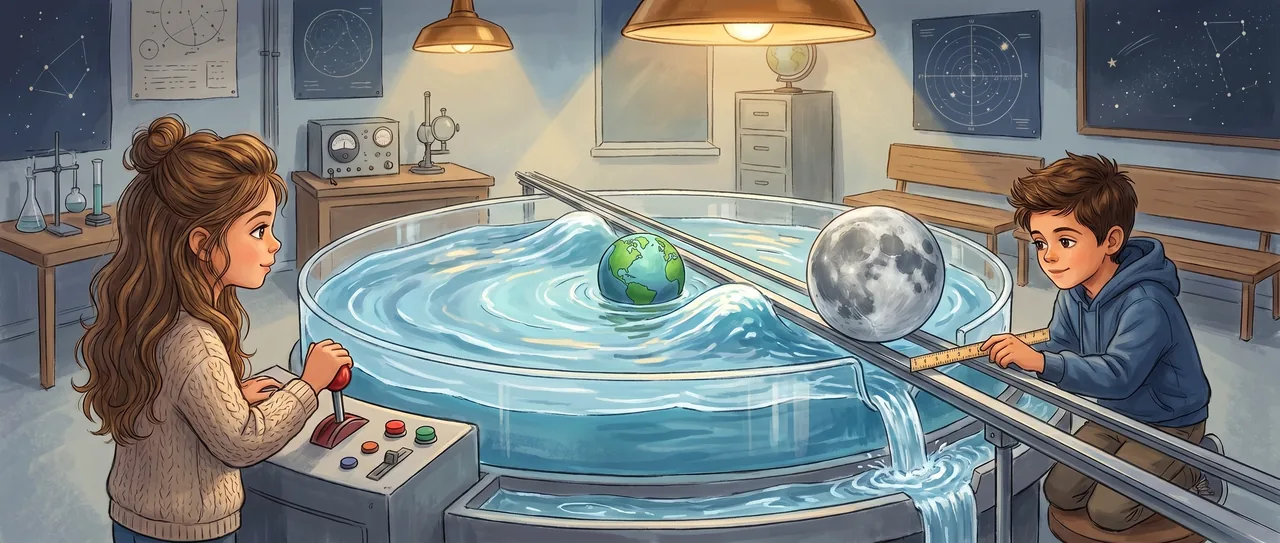
The tide table was a clear round basin as wide as a bed. A rubber Earth turned in the middle, painted with green continents and white clouds. Around it ran a metal rail with a silver Moon that could slide nearer or farther away. Above the basin, a lamp made sunrise. A small screen counted the length of a day.
Soren wiped water from the label with his sleeve.
"Maybe we turned too fast," he said.
"We turned the handle at normal speed."
"Normal for us," said Soren. "Not normal for Earth."
Maya let go of the handle. The rubber Earth kept spinning for a breath, carrying a bulge of water with it. The bulge did not point exactly at the silver Moon. It leaned forward, as if Earth were dragging the sea ahead and the Moon were being tugged by the sleeve.
Soren watched it twice. Then a third time.
"The high tide is not under the Moon," he said.
"It is in front."
"Because Earth spins."
"Because Earth is impatient," Maya said.
Soren looked at the small screen. It still said twenty-four-hour day.
Maya's fingers went to the row of buttons beside the handle. Present. Ice Age. First oceans. Young Earth.
She pressed Young Earth.
The screen blinked.
Day length: about six hours.
The lamp snapped around.
Morning flashed over the tiny continents. Noon came before Maya could blink properly. Evening chased it. Midnight fell and was gone. The painted Earth spun like it had somewhere to be.
Soren slid the Moon inward to the marked ring. It looked wrong, not like a Moon in the sky, but like a pale coin held too close to one eye.
"Ten times closer," he said. "Then the tide-making pull is not ten times. It goes by the cube. Ten times ten times ten."
"A thousand," Maya said.
They turned the handle together.
The water climbed.
It did not make a neat little beach tide, the kind that politely wets your ankles and leaves shells. It rose in two shining humps and shouldered up the continents. It slapped the clear wall. It poured into the overflow gutters with a hard, steady sound.
The lamp kept racing. Dawn, noon, dusk, dark. Dawn, noon, dusk, dark. Four sunrises in one ordinary day. A Moon huge enough to make the sea and stone answer.
The room did not get bigger. It got older.
Soren's mouth was open. He closed it, then opened it again. "The model was not broken. We were making old Earth keep today's clock."
Maya grabbed the wet instruction card and flipped it over. On the back, in tiny print, someone had written notes for staff.
Lunar laser ranging: the Moon is moving away from Earth at about three point eight centimeters each year. The rate has not always been the same. Astronauts left reflectors on the Moon. Lasers from Earth measure the distance.
Soren read it twice.
"Three point eight centimeters," he said.
He pulled his paper notebook from his pocket, then stopped with the pencil hovering. The tide table was still dripping. He put the notebook on a dry stool instead and took the ruler from its spiral.
"That is smaller than my thumb," he said.
Maya looked from the ruler to the silver Moon. "Across all that space."
"And they can tell."
He set the ruler on the rail, starting at the present-day Moon mark. Three point eight centimeters made a tiny gap, barely enough to look important. Soren pressed his finger there.
All around the basin were big labels. Giant Impact. Young Earth. First Oceans. Present Day. They had arrows and colors and confident words. But the Moon's leaving for one year was just Soren's fingertip on cold metal.
Maya took a roll of blue tape from the tool cart. "We need a new mark."
"For next year?"
"For every year," Maya said.
Soren measured again. "If we make one mark per year, the rail fills with tiny marks. If we make one mark per century, it is three hundred eighty centimeters. That is longer than the table."
Maya grinned. "Good."
The director came back carrying a dry sock and stopped at the doorway.
Water ticked from the overflow gutters into the tank below. The six-hour Earth spun under the lamp. The silver Moon hung close, enormous, and the little sea kept trying to climb out of its world.
"I said no flooding," the director said.
"It is not flooding," Soren said. "It is the overflow system."
Maya pointed to the gutters. "They built it for this. Someone knew it was supposed to be too much."
The director looked at the staff card in Maya's hand, then at the six-hour day on the screen.
"The trustees are wearing nice shoes," the director said.
"Then they should stand back," Maya said.
For a moment, only the motor hummed.
Then the director took one long breath and moved the velvet rope two steps farther from the table.
The preview crowd came in smelling like raincoats and popcorn from the lobby. The director began with the safe Moon. The present-day tide rose and fell. People nodded. The silver ball looked familiar. The Earth turned slowly enough that nobody had to hurry.
Maya waited by the controls. Soren waited by the rail with the ruler in his hand.
When the director said, "And now, much earlier," Maya pressed Young Earth.
The lamp began to race.
A sound went through the crowd, not quite a gasp and not quite a laugh. The Moon slid inward. It grew without growing, only moving closer, until the silver ball seemed too near to belong to the same sky.
Soren turned the handle.
The ocean rose.
It climbed the continents. It hit the walls and poured into the gutters. The first row stepped back. No one left.
The director did not speak for several seconds.
Soren placed the ruler on the rail. "This is how far the Moon moves away in one year now," he said.
His finger showed the small space.
Maya moved the silver Moon back to Present Day. The table calmed. The ordinary tide breathed in and out, low and patient.
Soren measured from the present mark and pressed a strip of blue tape onto the rail.
Maya slid the silver Moon outward until its edge touched the new pencil line.
Read the interactive version, listen to the narration, and earn a gold star →
A science-verified short story for curious kids · Curiosity Land