The Empty Name
The math companion was supposed to give answers.
That was the whole point of the demonstration. The coordinator had said it three times while rushing between tables with a cable in her teeth and a badge stuck sideways on her sweater.
"Ask it anything about primes," she had said. "It can search farther than a person could read in a lifetime. Please keep the questions clean. We have visitors in six minutes."
Maya had not asked anything yet.
Soren had asked the companion to count primes between one trillion and one trillion plus one million, then between one quadrillion and one quadrillion plus one million, because he wanted to see how tired the screen looked afterward.
The screen did not look tired. It bloomed with points.
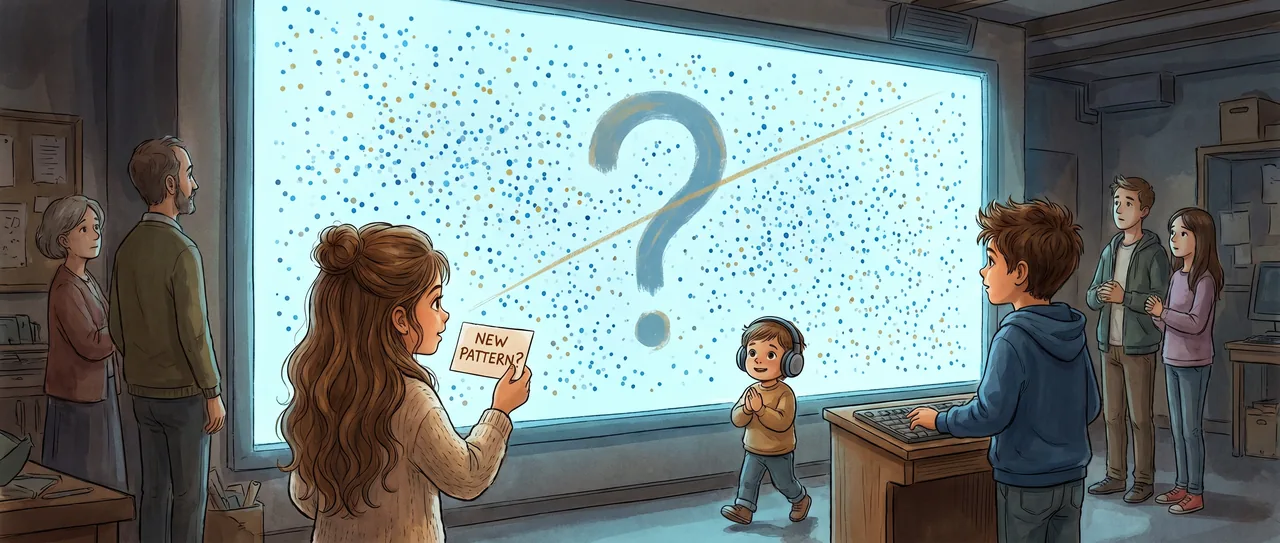
Each point was a range of numbers. Blue meant fewer primes than the smooth prediction. Gold meant more. The prediction came from the old rule that primes thin out, slowly, as numbers get larger. Soren knew that part. He had written it in his notebook two months ago, then crossed out half of it because "slowly" was not a number.
The companion said, "Pattern detected. Does the diagonal gold feature have a name?"
The room kept making room noises. Chairs scraped. The coordinator muttered at a projector. Somewhere, a printer clicked like an insect.
Maya leaned closer.
"It asked us," she said.
"It asks lots of things," Soren said.
"Not that kind."
The gold feature ran across the prime map like a scratch in sunlight. It was not straight, not exactly. It bent where the ranges grew wider. It thinned, vanished, returned. Around it, the blue and gold speckles looked random, but the streak had the awful neatness of something that had been waiting there before anyone knew how to look.
Soren opened the companion log.
Question generated after search across selected number ranges. Matching theorem label not found.
"Maybe it is Chebyshev's bias," Soren said.
Maya shook her head before he finished. "Different shape."
"You do not know that."
"Show Chebyshev's bias," Maya told the companion.
A second window appeared. It showed primes sorted by remainders, the way some endings win more often than others for a while, even though the big rules say they should balance in the long run.
The coordinator hurried past. "Beautiful, yes, residues, biases, all very famous. Try to keep the named examples ready."
"This one is not that," Maya said.
The coordinator was already under a table, reaching for a cable. "Then turn off smoothing. Smoothing invents ghosts."
Soren turned off smoothing.
The gold scratch broke into thousands of tiny squares.
It stayed.
Maya smiled without showing teeth.
Soren did not smile yet. He changed the block size. The map redrew. He changed the starting point. It redrew again. He asked for only primes that survived the usual wheel, numbers not knocked out by two, three, five, seven, eleven, or thirteen. He asked for a comparison with artificial points placed at the expected prime density, the kind of pretend-prime mist mathematicians used when they wanted to know what randomness would look like.
The pretend-prime map fizzed evenly.
The real one kept its gold scratch.
"It could still be an artifact," Soren said.
"Of what?"
He liked that question. It gave him handles.
"Grid. Search method. Color scale. Maybe the companion was trained on old papers and is seeing something because someone wrote about it already."
Maya tapped the empty theorem-label box under the streak. "Then it would have a name."
The visitors began to enter. Mostly adults. A few teenagers. One little kid with enormous headphones. Everyone wore the expression people wore near mathematics exhibits, interested but prepared to be confused.
The coordinator popped up from behind the table. Her hair had escaped its clip on one side.
"Prime Number Theater in two minutes," she said. "Give me the safe sequence. Euclid, gaps, prime number theorem, maybe Riemann if nobody looks sleepy."
"The companion found something," Soren said.
"It always finds something."
"It asked whether the something had a name."
That stopped her for almost one second.
"Then search the library," she said. "If it is unlabeled, do not put it on the big screen. People like knowing what they are looking at."
She rushed away to greet a man with a camera.
Maya watched the gold scratch. Soren watched the library search bar fill with names.
Prime number theorem. Dirichlet's theorem. Riemann hypothesis. Chebyshev's bias. Skewes number. Maier's theorem. Large gaps. Small gaps. Arithmetic progressions.
Each name came with a little door. Soren opened them one by one.
The prime number theorem described the broad thinning, not the scratch.
Dirichlet promised that certain arithmetic paths held infinitely many primes, not this bend across these ranges.
Riemann, even if true, would fence in the error, not draw this line inside it.
Chebyshev's bias leaned one way between remainders, not this.
Maier showed that primes could clump strangely in short intervals, stranger than the simple model expected, but the companion marked it only partial, partial, partial.
No label matched.
The companion said, "Nearest known results do not name the detected feature. Status options: artifact, finite coincidence, open regularity."
Maya whispered, "Open regularity."
Soren felt the words land wrong, then right. Not like a trophy. Like a loose stair under his foot.
At school, when he wrote questions in margins, teachers drew arrows back to the assigned problem. At home, relatives said math was nice because it had answers at the end. Here was a machine built from other people's mathematics, searching ranges so huge the commas lost their meaning, and it had reached the edge of its own names.
It had not said, Stop.
It had said, What is this called?
Maya was already moving. She pulled three white label cards from the demonstration tray. The cards were meant for famous names. EUCLID. GAUSS. RIEMANN. The empty ones were for visitors to hold during the show.
"We need to say what we know," she said.
"We do not know much."
"Good. Then it will be short."
Soren took one card. He did not write a name. He wrote, Seen in searched ranges. Not proved. Not matched.
Maya took the second card and wrote, Could be artifact. Could be coincidence. Could be something.
On the third card, Soren wrote, Does it have a name?
The coordinator turned and saw them carrying the cards toward the main projector.
"No, no, the first slide is Euclid," she said.
"This is first," Maya said.
"We cannot present an unknown as a result."
"We are not."
Soren plugged the companion into the big screen before his hands could become too careful. The prime map leaped onto the wall, three meters wide. The gold scratch crossed it like a path seen from far above.
The visitors quieted.
The coordinator stood beside the projector, holding the Euclid slide remote in one hand. Her mouth opened. Then the companion spoke through the room speakers.
"Pattern detected. Does the diagonal gold feature have a name?"
Nobody answered.
The little kid with headphones stepped closer to the screen. A teenager lifted her phone, then lowered it without taking a picture. The man with the camera forgot the camera was hanging from his neck.
Maya held up the first card.
Soren held up the second.
Maya slid the blank label into the holder beneath the projection. Soren tapped the return key, and the question mark filled the whole screen.
Read the interactive version, listen to the narration, and earn a gold star →
A science-verified short story for curious kids · Curiosity Land