The Dog That Wasn't There Yet
Maya arrived in the perception room exactly late enough to miss whatever everyone else had been told.
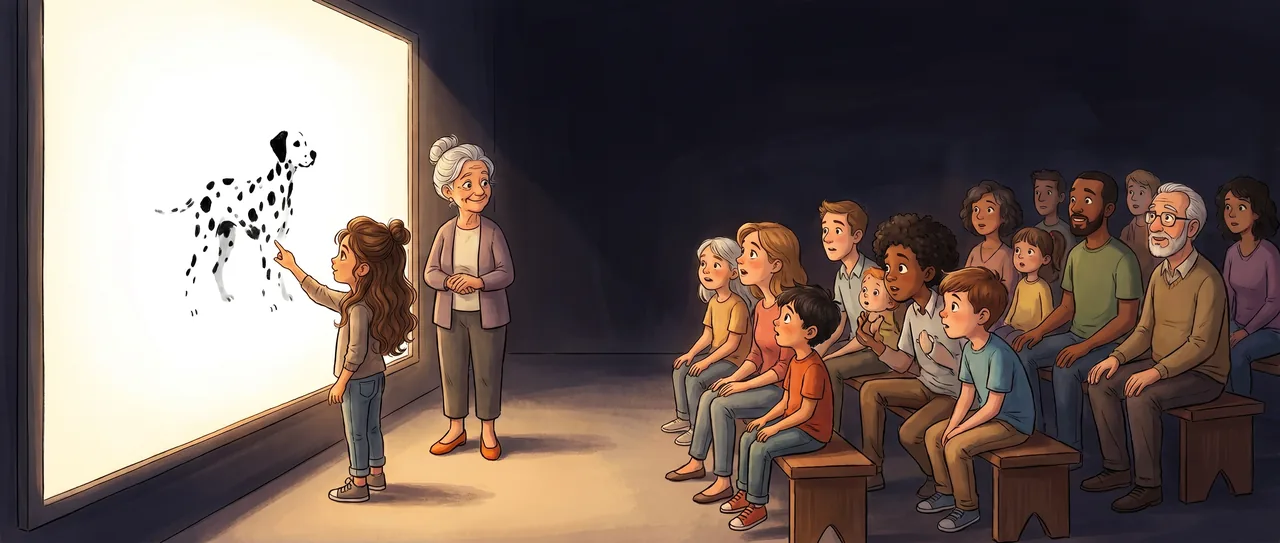
The class stood in a half circle before a huge screen. On it was a mess of black and white splashes, like snow dumped on a forest floor, or paint spilled by someone who had sneezed while holding the brush.
The exhibit designer clapped once. She had silver hair, orange shoes, and the tight smile of an adult whose morning had already lost several screws.
"Excellent," the designer said. "Who sees it?"
Every hand went up except Maya's.
"The dog," someone said.
"The spots," someone else said.
"It's sniffing the ground," said another voice.
Maya stared harder. Black patch, white patch, black branch, white emptiness. No dog. Not even a bad dog.
"There isn't one," Maya said.
The designer turned. "You came in after the hint. That's interesting. Look again. It's a Dalmatian. Head down. Under the trees. Here, the ear is this black patch. The back is here. The tail is up here."
Her finger did not touch the screen, but it carved the mess into pieces.
And then the dog arrived.
Not slowly. Not like finding a shape in a cloud. One second there were splashes. The next second there was a dog with its nose to the ground, white body broken by black spots, standing in snowy leaves.
Maya blinked.
The dog stayed.
"You changed it," Maya said.
"Same picture," the designer said.
"No. It moved."
The designer checked the control tablet, impatient now. "It did not move. That is the point. Your brain got a prediction, and now the picture fits it."
Maya stepped to the left. Dog. She crouched. Dog. She turned her head sideways until the room tilted. Lumpy sideways dog.
"Make it go back," Maya said.
The designer's tight smile loosened in one corner. "I can't. Not for you."
That was not an answer Maya liked.
The room was full of stations, all waiting for the grand opening in less than an hour. There was a wall of mirrors that were not mirrors, a table with a paper card and two printed dots, a hollow mask turning slowly on a stand, and a booth labeled LISTEN FIRST.
The designer hurried them through as if wonder had a schedule.
At the paper card, Maya covered one eye and brought the page toward her face. One dot vanished. The paper did not grow a hole. The white around it simply slid over the missing place as if the dot had never deserved to exist.
"Blind spot," the designer said. "Where the optic nerve leaves the eye, there are no light receptors. Your brain fills in the gap. Next station."
Maya stayed one extra breath. She moved the paper back and forth. Dot. No dot. Dot. No dot. The world had a patch in it, and she had been walking around with her own head mending it.
At the mask, the inside of a face turned on a motor. It should have looked like a bowl with a nose dented inward. Instead, the hollow face bulged out and watched Maya pass.
She stopped.
The mask's empty eyes followed her.
"That's cheating," Maya said.
"It's plastic," the designer said. "Plastic is allowed to be strange. People usually expect faces to stick out, not cave in. Your visual system uses that expectation. It is often useful. Here it is wrong."
Maya leaned close enough to see the shadow inside the hollow cheek. For one flicker, the face snapped inward. Then it popped out again and stared.
The designer glanced at the clock. "We have to test the final theater. Please, everyone inside."
The final theater was a small black room with soft benches and a screen as wide as the wall. Above the entrance hung a sign with big letters:
YOUR BRAIN DOES NOT TAKE PICTURES. IT MAKES GUESSES.
Inside, the designer dimmed the lights. The dog picture appeared again.
Everyone said, "Dog."
The designer waited.
Nothing happened.
She tapped the tablet. The picture switched to the blind spot card, then the hollow mask, then a video of a checkerboard with a shadow across it. She sounded more and more cheerful with every sentence, which made Maya suspect the cheer was held on with tape.
"And here we show that two squares can send the same amount of light to the eye, but appear different because the brain is judging shadow. Here we show how prior knowledge shapes what you hear in noisy sound. Here we show prediction and correction working together."
The class watched politely.
Polite watching was the worst kind. It meant nothing had cracked open.
The lights came up.
The designer pressed her lips together. "It worked better in rehearsal."
Maya was still looking at the dog.
"No, it didn't," Maya said.
The designer looked at her. "Pardon?"
"In rehearsal, everyone already knew. The people who built it knew. The people who practiced knew. They all had the dog in their heads before the dog came on."
"The sign explains what to notice," the designer said.
"The sign ruins it."
The class went quiet in the way people go quiet when an eleven-year-old says the thing adults were stepping around.
The designer's orange shoe tapped once.
Maya pointed to the entrance sign. "That tells them the answer before their eyes get a chance to be wrong. The wrong part is the door."
The designer did not answer. She looked at the dog picture. Then at the sign. Then at the dog again.
"Everyone on my team can see the dog immediately," she said.
"Because you broke yourselves," Maya said.
The designer made a sound that might have been a laugh if there had been more time.
Outside the theater, the first real visitors had begun to gather, families with raincoats and paper maps and younger kids pressing their noses to glass cases. The designer looked at them, then at the sign, then at Maya.
"I cannot reprint panels in twenty minutes," she said.
Maya was already moving.
She took the black cloth from the hollow mask stand and dragged a chair to the theater entrance. The designer opened her mouth.
"It's not touching the screen," Maya said.
"That was not my question."
Maya climbed onto the chair and draped the cloth over the sign. The words disappeared.
"Now they go in not knowing," Maya said.
The designer stared at the covered sign. "And the explanation?"
"After."
"People like explanations before they feel confused."
"No, adults like explanations before kids feel confused."
The designer looked as if several screws in the morning had rolled back into place, but not the same screws.
When the doors opened, Maya stood just inside the theater. The first visitors came in. No one told them anything.
The dog picture appeared.
A small child said, "Snow."
A grown-up said, "Branches?"
Someone near the back said, "Is this the broken part?"
Maya waited until the room had filled with wrong answers.
Then she stepped to the screen and traced the air just beside the black patch.
"Here is an ear," she said. "Here is the nose. Here is the back. Don't try to believe me. Just look."
The room changed without the screen changing.
Maya heard it happen. It was not a word at first. It was little breaths, chairs creaking, one sharp laugh, a whisper from the back that said, "Oh. Oh, there it is."
The dog stood in the snow for all of them now.
Maya looked at the screen and tried to lose it. She tried to break the dog back into splashes. The white body held. The black ear held. The world had learned a shape and would not give it back.
The next part was the listening booth. Before the sentence appeared, the sound was only crackle and hum. After the words came up, the same crackle carried syllables. People leaned forward as if the speakers had become clearer, though the designer did not touch the volume.
At the hollow mask, visitors ducked and laughed when the empty face followed them. At the blind spot card, grown-ups said, "That can't be right," and moved the paper again and again until the dot vanished exactly where their own eyes had no eyes.
The designer stood beside Maya at the back of the theater.
"We needed someone who hadn't been told what to see," she said.
Maya did not look away from the visitors. "You needed someone late."
"I needed someone who argued with the dog."
On the wall, the Dalmatian sniffed forever at the snowy ground, made of nothing but the same black and white patches that had been there before.
When the show ended, the covered sign stayed covered. The designer brought out a marker and wrote three words on the black cloth in large crooked letters.
GET CONFUSED FIRST.
Maya read it twice. The letters were just letters. Then they were instructions. Then they were almost a dare.
She left the theater while the next group was still lining up. In the lobby, rain streaked the tall glass doors. The city outside mixed with the reflection of the room behind her, so that people on the sidewalk walked through hanging planets, and the museum lights floated over the wet street.
Maya raised her hand toward the glass.
Her fingertip stopped on the cold pane between her face and the rain.
Read the interactive version, listen to the narration, and earn a gold star →
A science-verified short story for curious kids · Curiosity Land