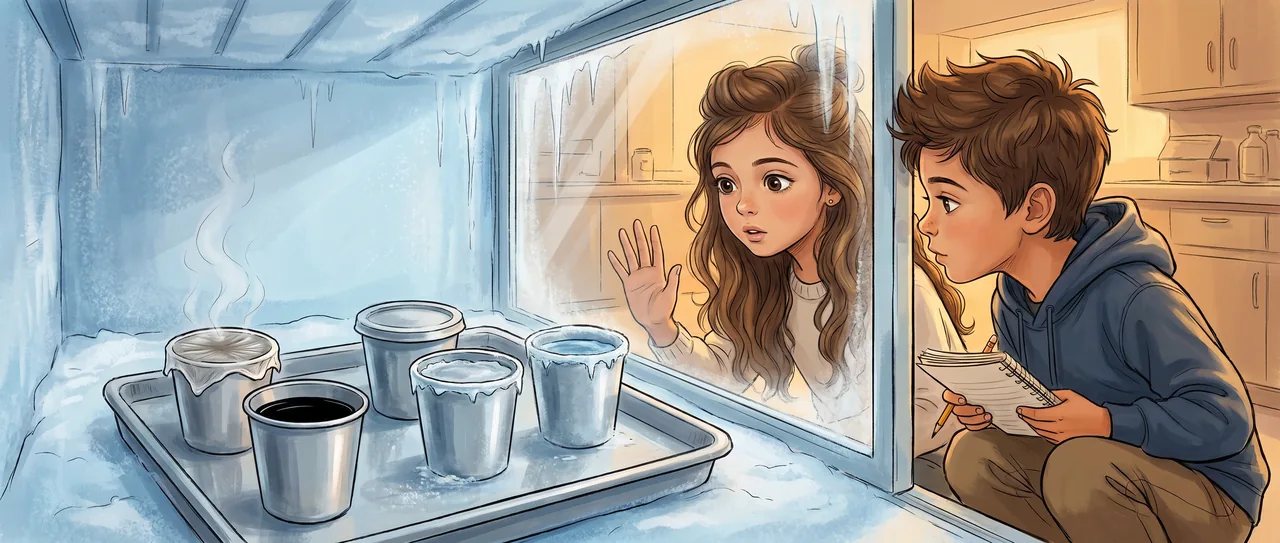
The Cup That Would Not Wait
The museum freezer had a window in its door, so everyone could watch ice happen.
Usually, that was the point.
Today, the freezer window showed twenty-four empty metal cups, one fogged thermometer, and the reflection of the museum technician pressing both hands into his hair.
“The visitors arrive in twenty minutes,” he said. “The cold-water race is canceled.”
Maya was already on the wrong side of the counter, where visitors were not supposed to stand. Soren stood beside her with his paper notebook open, because the museum tablets were all clipped to their charging rail like obedient beetles.
“Why canceled?” Maya asked.
The technician pointed at the kettle. It was still sighing steam. “Because someone refilled the hot tank instead of the cold tank. We cannot race freezing water if all the water is hot.”
“We have cold water,” Soren said.
The technician pointed at a small pitcher sweating on the counter. “Enough for three cups. The demonstration needs twelve. It is called What Freezes First, not Watch Me Apologize To Families.”
Maya looked at the steam. She looked at the freezer. She looked at the wall behind it, where old science questions were printed in silver letters.
One of them said: Erasto Mpemba asked why hot ice cream mix sometimes froze faster than cold mix.
Maya tapped the sentence with one finger.
The technician did not turn around. He was checking a panel that blinked orange. “Not that today.”
“Why not?” Maya asked.
“Because people leave here saying hot water always freezes faster, and then they try it at home, and then they send emails.” He shut the panel too hard. “It is not a trick we understand well enough for a show.”
Soren wrote one word: sometimes.
Maya saw it before his pencil stopped moving.
“Sometimes is enough,” she said.
“For what?” asked the technician.
“For a show that tells the truth.”
The technician finally looked at them. He had the face adults got when a child had made a sentence that sounded reasonable and inconvenient at the same time.
“No myths,” he said. “No promises. No touching the compressor controls. I have to fix the alarm before the school group gets here.”
He left them with the freezer, the steaming kettle, three cups of cold water, and a demonstration that was supposed to be impossible.
Soren drew a fast grid in his notebook.
“We need pairs,” he said. “Same cups. Same amount. Same shelf if we can. But not too close, or the hot ones warm the cold ones.”
“Shallow cups,” Maya said.
“Why?”
“Edges freeze first. More edge.”
Soren nodded and changed the drawing. “Open or covered?”
Maya watched steam curl away from the kettle spout and vanish against the cold glass door.
“Both,” she said. “If steam matters, covering matters.”
“We only have three cold cups.”
“Then three races.”
They moved quickly, but not carelessly. That was the hard part.
Soren measured water into six small metal cups, three from the cold pitcher, three from the hot tank. He did not fill them to the same line by eye. He used the measuring cylinder with blue numbers, because his eyes were always trying to be helpful and he did not entirely trust them.
Maya arranged the cups on a tray that slid into the freezer. Open hot beside open cold, with an empty space between. Covered hot beside covered cold, each with a flat lid. Deep hot beside deep cold, in taller cups the technician used for slow demonstrations.
The hot cups breathed white ghosts. The cold cups sat still and ordinary.
Maya pressed the freezer button.
The drawer swallowed the tray.
Through the window, the six cups looked like tiny planets in a glass night.
At first, nothing happened.
That was not true, but it looked true.
The hot open cup steamed so hard the window blurred above it. Drops gathered on the freezer ceiling. The covered hot cup made its lid tremble faintly. The cold cups looked patient.
Soren crouched until his nose nearly touched the glass.
“Open hot is losing water,” he said.
“Is that cheating?” Maya asked.
“It is a condition.”
“That sounds like cheating wearing a lab coat.”
“It might be why it wins, if it wins.”
Maya smiled. “So we let it.”
At four minutes, the covered cold cup had a thin ring at its rim.
At five minutes, the open hot cup had a wider ring, cloudy and uneven, like a shoreline seen from high above.
The technician hurried past carrying a coil of cable. He slowed down just enough to frown through the glass.
“Do not call it yet,” he said.
“We are not,” Soren said.
The technician hurried away again.
At seven minutes, the deep cold cup had ice at the wall. The deep hot cup did not. Soren put a mark beside deep cold.
Maya did not mind. The list in her head liked it better when the world refused to march in one line.
At nine minutes, the covered cold cup had more ice than the covered hot cup.
Soren marked that too.
At ten minutes, the open hot cup stopped shining.
Maya leaned in.
The surface had gone dull all at once. Not white exactly. Not clear. A skin had pulled itself from rim to rim, wrinkled in the middle where steam had been rising a moment before.
The open cold cup beside it was still a black circle of water.
Soren checked the thermometer display taped to the outside of the cups. The cold cup read below zero.
He did not write for a second.
“It is colder than freezing,” he said.
“It is not frozen.”
“No.”
Maya put her hand flat on the freezer door.
The room changed size.
Behind them, the first visitors came in, loud with coats and footsteps.
The technician returned with the cable looped over one shoulder. “Tell me you did not break anything.”
“Open hot froze first,” Maya said.
“One open hot froze before one open cold,” Soren said. “Covered cold is winning its race. Deep cold is winning its race.”
The technician looked through the glass.
He stopped moving.
Maya pointed to the wall sentence. “He did not ask why hot water always freezes faster.”
Soren closed his notebook, but kept one finger inside the page. “He asked why it did when it did.”
The technician gave a small laugh, the kind that escaped before an adult could decide whether to allow it.
The school group pressed closer.
“Is it solved?” one child asked.
The technician opened his mouth.
Maya answered first. “No.”
Soren said, “That is why the window is useful.”
The technician looked at the freezer, then at the children waiting behind the rope, then at the three races running side by side.
“All right,” he said. “No promises. Everybody watch the cups that disagree.”
Maya set the frozen hot cup on the tray beside the cold cup. Soren touched the cold surface with the thermometer tip. White needles shot from the glass wall to the center.
Read the interactive version, listen to the narration, and earn a gold star →
A science-verified short story for curious kids · Curiosity Land