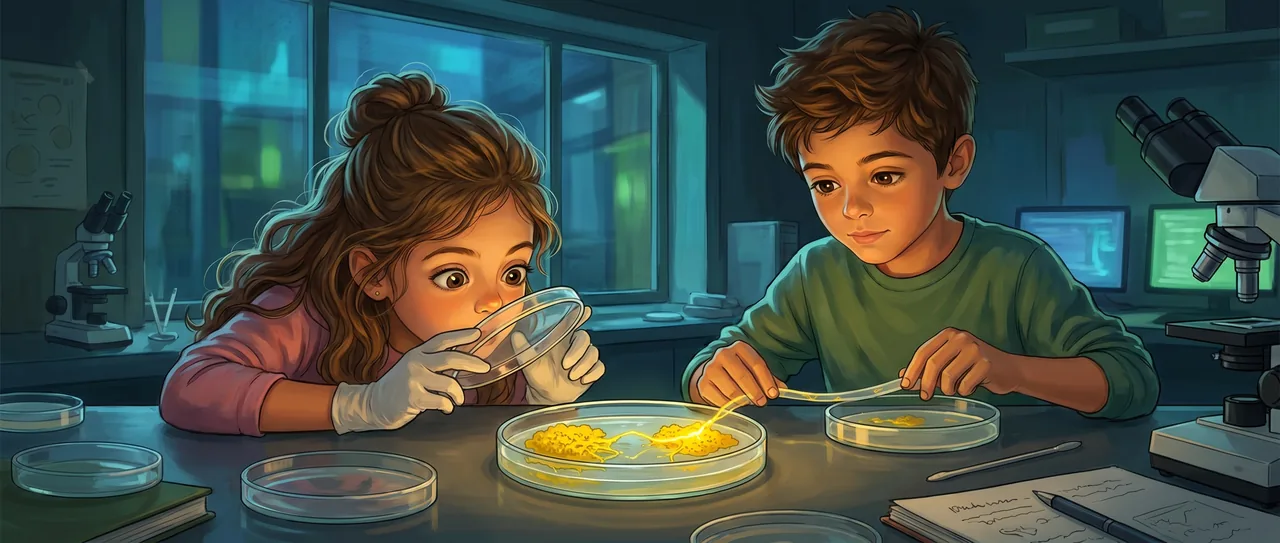
The Cell That Remembered Wrong
The slime mold ruined Brain Week before the doors even opened.
It was supposed to stop at the bitter line.
That was the whole point of the dish. On one side, a yellow puddle of Physarum polycephalum crept through damp agar. On the other side waited an oat flake. Between them lay a thin stripe of quinine, harmless but bitter, painted across the glass like a warning.
The museum coordinator had made a neat label for it.
No brain. No nerves. Just avoidance.
But the slime mold did not avoid it.
It reached the quinine stripe, paused, thickened into a brighter yellow lip, and then flowed across.
Maya leaned so close her breath fogged the lid.
“It’s not stopping,” she said.
“It stopped a little,” Soren said.
“Not like yesterday.”
The coordinator pressed both palms on the table. She had a headset around her neck, three visitor badges clipped to her pocket, and the look of someone who had not eaten lunch on any day that week.
“That plate is no good,” she said. “We’ll use the backup. Brain Week starts tomorrow. I need dependable slime.”
Soren wrote dependable slime in his notebook, then circled it because it seemed like a phrase that should not exist.
Maya was still watching the yellow front widen over the bitter stripe.
“Maybe it is dependable,” she said. “Maybe we changed what it depends on.”
The coordinator picked up the failed label and frowned at it.
“It has no nervous system,” she said. “It can’t learn the way animals learn.”
Maya said, “I didn’t say the way animals learn.”
Soren looked from the dish to the shelf of other dishes. One held a maze, its dead ends empty, its shortest route shining with a thick yellow tube. Another held oat flakes arranged like cities around Tokyo Bay. The Physarum had connected them with branching veins, not exactly like the subway map pinned beside it, but close enough to make Soren’s scalp feel fizzy.
The famous Tokyo experiment was why the museum wanted the slime mold. No brain, yet it could make useful networks. No planner, yet it could trim away waste. No train schedule, yet there it was, making something that looked like one.
But this dish was worse.
A maze could be solved by growing everywhere and keeping what worked. A network could be shaped by food and distance. This looked like yesterday had gotten inside today.
The coordinator checked her tablet.
“I have to go argue with the planetarium printer,” she said. “You two may observe. You may not create a disaster. If you touch the cultures, use gloves and label everything.”
“We need fresh quinine strips,” Soren said.
She stared at him.
“To prove it is not the strip getting weak,” he said.
The coordinator pointed at a drawer. “Disposable bridges. Quinine bottle. Pipettes. If anything smells strange, call me. If anything escapes, call me louder.”
When she left, Maya pulled on gloves too large for her fingers.
“You think it remembers,” Soren said.
“I think the wrong plate went right,” Maya said.
“That is not a mechanism.”
“No,” Maya said. “It’s a place to start.”
They made two new plates.
On each plate, they laid a narrow agar bridge between a yellow blob and an oat flake. On each bridge, Soren pipetted the same amount of quinine solution, counting drops under his breath. Maya turned both dishes so the light from the window hit them equally. Soren made a mark on the glass lids with tape, not on the agar. Maya moved the oat flakes until the distances matched.
One yellow blob came from the backup culture in the dark cabinet, the one nobody had used for demonstrations. The other came from the plate that had crossed the bitter stripe every afternoon while the coordinator practiced her visitor talk.
“Trial one,” Soren said.
Maya said, “Trial not-one. It already had trials.”
Soren wrote that down too.
For the first hour, nothing dramatic happened. Physarum did not perform for people. It thickened, thinned, pulsed, and reached. Its yellow veins shimmered as the inner fluid streamed one way, then the other, like breathing without lungs.
The fresh blob touched the quinine bridge and pulled back into itself.
The practiced blob touched the quinine bridge and paused.
“Come on,” Maya whispered.
“It is not a dog,” Soren said.
“I know.”
The practiced blob spread a narrow tongue over the bitter line.
Soren stopped chewing his pencil.
The fresh blob sent a side branch along the edge, as if looking for another way.
By lunchtime, the practiced blob had crossed the bridge and wrapped the oat flake in yellow. The fresh blob had not.
“That could still be because the practiced culture is hungrier,” Soren said.
Maya was already lifting another clean dish.
They switched the oat positions. They cut equal pieces from the fronts with sterile loops. Soren hated cutting a living thing, even one with no face, so he made the cuts quickly and exactly. Maya timed him. They made new quinine bridges. They made a plain bridge too, with no quinine at all, because Soren said a control was a way of being fair to a question.
On the plain bridge, both blobs crossed.
On the quinine bridge, the practiced one hesitated less.
Again.
By late afternoon, the coordinator returned with printer ink on her sleeve and found them surrounded by labeled dishes.
Maya held up two plates without speaking.
The coordinator looked. The fresh Physarum had made a fat yellow border along its side of the bitter bridge. The practiced one had crossed and fed.
“Contamination?” the coordinator asked.
“We used new bridges,” Soren said. “Same quinine. Same distance. Same oat size, mostly. Same light.”
“Mostly,” Maya said.
“Very mostly,” Soren said.
The coordinator lowered herself onto the stool.
“It habituated,” Soren said.
The word sounded too large for the small yellow smear in the dish.
Maya tapped the old label with one gloved finger.
No brain. No nerves. Just avoidance.
“That last part is wrong,” she said.
The coordinator did not answer right away.
In the quiet, the Physarum pulsed.
Soren had seen videos of neurons firing, bright signals branching through dark. This was not that. There were no synapses hiding in the slime mold, no tiny brain waiting to be found, no secret animal inside the yellow sheet. It was one cell, spread wide, with many nuclei and no nervous system, and still the old irritation did not frighten it the same way.
He looked at the Brain Week banner on the far wall. It showed a pink cartoon brain wearing a lightning bolt crown.
Maya followed his gaze.
“Too bossy,” she said.
“The crown?”
“The whole thing.”
Soren took a blank exhibit card. He did not cross out the old label. He set the blank card underneath it and wrote carefully, in letters large enough for visitors to read:
No brain. No nerves. Not just avoidance.
The coordinator leaned over his shoulder.
“That is going to make people ask questions,” she said.
Maya grinned. “Good.”
The coordinator pinched the bridge of her nose, then laughed once, very tired and very real.
“I will need a better title than Dependable Slime,” she said.
Soren slid his notebook halfway behind a stack of lids.
Maya said, “The Cell That Got Used To It.”
“The Cell That Learned Without a Brain,” Soren said.
The coordinator looked at the yellow networks, the maze, the Tokyo plate, the crossed bitter bridges.
“Both,” she said. “We’ll use both.”
They stayed after closing to set up the final display.
The museum lights dimmed row by row. The lab window turned black and reflected the table back at them, a small island of glass dishes and yellow branching lives. Somewhere beyond the wall, the planetarium projector hummed through tomorrow’s stars.
Maya held two bits of Physarum on separate loops, one from the practiced plate and one from the fresh culture.
“They can fuse back together,” she said.
“I know,” Soren said.
“If one part got used to quinine and the other part did not...”
The coordinator, halfway to the door with a box of signs, stopped walking.
Soren put a clean dish between them. “We should not answer that on the exhibit label.”
“No,” Maya said. “We should put it where people can see the question.”
They placed the two yellow pieces on the same damp agar, close but not touching. Between them, Soren set a tiny bridge with no quinine, only clear gel.
For a while, nothing moved except the pulsing inside each separate yellow body.
Then one edge softened.
A thin vein reached from the practiced piece toward the fresh one.
Maya lowered her face until her nose nearly touched the lid.
Across the clear bridge, the two yellow fronts met and brightened at the seam.
Read the interactive version, listen to the narration, and earn a gold star →
A science-verified short story for curious kids · Curiosity Land