Not an Organ Yet
The poster outside the glass lab said PRINT A HEART BY LUNCH.
Soren stopped in front of it so suddenly that the visitor behind him bumped his backpack.
He was eleven, which meant people still gave him stickers at science events, but old enough to know when a poster was cheating. He had read three articles about bioprinting before coming to the university. One had a picture of a tiny printed ear shape. One had a video of pink gel sliding from a nozzle. One said the hard part, again and again, was not the shape.
The hard part was keeping the middle alive.
Inside the lab, the bioprinter waited behind clear plastic panels. It did not look like a miracle machine. It looked like a very careful box with a needle, a cold cartridge, and a bed that could move without wobbling.
The lab director clapped her hands once.
“Welcome, future inventors,” she said. Her white coat had three pens in one pocket and a coffee stain near the buttons. “Today we will print living material. Not a toy. Not plastic. A real tissue structure.”
A camera on a tripod pointed at the printer. Behind it stood three adults wearing visitor badges. Their smiles looked practiced.
The lab director saw Soren looking at the poster.
“Yes,” she said, before he asked anything. “The poster is enthusiastic.”
“It says heart by lunch,” Soren said.
“It gets people through the door.”
“It is not true.”
The director’s smile twitched. “Also true. Please do not say that when the camera light is on.”
Soren opened his notebook. The director looked at it as if it were an antique tool.
“You brought paper into a clean lab tour,” she said.
“It is outside the sterile line,” Soren said.
“That is not the part I meant.”
The printer hummed awake.
On the screen, a file showed a small heart shape, no bigger than a cookie. The inside was solid red. The director tapped it with one finger.
“For the demonstration, we use a bioink made of hydrogel and living cartilage cells,” she said. “The gel holds the cells in place. The printer lays it down in threads, layer by layer. Later, in an incubator, the cells can stay alive and make some of their own material.”
Soren wrote: not like melted plastic.
The nozzle lowered.
A clear thread slid onto the print bed. It was so soft that it shone only when the light caught it. The printer moved left, paused, moved right, rose a hair, and crossed the first line with another. Slowly the heart shape became visible, not red like the screen, but pale and wet and almost not there.
The camera adult whispered, “Can we get closer?”
“Not closer,” the director said. “Cells dislike being breathed on.”
Soren looked at the printed heart. It was neat. It was also wrong.
“How does the middle eat?” he asked.
The director kept her eyes on the printer. “It does not eat. Cells take in oxygen and nutrients from the liquid around them.”
“But the middle is farther from the liquid.”
“Yes.”
“How far is too far?”
The director pressed her lips together. The camera light was not on yet.
“Closer than people expect,” she said. “That is one reason printing a whole organ is not the same as printing an organ shape.”
She led him to a microscope screen near the incubators. On it was a round slice from an older, thicker print. The outside glowed green. The center had a dim, reddish cloud.
“Green cells were alive when we stained them,” the director said. “Red ones were not.”
Soren did not write at first.
The round print looked like a planet with a dead core.
Then the director changed the image. The next sample was not solid. It was a lattice, full of thin spaces. Green points crowded along the strands all the way through.
“The boring empty parts,” Soren said.
The director glanced at him.
“They are not boring,” he said. “They are where the soup can go.”
“Nutrient medium,” she said automatically.
“Soup for cells.”
The director gave a short laugh, then looked toward the camera adults and stopped laughing too quickly.
“We were supposed to print the heart outline for the donors,” she said. “It photographs well.”
“It lies well.”
“Soren.”
He had not told her his name. It was on his badge. Still, it sounded different when she said it, like he had become part of the equipment she was worried about.
The printer finished. The little heart sat on the bed, glossy and perfect and hungry in the middle.
The director checked the time. “We have one cartridge left for the live recording. I can switch to the safe practice gel and do the heart again.”
“Does it have to be a heart?” Soren asked.
“The hospital board likes symbols.”
“Blood vessels are symbols.”
“They look like noodles.”
“Important noodles.”
The director looked at the solid heart file on the screen. Then at the visitors. Then at Soren’s notebook, where he had drawn a square filled with branching paths that split and split again, leaving no thick middle anywhere.
“That is not an organ,” she said.
“No,” Soren said. “That is the problem.”
She did not answer for three seconds. During the three seconds, the printer fans seemed very loud.
Then she slid the keyboard toward him, stopping before it crossed the clean boundary.
“Tell me the pattern,” she said. “I will enter it.”
Soren did not try to make it pretty. He used what he knew from plastic printing, then changed the parts that would be cruel to cells. No solid block. No huge empty gap that would collapse. Thin walls. Repeating branches. Spaces close enough for liquid to reach, wide enough not to seal shut when the gel sagged.
“Again,” the director said, typing fast. “The branch after the second split.”
“Not straight,” Soren said. “Angle it. If the lines cross too soon, the corner gets thick.”
She angled it.
The camera adult said, “Are we filming the child designing the heart?”
“We are not printing a heart,” the director said.
The camera adult lowered the camera. “But the poster says heart.”
“The poster is enthusiastic,” Soren said.
This time the director did not hide her laugh.
She loaded the cell cartridge. The nozzle descended again.
The first line landed. Then another. Then a branch. Then two branches from that branch. The print did not become a heart. It became a pale map of tiny roads, stacked carefully in layers, with open channels running between them.
On the magnified screen, the printed strand was no longer a strand.
It was full of small round cells, suspended in the gel like passengers in a clear train. They were not decorations in a material. They were the reason the material had to be gentle. The nozzle moved slowly because speed could harm them. The gel was soft because they had to live inside it. The shape had holes because every hidden cell would need the world to reach it.
Soren put his pencil down.
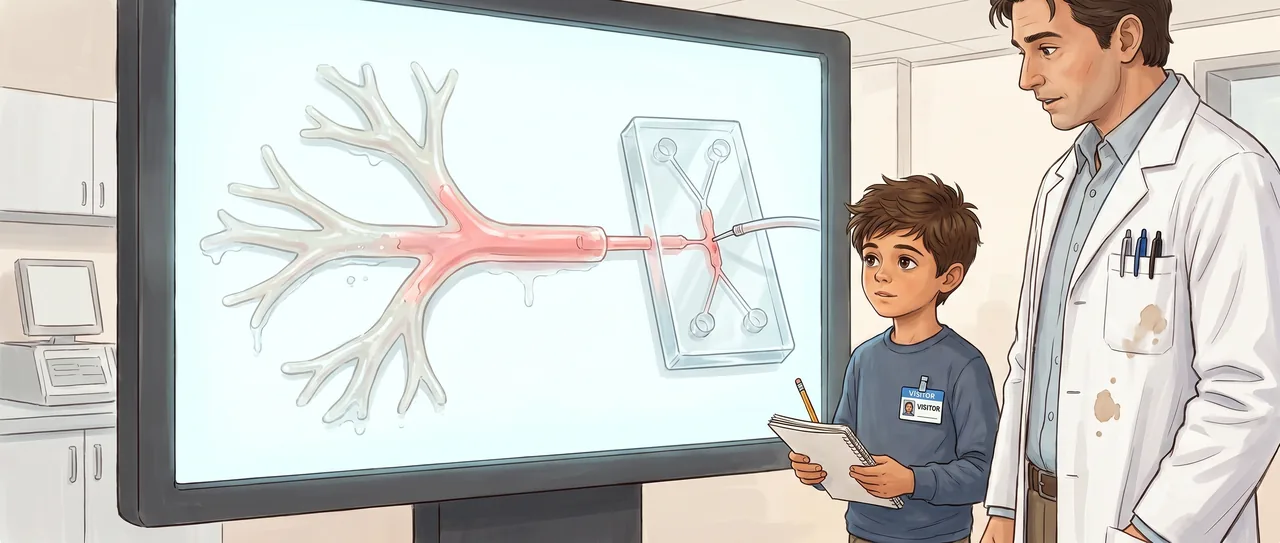
The director brought out a clear chip from a warm incubator. Inside it was an older printed vessel segment, grown for weeks, its channel lined with living cells. A thin tube connected it to a small pump.
“Researchers have printed working blood vessel structures,” she said, not to the donors now, but to the room. “Small ones. Not whole organs. Not yet. But without vessels, the larger dream has nowhere to begin.”
The visitors had stopped smiling their practiced smiles.
Soren leaned closer to the glass. The pump pressed pink nutrient medium into the tiny channel. It moved in pulses, not because the vessel was a heart, but because the pump was pretending to be one for the cells.
His branching print rested beside it, new and pale and not ready for anything except the next question.
The director turned on the camera.
“Tell them what we printed,” she said.
Soren stood beside the bioprinter. He did not look at the poster. He looked at the clear chip, the tubes, the wet little map he had helped make.
“Not an organ yet,” he said. “A way for the inside not to be alone.”
The pump clicked once. Inside the clear chip, a red thread of medium entered the first branch and split into two.
Read the interactive version, listen to the narration, and earn a gold star →
A science-verified short story for curious kids · Curiosity Land