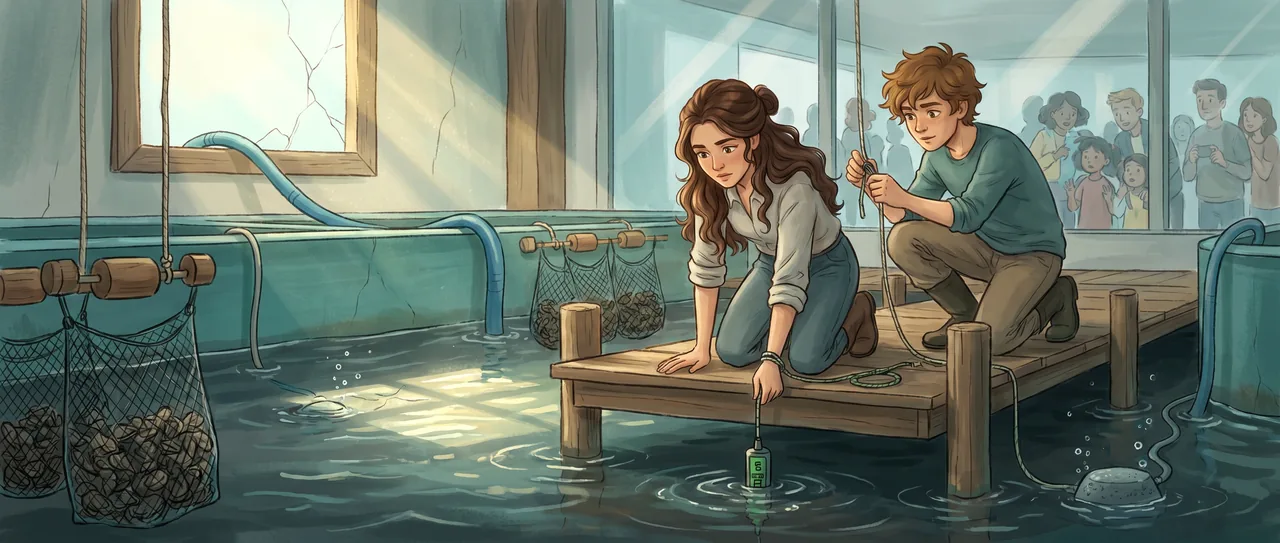
Where the Pump Breathes
The oysters had refused.
That was what the hatchery director said, though oysters were not the sort of animals that could fold their arms and be difficult. They were specks in a glass dish under a microscope, smaller than sand, and this morning most of them were still round.
“They should have made their first shells overnight,” the director said. She had a headset on one ear and a coil of blue tubing around her wrist. “Little D shapes. Very photogenic. The visitors love a baby oyster with ambition.”
On the other side of the wet room, people were already filling the visitor hall. Their voices came through the glass wall in waves. The hatchery was having Future Bay Day. There were posters about restored reefs, baskets of young oysters hanging from the dock, and a table where children could turn a crank to light a model buoy.
Maya leaned over the microscope screen. The larvae drifted like pale moons. Some had a sharp clear edge, but most did not.
“Not refusing,” she said.
Soren bent close enough that his breath fogged the corner of the screen. “Not building.”
The director tapped her headset. “I know. I know. I promised the livestream a shell formation shot in nine minutes.” She looked at the two small tanks beside the microscope. Both had labels written in marker. Yesterday, seven p.m. Bay water. Yesterday, seven p.m. Hatchery water.
“The filter probably clogged,” she said. “Or the pH probe is sulking again. It sulks during crowds.”
“Probes don’t sulk,” Soren said.
“This one has a personality,” the director said, and hurried toward the visitor hall, dragging the blue tubing like a tail. “Do not touch the big tanks. Do not open anything with a red handle. If the mayor asks, say the oysters are being thoughtful.”
Maya watched the larvae roll in the shallow dish. Round, round, round, then one with a clean hinge like a tiny open book.
“That one did it,” she said.
Soren checked the label on the dish. “From hatchery water.”
Maya pointed to the other tank, the bay water tank. A thin stream of bubbles came up through a stone at the bottom. The bubbles popped in a soft, steady tick.
“That sound is wrong,” she said.
“It is just air.”
“Where from?”
Soren followed the clear tube with his finger. It ran behind the table, under a mat, around a bucket, and through a slot in the glass wall. On the visitor side, it disappeared beneath a row of folding chairs.
The chairs were full of adults drinking coffee and talking. A baby in a stroller slapped a plastic fish against a tray. Someone laughed hard enough to cough.
Soren looked back at the bubbles. “The pump is breathing the room.”
Maya was already moving.
There was a cart labeled Water Testing. On it were plastic droppers, salinity strips, a thermometer, and a pH meter in a cup of clear liquid. Soren lifted the meter carefully, rinsed it the way the laminated directions said, then lowered it into the hatchery water tank.
The numbers blinked, climbed, stopped.
“Eight point one,” he said.
Maya waited with both hands flat on the table.
He rinsed the probe and moved it to the bay water tank.
The numbers sank.
“Seven point seven,” he said.
“That’s not much,” Maya said, but she said it in the way she said things that did not fit, not in the way she said things that were small.
Soren grabbed the folded pH scale card from the cart. “It is much if it’s pH. Each step is ten times.”
Maya looked through the glass at the talking crowd. “They’re putting themselves in the tank.”
Soren did not answer right away. He had found another instrument on the cart, a carbon dioxide meter with a black grill on top. He switched it on. In the wet room, the number settled. He carried it to the slot in the glass wall and held it near the tube’s disappearing place.
The number climbed while the visitors talked.
Maya’s face changed, not into a smile, not exactly. More like a door had opened and cold bright air had come through.
“The invisible part of breathing,” she said.
Soren looked at the bay water tank. The bubbles kept coming, cheerful and terrible.
On the wall above the microscope was a strip of pictures from deep-sea cores. The shells of ancient plankton showed up as white flecks in dark mud. Under the strip, a sentence said that today’s ocean acidification is happening about ten times faster than any natural acidification found in the geological record.
Soren read it twice. He did not write it down. His notebook was in his back pocket, but his hands were wet.
Maya went to the window. It opened only a crack, enough for air and not enough for a gull, according to a sticker. Outside, the dock rocked in sunlight. Mesh bags of young oysters hung from ropes, knocking softly against the floats.
“We need the pump to breathe out there,” she said.
“The tube won’t reach.”
“Blue tubing.”
They both looked toward the director. She was in the visitor hall, speaking into a microphone with too much cheer.
“Our hatchery uses sensors, careful timing, and a little stubbornness,” she was saying. “Every baby oyster begins as a swimmer. Then, when the chemistry is right, it builds a shell and settles down.”
The coil of blue tubing lay on a chair beside her forgotten clipboard.
Maya slipped through the door. She did not run. Running made adults look. Soren stayed by the tanks, holding the pH probe upright in its cup like a candle.
Maya returned with the coil tucked under one arm.
“She was showing the mayor the crank buoy,” Maya said.
They worked fast. Soren matched the tube ends and twisted the connector until it held. Maya fed the blue line through the gull crack in the window. It flopped outside, then slid down toward the dock. The old tube still went under the chairs, still drinking the crowded room.
“Switch it,” Maya said.
Soren pinched the old tube, pulled it free from the pump, and jammed the blue tube onto the nozzle.
For one second, the bubbles stopped.
The larvae drifted in stillness.
Then the new bubbles began, smaller at first, then steady.
Maya leaned close to the tank. “Come on.”
“They can’t build in one minute,” Soren said.
“I know.”
“You said come on.”
“To the water.”
The pH meter blinked in the bay water tank. Seven point seven. Seven point seven. Seven point eight.
The director came back with the mayor, a camera person, and half the visitor hall pressed against the glass behind them.
“What did you touch?” she asked.
“The pump was breathing people,” Soren said.
The director looked at the tube, the open window, the pH meter, and the microscope screen. Her mouth opened as if she had three sentences trying to escape at once.
Maya moved the microscope dish aside and slid in a dish from the hatchery water. On the screen, a larva turned slowly. Its shell edge flashed clear as glass. The room behind the glass went quiet in pieces.
“That is the hinge,” the director said into the microphone, but softer now. “That is the first shell.”
Soren picked up the dish from the bay water and placed it under the microscope after Maya. The round larvae floated without edges. They were alive. They were busy. They were missing the part the room had come to see.
The mayor lowered his coffee cup.
The director took off her headset. “Our big tanks pull outside air,” she said. “And we buffer intake water when the bay comes in too sour. This little demo line was supposed to be temporary.” She looked at Maya and Soren. “Temporary things become real when no one checks them.”
Maya was still looking at the round larvae. “The bay comes in sour?”
“Some days,” the director said. “Upwelling can bring deep water with more carbon dioxide. The extra carbon dioxide people add to the air is changing the starting point. The sensors tell us when to help the hatchery water.”
Soren wiped his wet fingers on his pants. “But not the whole bay.”
The director did not answer quickly. Outside, something knocked under the dock. Rope against wood. A floating bag shifting with the tide.
Then she said, “The whole bay is why we build better sensors. Better reefs. Better rules. Better everything.”
Maya turned to the cart. “Is there a probe we can put in the water outside?”
The director looked toward the waiting visitors, the mayor, the camera. Her headset dangled from one hand. For the first time all morning, she smiled like she had forgotten about the livestream.
“There is,” she said. “But the cord tangles.”
“We untangle,” Soren said.
The cord was in a gray case under the cart, looped badly around the sensor and itself. Soren worked one knot loose. Maya found the end that mattered and fed it through. Neither of them spoke. The visitors watched as if the knot were another kind of animal.
At the end of the dock, Soren clipped the sensor to the rope. Maya lowered it until the black water closed over her wrist, and the green numbers woke under the clear lid.
Read the interactive version, listen to the narration, and earn a gold star →
A science-verified short story for curious kids · Curiosity Land