The Wall That Would Not Be Built
The wall failed for the fourth time.
It was supposed to be a perfect glowing circle on the microscope slide, a tiny cell boundary for the first visitors of the university chemistry open house. Instead, it tore into islands. Green shreds drifted away from the glass ring and curled into blobs.
The chemist made a sound like a kettle trying not to boil.
"It printed beautifully yesterday," she said. "The dean will be here in six minutes. I need one clean membrane. One. Please keep it from drying out. Do not touch the blue power button. Do not mix the vials unless you know exactly why."
Then she hurried to the front counter, where a banner had come loose and was hanging over the word FUTURE.
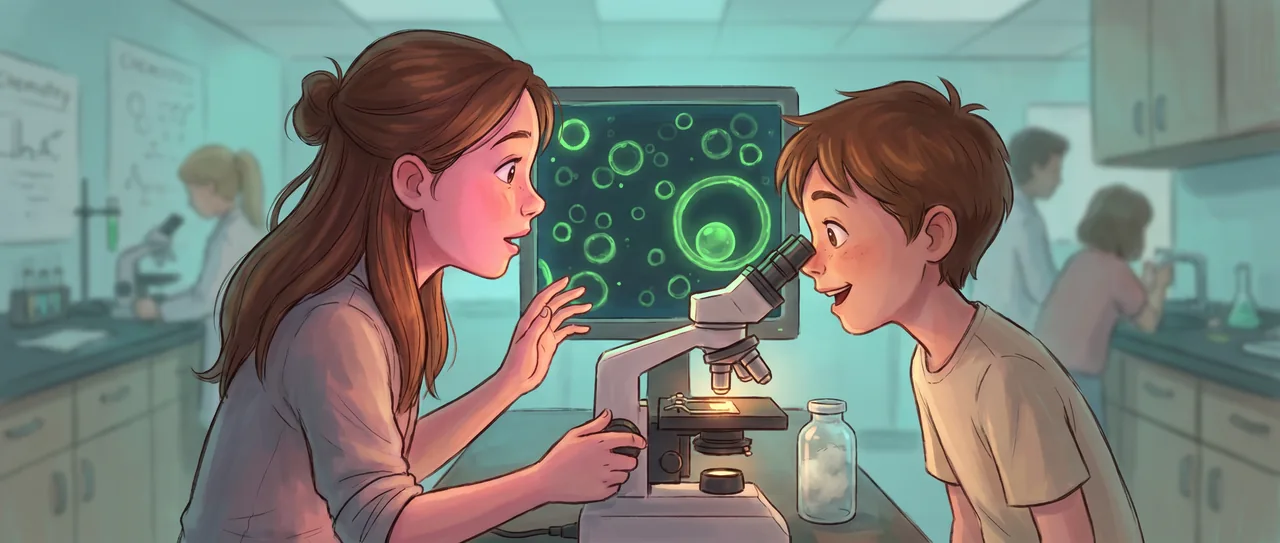
Maya bent close to the microscope screen. The green pieces were still moving.
"It doesn't want the circle," she said.
Soren looked at the tray. There were glass slides, droppers, a shallow dish of clear liquid, and three small vials with labels printed too small for anyone who enjoyed happiness. He turned one until the words caught the light.
"Phospholipid mix," he read. "Fluorescent head group. Dried film. Add buffer. Gentle agitation."
"She spread it," Maya said.
"She printed it."
"Same mistake with a fancier verb."
Soren did not smile yet. He was watching the torn green pieces drift. When they bumped one another, they did not stick into a line. They rounded. Even the torn bits tried to make edges without corners.
Maya reached for a clean slide.
Soren moved the vial out of reach.
"She said do not mix unless we know why."
"We know why it failed."
"We know what it did. Not why."
Maya pointed at the screen. "Pieces hate being flat. Pieces like being bubbles."
"That is not a why. That is a personality."
Maya accepted this and looked around the table as if the why might be hiding under the lens cloth.
The open house room smelled like warm plastic, clean metal, and somebody's coffee forgotten on a shelf. On the next table, a model of DNA made of colored magnets lay half-built. Beyond that sat a small machine with a clear lid and a sign that said DNA ORIGAMI, OVERNIGHT RUN. Someone had taped the sign crookedly.
Soren picked up the instruction card for the membrane demo. He read silently, lips barely moving.
Maya waited for three seconds, which for her was a long and generous friendship.
"Anything?"
"A phospholipid has a head that mixes with water," Soren said. "And two tails that do not. The tails are fatty. Oil-ish."
Maya took the card from him, scanned it, and gave it back. "So every molecule is a problem."
"That is a better why."
On the screen, one glowing shred pinched inward. The green line thickened at the edge, making a circle too lumpy to be a circle and too closed to be nothing.
Maya tapped the table twice. "If the heads like water and tails hate water, then spreading them on glass is rude. Half of each one is exposed to the wrong place."
"The tails would try to hide."
"Inside."
"But there is no inside unless they make one."
They both looked at the small vial labeled Dried Phospholipid Film.
The chemist called from across the room, "How is my wall?"
Maya said, "Terrible."
The chemist winced without turning around. "Please improve your lying before the dean arrives."
Soren uncapped the vial. Inside, a faint pearly smear clung to the glass, almost invisible.
"We need buffer," he said.
Maya already had the dropper. "Not on a slide. In the vial. Everywhere at once."
"Gentle agitation," Soren said.
"That means swirl, not attack."
"I know what gentle means."
"You know what every word means. That's your thing."
"Not every word. Amphiphilic was new."
Maya dripped clear buffer into the vial. Soren recapped it and rolled it between his palms, slow enough that the liquid climbed the glass and slid back down. The pearly smear loosened. Tiny flecks lifted like dust waking up.
Nothing spectacular happened.
The dean's laugh rose near the doorway. It was a large laugh, the kind that expected chairs to get out of its way.
Maya stared at the vial. "Maybe warmer. Cells are warm."
"Some phospholipids need certain temperatures," Soren said. "The card says room temperature is fine for this mix. But palms are not a crime."
He kept rolling. Maya counted under her breath, not numbers exactly, more like footsteps.
At thirty, she took the vial and held it up to the lamp. The liquid looked cloudy now, faintly, as if a ghost had breathed into it.
"Slide," Soren said.
Maya put one drop on clean glass. Soren lowered the coverslip from one edge so it would not trap a giant air bubble. They had both learned that the hard way during the second failure, when their cell boundary had been mostly ceiling.
The microscope screen went pale, then green, then blurred. Maya turned the focus knob too far. Soren turned it back a little.
The field sharpened.
The screen filled with rings.
Not one ring. Not a perfect printed circle made for a dean. Dozens. Hundreds. Green loops floated in the dark, some small as pinpricks, some large and wobbling, some nested close to one another like secrets overheard. They trembled when the table shook. They drifted. They held.
Maya stopped moving.
Soren's hand stayed on the focus knob.
The chemist arrived behind them with the dean and half the front row of visitors. She opened her mouth, probably to apologize for the wall.
On the screen, a bright vesicle bumped another and slid away, its glowing rim bending and rounding back.
The chemist shut her mouth.
Maya said, "We didn't build the wall."
Soren said, "We gave the molecules water."
The dean leaned closer. "Are those cells?"
"No," Soren said. "Just membranes. Bags, really. The molecules have heads that face the water and tails that hide from it. Two layers, tails tucked in."
Maya added, "They make the hiding place by being together."
The chemist looked from the vial to the microscope. Her cheeks had gone pink, but not the embarrassed kind now.
"Vesicles," she said softly. "Lovely ones."
The visitors pressed closer. Phones came out. The dean's big laugh disappeared into a small silence.
Soren glanced at the instruction card again. "If every part liked water, it would just dissolve. If every part hated water, it would clump somewhere else. The awkward part makes the edge."
Maya looked at him quickly.
"That was good," she said.
"It was accurate."
"Also good."
The chemist began explaining to the visitors, too fast, waving both hands. "Cell membranes are not tiny brick walls. They arise from molecular properties. Local interactions. Hydrophilic heads, hydrophobic tails. No foreman. No tweezers. Given the right conditions, order appears."
Maya heard the words, but she was watching the screen. A vesicle near the corner had a smaller glowing sphere inside it. Not alive. Not thinking. Not trying. Still, there it was, a boundary inside a boundary, made from pieces too small to see.
Soren had seen it too. He did not point. He leaned in until his nose nearly touched the screen.
"There are more kinds," the chemist said, noticing where they were looking and then noticing they were not looking at her. "DNA origami folds into boxes and smiley faces and little hinges, if the sequences are designed correctly. Protein subunits can assemble into geometric shells, like virus capsids. Icosahedrons, sometimes. Beautiful symmetry."
"Do you place each protein?" Maya asked.
"No."
"Each DNA bend?"
"No. We design strands that match in particular places. Then we heat and cool them in solution. The base pairs find their partners. Usually. Chemistry is not obedience."
That last sentence made the chemist look happier than the dean had.
Soren walked to the small machine with the clear lid. The crooked sign still said DNA ORIGAMI, OVERNIGHT RUN. Inside the cooling block were empty holes for tiny tubes.
"Why is it canceled?" he asked.
"Not canceled," the chemist said. "Unimpressive on open house time. It takes hours. The folding happens while nobody can see it."
Maya came beside Soren. "Do you have the strands?"
The chemist hesitated. The dean was now showing the vesicles to someone who had come in late, claiming credit only with his posture.
"Prepared," the chemist said. "Scaffold strand. Staple strands. Buffer with magnesium. They are in the cold rack. But the thermal program needs to start now if we want folded structures tomorrow."
Soren read the card taped to the machine. "Heat to separate. Cool slowly so matches form."
Maya said, "Make the weather again."
The chemist folded her arms. "You would need to load the tubes in the correct wells, close the lid fully, and start the saved program. If you press the wrong program, we get expensive soup."
Soren looked at the display. "Saved program number three matches the card. Ninety-five degrees, then gradual cooling to twenty-five."
Maya checked the cold rack. "Tubes have numbers. Wells have numbers. That part is trying very hard not to be mysterious."
"Mystery can have labels," Soren said.
The chemist stepped aside.
Maya placed the first tiny tube into the block. It clicked softly into the well. Soren placed the second, then the third, each no bigger than the last joint of his finger. The liquid inside them was clear. It did not glow. It did not cloud. It gave nothing away.
Behind them, the microscope screen shone with green rings, drifting in their dark square of water.
Maya closed the clear lid.
Soren pressed the green button, and the machine began to breathe warm air through its vents.
Read the interactive version, listen to the narration, and earn a gold star →
A science-verified short story for curious kids · Curiosity Land